Three Broken Bargains: Can America, Europe, or China Deliver Prosperity?
As cheap borrowing, easy globalization, and demographic tailwinds fade, the United States, Europe, and China face distinct structural strains on their economic survival.
For three decades, the global economy ran on three quiet assumptions: money would remain cheap, supply chains would expand across borders without political friction, and a growing pool of working-age adults would support young and old alike. Those foundations have largely eroded. In their place stands an uncomfortable reality confronting policymakers across Washington, Brussels, and Beijing. None of the world's three dominant economic architectures look fully equipped for the era now taking shape.
The central dilemma facing Western democracies is sharp. Is the West choosing between two unsustainable bargains—Europe's promise of social security without enough growth, and America's promise of economic freedom and consumption without enough fiscal discipline?
To understand the dilemma, consider how the American model functions. The United States champions a largely free-market economy centered on private enterprise, consumer spending, and light regulatory restraint. That formula has made America an unrivaled engine for innovation, creating frontier industries from software to advanced hardware, alongside resilient job creation. Yet this dynamism carries a compounding price tag.
First comes inflation—the general rise in the prices of everyday goods and services over time, which reduces the purchasing power of every dollar a worker earns. When inflation lingers, it eats away at household paychecks. Second comes the federal budget deficit, the yearly gap between what the government spends and the revenue it collects in taxes. To cover that gap, the United States issues Treasury bonds, piling up national debt, which is the total accumulation of all unpaid borrowed money over decades.
Here lies the trap for the Federal Reserve, the central bank tasked with stabilizing the currency. To tame inflation, the Federal Reserve raises interest rates—the percentage cost that borrowers must pay to lenders for the use of money. When interest rates climb, mortgages, car loans, and business borrowing become more expensive, cooling off spending. But higher interest rates also apply to government debt. As Washington rolls over trillions of dollars in obligations at elevated rates, annual interest payments claim a larger share of federal revenue, crowding out other public investments. The question of how long the American government can borrow without triggering a serious fiscal crisis remains unanswered, but the trade-off is narrowing: fight inflation aggressively, or avoid ballooning the cost of the sovereign debt pile.
Across the Atlantic, Europe chose a different path, placing collective security at its core. Countries across the European Union maintain extensive social safety nets, universal healthcare guarantees, regulated work hours, and robust pension plans. This arrangement shields citizens from the brutal dislocations of unbridled capitalism.
Yet this model is straining under sluggish growth, aging populations, and weak productivity—the economic measure of how much output of goods and services a society generates for every hour worked. High productivity allows wages to rise and living standards to improve without fueling inflation. When productivity stalls, an economy cannot easily create the wealth needed to fund generous entitlements. As birth rates drop and retirement rolls expand, fewer workers remain in the labor force to pay the taxes that support state pensions and public clinics. Without faster economic expansion, Europe's social contract becomes increasingly difficult to finance.
Then there is China, which presents a state-directed alternative to Western models. Rather than relying entirely on market forces or private consumption, Beijing orchestrates large-scale economic activity through direct government planning, state-owned enterprises, and directed bank lending. This structure provides remarkable industrial execution. When the state identifies a strategic priority, it mobilizes capital, factories, and supply chains at unmatched scale and speed.
Yet this command approach generates its own distortions. China's reliance on state-directed investment has repeatedly channeled vast sums into real estate, infrastructure, and heavy manufacturing regardless of commercial demand, accumulating severe domestic debt. Because resources are allocated by bureaucratic design rather than market returns, capital frequently flows into redundant capacity. State control can jumpstart industrialization, but administrative quotas cannot easily substitute for the organic efficiency that private markets offer when allocating capital.
When evaluated side by side, each model possesses a distinct competitive advantage. The United States excels at disruptive innovation, high-wage job creation, and entrepreneurial risk-taking. China demonstrates unmatched capability in manufacturing execution and industrial deployment. Europe maintains the world's most humane protections against poverty, illness, and economic shocks.
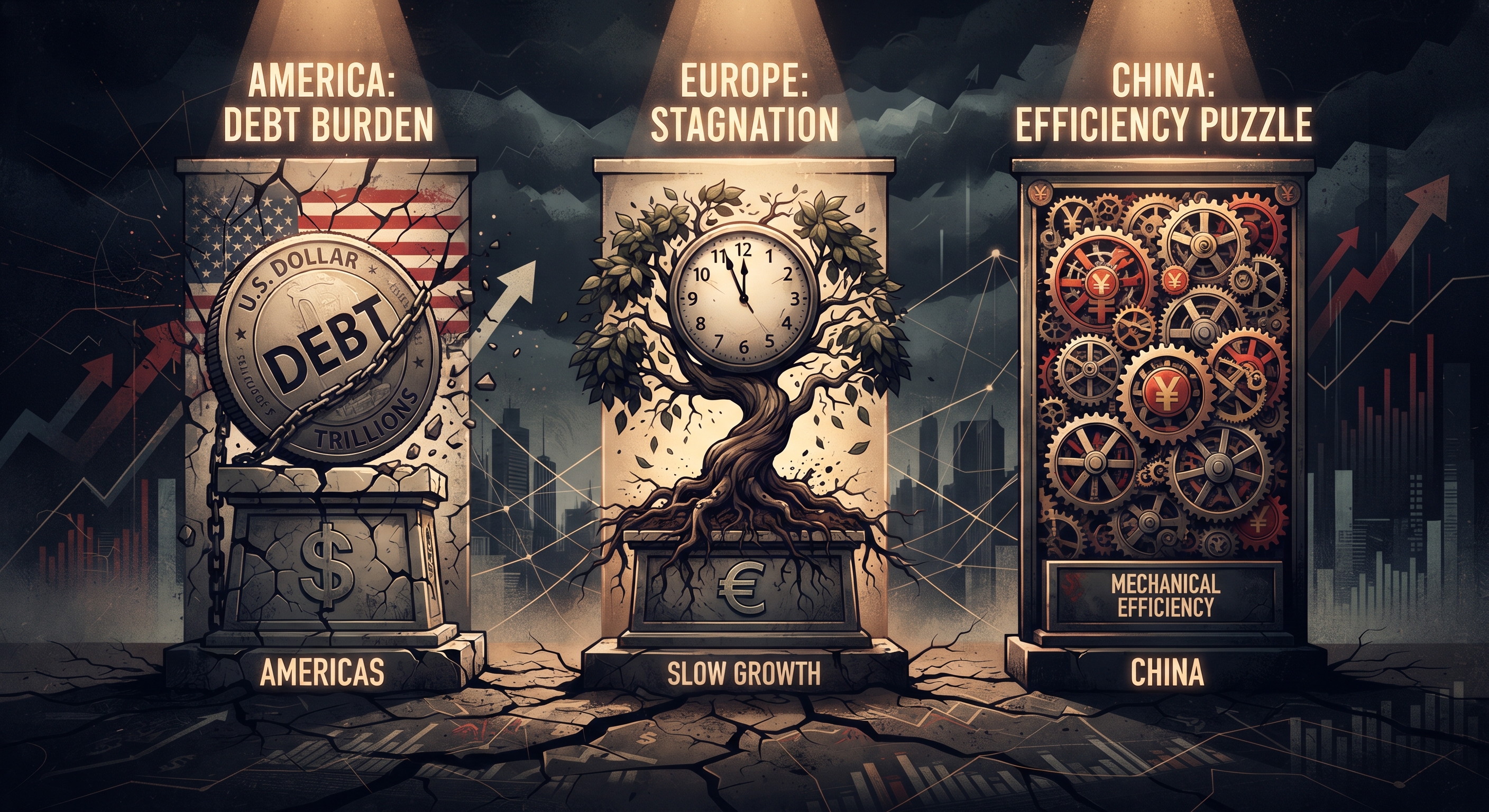
At the same time, their vulnerabilities mirror their strengths. America may have a debt problem. Europe may have a growth problem. China may have an efficiency problem.
Some economists and policy thinkers have asked whether an ideal system could combine the best elements of all three: American innovation, Chinese industrial execution, and European social protection. In practice, fusing those elements is exceptionally difficult. The free-wheeling risk tolerance that powers Silicon Valley resists the state mandates that enable Chinese-style mobilization, just as the extensive taxation required for European-style welfare can dampen the incentives that drive aggressive venture investment.
The real test ahead will not be theoretical. For years, low borrowing costs, open international trade, and favorable demographic balances cushioned the structural mistakes of every major capital. None of those tailwinds can be taken for granted today. Which system can actually deliver prosperity when cheap money, globalization and favorable demographics can no longer do the heavy lifting?