Somali Pirates Are Back. But What Is Driving Them Back to Sea?
Somali piracy is returning to the waters off the Horn of Africa after years of relative calm. But behind the hijackings and ransom demands is a harder question: what happens to coastal communities when the sea that once sustained them can no longer provide a living?
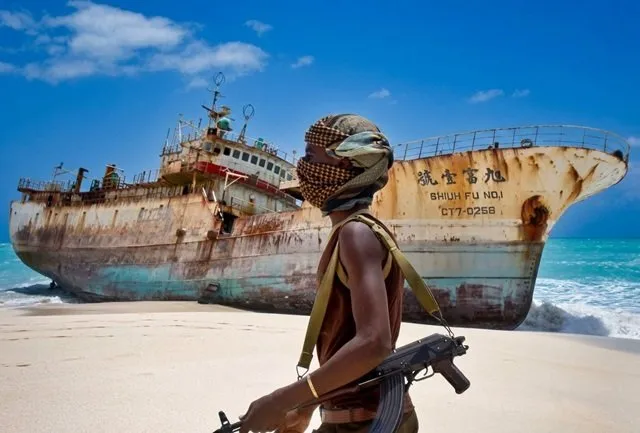
For more than a decade, Somali piracy was treated as a problem that the international community had largely solved. Warships patrolled the Indian Ocean, commercial vessels adopted defensive measures, private security became common and pirate attacks fell dramatically. By the middle of the 2010s, the once notorious pirate economy appeared to have been pushed into history.
In 2026, that assumption is being tested.
Since late April, Somali pirate groups have seized several commercial vessels and targeted fishing boats and dhows. The resurgence is still nowhere near the scale of the piracy crisis between 2005 and 2011, when more than 1,000 vessels were attacked and more than 200 were successfully hijacked. But the speed of the recent comeback has alarmed maritime-security experts, particularly because several ships and dozens of seafarers have again been held for ransom.
The important question, however, is not simply why Somali pirates have returned.
It is why piracy has once again become economically attractive to people living along one of the poorest and least governed coastlines in the world.
The Pirates Did Not Come Out of Nowhere
The popular image of Somali piracy is that of armed men suddenly emerging from impoverished coastal villages to attack international shipping.
The reality has always been more complicated.
Somalia's central government collapsed in 1991, leaving the country's enormous coastline with little effective maritime enforcement. Foreign fishing vessels entered Somali waters, and local fishermen increasingly complained that illegal, unreported and unregulated fishing was taking resources away from communities that depended on the sea. The breakdown of government also made it difficult to police those waters or enforce fishing regulations.
Some of the earliest pirate groups therefore presented themselves not as criminals, but as coastal defenders. They claimed to be protecting Somali waters from foreign fishing fleets and other vessels exploiting the absence of a functioning state.
That justification did not survive the transformation of piracy into a highly profitable ransom industry.
Once criminal networks discovered that a captured commercial vessel could generate millions of dollars, the original grievances became mixed with a far more powerful incentive: money.
The distinction matters today because the underlying grievances have not disappeared, even though the piracy economy changed dramatically.
For Somali Fishermen, the Sea Is Their Economy
Along Somalia's northeastern coast, fishing is not simply an occupation. It is one of the few economic activities available to communities that have limited access to formal employment and infrastructure.
That makes the deterioration of the fishing economy particularly painful.
In Bander Beyla, a Puntland fishing town now caught up in the renewed piracy crisis, fishermen have described declining catches and growing competition from foreign trawlers. One fisherman interviewed by Al Jazeera said that he had been fishing for two decades but was catching less fish and increasingly struggling to support his family.
For a family living from fishing, the consequences are immediate. Less fish means less food, less money and fewer opportunities to pay for children's education, healthcare and basic household expenses.
When there are few alternative jobs, losing access to the sea can mean losing the economic foundation of the entire household.
This is why piracy cannot be understood entirely through the language of maritime security. It is also a story about livelihoods.
Illegal Fishing Makes the Problem Worse
Somali coastal communities have long complained about foreign vessels exploiting their waters.
The problem is not simply that fish are being caught. It is that local fishermen often lack the equipment, capital and political power to compete with industrial fleets.
A small Somali fishing boat cannot compete with a large commercial trawler equipped with sophisticated navigation and fishing technology. When those vessels operate illegally or outside the limits imposed by authorities, the impact on local fishermen can be devastating.
Recent research from Somali and international scholars has increasingly emphasized the connection between illegal fishing, environmental degradation, weak governance and maritime crime. The argument is not that illegal fishing automatically creates pirates. Rather, it contributes to an economic environment in which piracy can become attractive to people who see legitimate fishing becoming less viable.
That distinction is important.
Poverty does not make people pirates. But poverty combined with weak institutions, disappearing livelihoods and the prospect of enormous ransom payments can make piracy harder to resist.
The Ransom Economy Is the Real Attraction
The romantic image of pirates as fishermen defending their waters obscures what happened once the business became professionalized.
Modern Somali piracy is not simply a group of poor fishermen taking revenge on foreign trawlers. It is an organized criminal enterprise involving financiers, intermediaries, armed groups and people who understand the economics of ransom.
The money involved can be enormous compared with legitimate coastal employment.
The recent resurgence demonstrates why that matters. RUSI reported that purported ransom payments in 2026 included more than $1 million for a Chinese fishing vessel, around $2.5 million for the Lutuf and as much as $2.7 million for another hijacked vessel.
For an international shipping company, those sums are part of a difficult business calculation.
For a young man in a community where formal employment is scarce, the numbers can look very different.
That is precisely why simply arresting pirates at sea cannot solve the problem permanently.
The Old Pirate Networks Never Fully Disappeared
One of the most important reasons piracy can return relatively quickly is that the criminal infrastructure did not completely vanish.
When international naval patrols and private security made piracy too risky, many pirate groups stopped attacking commercial vessels. But that did not necessarily mean the people and relationships behind them disappeared.
According to RUSI, some of the networks involved in the previous piracy boom diversified into smuggling and other forms of economic activity. Some former pirate financiers and operators are understood to have maintained connections in Puntland and elsewhere.
That means the current resurgence does not require Somalia to build a new piracy industry from scratch.
The knowledge, contacts and financial structures already exist.
What changed was the calculation.
The Security Umbrella Has Become Weaker
The international response to Somali piracy was remarkably effective.
Naval forces from multiple countries patrolled the region. Shipping companies adopted new defensive measures. Vessels increased speed, adjusted routes and employed armed guards. Together, those measures made piracy considerably more difficult and less profitable.
But the geopolitical environment has changed.
The Middle East conflict has placed additional demands on naval forces operating in and around the Red Sea and Gulf of Aden. Maritime-security experts have warned that international naval resources are stretched, creating opportunities for criminal groups along the Somali coast.
At the same time, the shipping industry has gradually reduced some of the expensive security measures adopted during the height of the piracy crisis because the threat appeared to have receded.
That creates a dangerous feedback loop.
When pirates disappear, ships reduce their security costs. When ships become less protected, piracy becomes more attractive. Successful hijackings then demonstrate to other criminal groups that the opportunity has returned.
But There Is Another Victim: The Fisherman
The most overlooked part of the new piracy story may be what happens to legitimate fishermen.
When authorities suspect that pirates are using fishing communities as logistical bases, restrictions can be imposed on coastal populations. Boats may be monitored, fishing trips limited and movements scrutinized.
In Bander Beyla, fishermen told Al Jazeera that restrictions imposed during the recent crisis prevented them from going to sea. Their problem was brutally simple: if they stayed ashore, they lost their income; if they went to sea, they risked being accused of supporting pirates.
That creates an extraordinary dilemma.
The people who are supposed to benefit from stronger maritime security can become collateral damage of that security.
If fishermen cannot fish because pirates operate from their coastline, the legitimate economy becomes even weaker. And when legitimate economic opportunities shrink, the incentives for criminal recruitment can become stronger.
Counter-piracy policy can therefore unintentionally deepen the economic conditions that helped piracy return in the first place.
Communities Can Also Turn Against Pirates
There is another side to the story that is often missed.
Somali communities are not necessarily passive supporters of piracy.
During the previous piracy boom, some coastal communities eventually turned against pirate groups after seeing the social consequences of the money flowing into their towns. In Eyl, one of the historic centers of Somali piracy, residents and local authorities eventually pushed pirates out. Researchers have documented concerns about drugs, violence, social disruption and young people abandoning education because piracy appeared more lucrative.
That history is relevant today.
In Bander Beyla, residents reportedly intervened when armed young men attempted to go to sea, warning that new pirate attacks would bring even greater hardship to the community.
This is an important reminder that the Somali coastal population should not be reduced to a binary choice between pirates and foreign governments.
Many residents want neither.
They want to fish.
Somalia's Coastal Economy Has Been Left Behind
The deeper problem is that Somalia has never built a strong enough coastal economy to replace the opportunities created by the sea.
A country with one of Africa's longest coastlines should, in theory, possess enormous economic potential. Fisheries, seafood processing, maritime transport, ports, tourism and related industries could create legitimate employment along the coast.
Instead, weak governance, insecurity, limited infrastructure and illegal fishing have prevented many communities from capturing the economic value of their own waters.
That is the paradox at the heart of Somali piracy.
The sea is potentially one of Somalia's greatest economic assets.
It is also where the country's weakness is most visible.
The Answer Cannot Be Warships Alone
The international community has already demonstrated that it can suppress Somali piracy with enough naval power.
The harder question is whether it can prevent piracy from becoming attractive again.
Warships can intercept pirates. They cannot create jobs in Bander Beyla.
Security forces can protect a commercial vessel. They cannot restore depleted fishing grounds.
International patrols can discourage a ransom attack. They cannot build a fish-processing industry that allows a Somali fisherman to earn a stable income without leaving his community.
That is why maritime security and economic development have to be treated as part of the same problem.
Give Fishermen a Reason to Stay Legitimate
A serious anti-piracy strategy should therefore begin much closer to shore.
Somalia needs stronger fisheries regulation, credible licensing systems and mechanisms capable of preventing foreign vessels from illegally exploiting Somali waters. Coastal communities need access to cold-storage facilities, markets, equipment and financing so that legitimate fishing becomes more profitable.
They also need alternatives.
A young person who can earn a decent income through fishing, logistics, boat repair, seafood processing or another coastal business has less reason to risk his life in a pirate skiff.
This is not an argument for excusing piracy.
It is an argument for understanding its economics.
The International Community Has a Role Too
Foreign governments cannot reasonably expect Somalia to solve the problem alone.
International naval patrols remain important, particularly while piracy is demonstrating that it can return. But foreign countries also need to take illegal fishing seriously.
It is difficult to tell Somali coastal communities that piracy is unacceptable while allowing illegal exploitation of their marine resources to continue unchecked.
The credibility of international maritime policy depends partly on whether the rules are applied consistently.
If the sea is governed only when international shipping is threatened, coastal communities will continue to see maritime security as something designed primarily to protect foreign commerce.
If the same effort is devoted to protecting Somali fisheries, the relationship can be different.
Pirates Are a Symptom, Not the Whole Disease
It is tempting to describe the current situation as the “return of Somali pirates.”
That is accurate as a description of what is happening at sea, but incomplete as an explanation.
The pirates are the visible part of a much larger problem: weak governance, poor coastal economies, illegal fishing, regional instability and a global shipping system that has become more vulnerable as naval resources are stretched.
The international community successfully suppressed Somali piracy once before.
But suppression is not the same as resolution.
If the economic conditions that made piracy attractive remain intact, the threat can return whenever the cost of attacking ships falls and the potential reward rises.
Somalia's Choice Is Bigger Than Piracy
Somalia does not simply need to choose between stronger security and allowing pirates to operate.
It needs to build an economy in which piracy becomes unnecessary and socially unacceptable.
That means protecting the fisherman as seriously as protecting the merchant ship. It means making Somali waters valuable to the people who live beside them, rather than allowing those waters to become a source of conflict between local communities, foreign fishing fleets, criminal groups and international navies.
The return of piracy is therefore a warning, but it is also an opportunity to address a much older problem.
Somalia's coastal communities do not need pirates.
They need a functioning economy.
And until legitimate livelihoods become more reliable than criminal ones, no number of warships can guarantee that the pirates will stay gone.