Somalia’s court says the president’s mandate has expired. The guns still answer to him
A Supreme Court ruling that Hassan Sheikh Mohamud’s term ended in May, with elections ordered within 90 days, has stripped the government of legal cover without changing who controls Mogadishu’s security forces—just as UN and AU support for Somalia winds down.
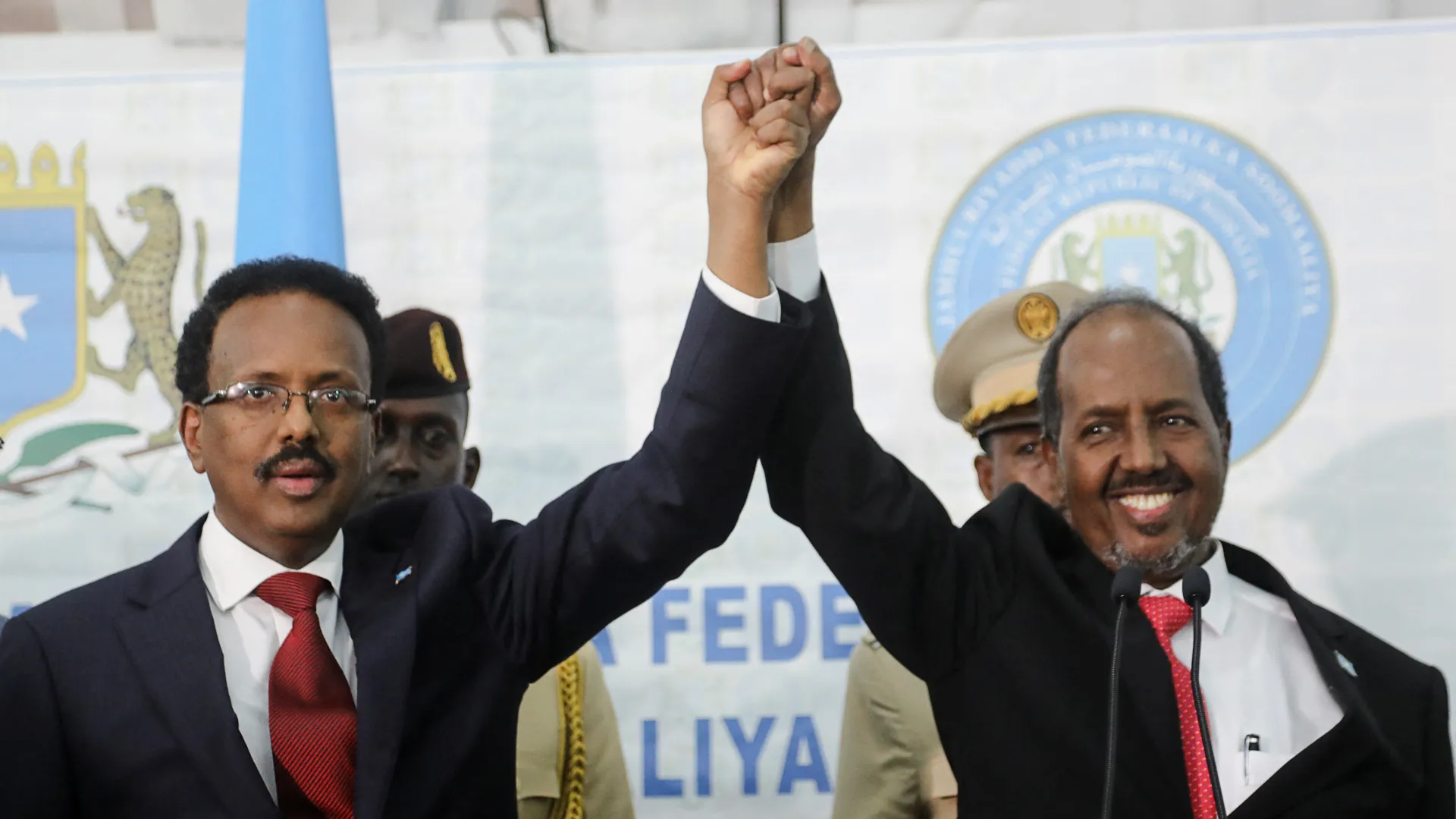
Somalia’s Supreme Court has done something no opposition coalition or donor communiqué managed: it has put a date on the end of President Hassan Sheikh Mohamud’s mandate, and placed that date in the past. On 5 November a five-judge panel of the court’s constitutional division ruled that the president’s term expired on 15 May 2026 and that both houses of parliament, and with them the cabinet, lost their mandates on 14 April. It gave political actors 30 days to agree a “workable electoral framework” and ordered elections within 90—a deadline that falls in early February 2027, months ahead of the electoral commission’s own timetable of 15 April and 15 May 2027.
The government says the ruling has no legal effect. The presidency controls the security forces and the treasury; the court controls only the question of legality. The coming weeks will test whether a judgment can change who governs in Mogadishu when the institutions that would enforce it answer to the man it rules against—and when the international scaffolding that has underwritten Somali governance for two decades is being taken down at the same time.
What the court decided
The dispute turns on the revised constitution that parliament approved on 4 March and Mohamud signed four days later, lengthening presidential and parliamentary terms from four years to five. The government reads that change as allowing the president to remain until May 2027 while Somalia moves from clan-based indirect elections to universal suffrage. The court, sitting under Article 191 of the revised charter, which gives it the powers of a Constitutional Court until one is established, held that a longer term applies to sitting office-holders only if the constitution says so explicitly. The revised text, it found, is silent. The original four-year mandates therefore stand—and have run out.
According to reporting of the judgment by Garowe Online, Somalia Today and JURIST, the court declared measures the institutions took under their constitutional and legal powers after those dates “unconstitutional, unlawful and null and void”, while allowing the federal government to continue as a caretaker limited to routine business. The case was brought by former president Sharif Sheikh Ahmed. The court found he lacked standing to challenge the amendments themselves, but ruled on the term extensions.
The timing matters. On 4 November, the day before the ruling, the presidency announced that Mohamud had dismissed Chief Justice Bashe Yusuf Ahmed and reappointed his predecessor, Ibrahim Idle Suleiman, citing complaints about the administration of justice. In a separate decision the court declared the dismissal void, saying the president had no authority to remove a chief justice by decree and accusing the presidency of seeking to obstruct the constitutional case. Under the revised charter, as reported by Somalia Today, removal requires the backing of two-thirds of the Supreme Judicial Council’s members for a complaint, followed by approval from a majority of each house of parliament.
The state attorney general’s office responded on 6 November that the ruling had no legal effect, disputing the court’s jurisdiction, Sharif’s standing and the composition of the bench, and promising further legal action. Former prime minister Hassan Ali Khaire alleged that troops had been sent to the court and that judges were being pursued; AFP said it could not verify those claims. Garowe Online has reported that the judges lost their protection details and took refuge at Sharif’s residence. That report is unconfirmed—but if accurate, judges sheltering with the petitioner whose case they decided would hand the government an argument about impartiality, however understandable their fear.
Who holds the power
Formally, the court now defines the limits of the government’s authority. In practice, power sits where it sat on 4 November. The presidency commands the federal security forces in Mogadishu, controls appointments and manages relations with donors and African Union troop contributors. The court has no means of enforcement beyond its standing. The opposition Somali Future Council, which includes the Puntland and Jubaland administrations, now has a legal argument it lacked a week ago. But Puntland and Jubaland had already severed relations with the federal government in 2024, according to Security Council Report, and their leverage lies in territory and forces beyond Mogadishu’s reach rather than in the capital itself.
The ruling’s most immediate effect is therefore on legitimacy rather than control. It hands anyone who resists a federal decision a legal vocabulary for doing so—and that vocabulary surfaced within days. On 8 November, police enforcing evictions and demolitions in the Warlaliska area of Mogadishu’s Daynile district killed three protesters, according to the Somali Guardian. Armed residents then ambushed the officers, who abandoned wounded colleagues and a gun-mounted pickup. Sharif urged residents holding the wounded officers not to hand them to the government, arguing that Somalia had no legitimate government, and to return them to their families instead. The eviction dispute is not known to be connected to the court case, and there is no evidence the clash was politically organised. But a former head of state telling civilians that the national police answer to no lawful authority is a new kind of risk in a capital that saw factional fighting over the constitutional changes as recently as June.
The scaffolding is thinning
The crisis coincides with an unusual run of external deadlines. The UN Transitional Assistance Mission in Somalia ceased operations at the end of October, its functions transferred to Somali institutions and UN agencies. The Security Council’s authorisation of the AU Support and Stabilization Mission in Somalia (AUSSOM) runs only to 31 December 2026 under resolution 2809. According to Security Council Report, the United States told the AU Commission in September that it would discontinue support for the UN Support Office in Somalia, which provides AUSSOM’s logistics, beyond the current authorisation, offering a 12-month wind-down rather than the 18 to 24 months of sustained support that troop contributors had requested. Washington also remains opposed to financing AUSSOM through UN assessed contributions under resolution 2719. Troop-contributing countries, meeting in Kampala in July, called for an “orderly, coordinated and phased exit”. Separately, the Council must renew the Al-Shabaab sanctions regime before it expires on 30 November.
These processes give outsiders leverage, but of a blunt kind. Partners can tie support to a political settlement; they cannot easily withdraw it without weakening the forces fighting Al-Shabaab, which Security Council Report says has exploited the political crisis to expand its territorial control. Mohamud, for his part, has resisted international scrutiny of Somalia’s internal politics. Somalia currently sits on both the UN Security Council and the AU Peace and Security Council, and Security Council Report notes that he objected to references to Somali domestic politics in the Kampala summit’s draft communiqué until they were dropped.
Who bears the burden
The costs fall first on residents of Mogadishu’s outer districts, where evictions, security operations and political mobilisation now intersect, and on people in contested federal member states such as South West, where the federal government moved to remove regional president Abdiaziz Laftagareen in March and pro-Laftagareen forces have since reportedly retaken several towns. They fall on the troop-contributing countries, led by Uganda, which are being asked to sustain a mission with uncertain financing whose political counterpart is now, in the view of Somalia’s highest court, a caretaker. And they fall on the electoral reform project itself. Mohamud’s case for staying on is that Somalia needs time to replace clan-based indirect elections with one-person, one-vote polls. Whatever the merits of that goal, the ruling has made it hostage to the prior question of who is entitled to run the transition.
What happens next
The president has called national consultations in Mogadishu for 14 to 18 November. The BBC reports that opposition leaders have questioned his legitimacy to convene them, and Somali outlets report that Western partners and Türkiye are pressing both sides to attend; the scope of that diplomacy has not been set out officially. Three paths are plausible. The government could disregard the ruling and press on with the April–May 2027 timetable, widening the rift with the opposition and the federal member states. The parties could treat the court’s 30-day window as a deadline for a negotiated transition framework rather than insisting on literal elections within 90 days—arguably the more realistic outcome, since no electoral model has yet been agreed. Or the confrontation over the judiciary could escalate, with rival claims to the chief justiceship and further security incidents in the capital.
The dates to watch are concrete: the 14–18 November talks; the sanctions renewal before 30 November; the court’s 30-day deadline in early December; and the Security Council’s decision on AUSSOM before 31 December. At each, Somalia’s formal authority and its actual power will be brought back into alignment—or pulled further apart.