Bab el-Mandeb Confrontation Pulls the Horn of Africa Into Middle Eastern War
Houthi missile attacks, Western naval patrols, and Israeli retaliation have turned the southern Red Sea into an autonomous theater of conflict, threatening shipping lanes and dragging African littoral states into external rivalries.
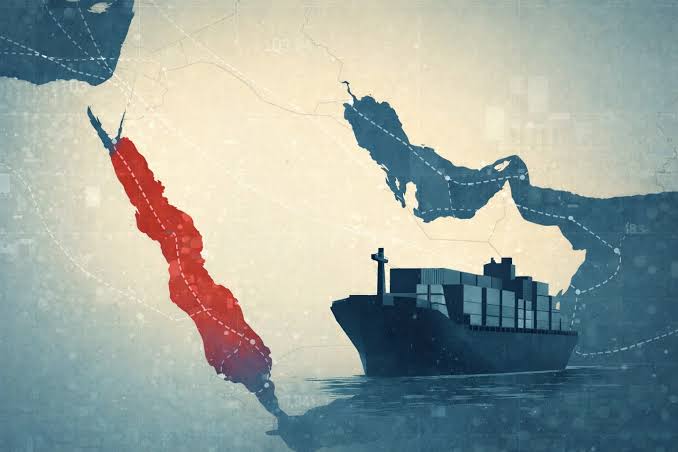
A corridor barely twenty miles wide at the Bab el-Mandeb strait now dictates terms to global commerce and regional security. The narrow choke point separating the southwestern tip of the Arabian Peninsula from the Horn of Africa has ceased to function merely as an auxiliary theater of the war in Gaza. It has developed into an autonomous geopolitical arena where ballistic missiles, maritime drones, and competing foreign alliances test the limits of Western naval power and destabilize coastal African states.
Yemen's Houthi authorities state publicly that their maritime operations target commercial vessels linked to Israel, as well as American and British warships [CLAIMED BY HOUTHIS]. The movement frames these attacks as an enforcement mechanism intended to compel an end to the military campaign in Gaza. Western naval coalitions led by the United States have intercepted salvos of anti-ship ballistic missiles, cruise missiles, and uncrewed aerial systems while conducting strikes against missile launching sites and radar facilities inside Yemen [OFFICIAL CLAIM]. Israel has expanded its direct military perimeter southward, mounting retaliatory airstrikes on Yemeni infrastructure following long-range missile and drone launches aimed at the port of Eilat and central Israeli territory [OFFICIAL CLAIM].
Yet the military confrontation cannot be explained solely by ideological declarations or local grievances in Yemen. The geography of the crisis exposes structural shifts across the wider Middle East and the Horn of Africa, where littoral states find their economic lifelines, security alignments, and sovereign waters entangled in conflicts driven from abroad.
The economics of circumvention
The strategic value of the corridor rests on a straightforward maritime equation connecting the Indian Ocean to the Mediterranean via the Bab el-Mandeb, the Red Sea, and the Suez Canal. For decades, this path carried roughly twelve percent of global trade, including critical shares of containerized consumer goods, European-Asian manufactured exports, refined petroleum, and liquefied natural gas.
The introduction of land-based anti-ship ballistic missiles into the maritime domain has upset that transit model. Major container carriers and energy shippers have redirected vessels around the Cape of Good Hope. Rerouting around Africa's southern cape adds ten to fourteen days to voyages between Asia and Northern Europe, consuming extra fuel, tying up container capacity, and inflating marine insurance premiums [REPORTED]. Higher operating costs have rippled through European import prices and strained supply chains that were built around predictable, tightly timed arrivals.
Egypt bears the sharpest direct economic wound. Revenues from the Suez Canal Authority represent a primary pillar of Cairo's foreign-currency earnings. As transits through the canal collapsed under the threat of Yemeni missile fire, Egyptian state revenues shrank dramatically [CONFIRMED]. The reduction places severe fiscal pressure on an economy already managing high external debt, currency depreciation, and structural inflation. For Cairo, the crisis at the southern gate of the Red Sea is an immediate national solvency emergency.
The asymmetrical naval balance
The clash off Yemen's coast has revealed the severe operational limits of conventional maritime superiority against land-based precision weapons [ANALYSIS]. Western navies have deployed advanced guided-missile destroyers equipped with multi-million-dollar air defense interceptors to destroy drones and anti-ship missiles produced for a fraction of that expenditure. This exchange creates an unsustainable cost asymmetry.
Controlling the waters of the Red Sea has proved fundamentally different from holding territory along its rim. The Houthi movement operates from rugged, mountainous terrain in northern and western Yemen, utilizing dispersed launching pads, mobile launchers, and subterranean storage. Western airstrikes can suppress specific coastal radar installations and identified batteries, but they have not neutralized the movement's capacity to threaten passing hulls.
Iran's role in sustaining this campaign remains central, though analysts draw clear distinctions between verified arms transfers and broader political alignment. Independent UN panel investigations and Western interdictions have confirmed that Tehran provides advanced missile components, drone technology, and maritime intelligence capabilities to Houthi arsenals [CONFIRMED]. Western defense intelligence assessments assert that Iranian surveillance vessels positioned in regional waters have supplied targeting data for merchant vessels that disable their automatic identification systems [OFFICIAL CLAIM].
Treating the Houthi movement merely as a passive proxy misreads its internal drivers [ANALYSIS]. The movement possesses its own religious, political, and tribal roots dating back decades before its 2014 takeover of Sanaa. While strategic cooperation with Tehran provides weapons systems and regional diplomatic backing, Houthi leaders leverage the maritime confrontation to consolidate domestic wartime authority, recruit fighters, and position themselves as the most militant vanguard of regional resistance.
Africa at the center of the crosshairs
Discussions of the Red Sea often treat the African coastline as passive geography adjacent to Middle Eastern turmoil. Across the Bab el-Mandeb, however, African states are actively shaping—and being compromised by—the standoff.
Djibouti occupies the most peculiar security position on the continent. Within its tiny territory, the country hosts the primary American military facility in Africa alongside China's sole overseas military base, alongside French, Japanese, and Italian installations. This extraordinary concentration of rival military outposts creates an uneasy equilibrium. While Djibouti benefits from base rental fees and port traffic serving landlocked Ethiopia, any regional confrontation that brings external powers into direct conflict risks turning its territory into an arena of friction.
Across the border, Eritrea maintains the longest uninterrupted coastline on the southern Red Sea, anchored by the ports of Massawa and Assab. Asmara has guarded its coastal sovereignty jealously, viewing foreign naval deployments and external security initiatives with deep suspicion. The militarization of maritime lanes threatens to draw external combatants directly into Eritrean waters.
For Ethiopia, Africa's second-most populous nation, the escalation compounds a thirty-year strategic vulnerability. Landlocked since Eritrea's independence in 1993, Addis Ababa relies almost entirely on Djibouti's ports for its import-export trade. Ethiopian officials view the instability in the Red Sea as proof that dependency on a single maritime funnel threatens national development, strengthening the government's controversial drive to secure sovereign access to the sea through agreements with coastal polities, including Somaliland.
That drive has already sparked diplomatic resistance from the federal government of Somalia in Mogadishu, which views external port deals in Somaliland as an assault on its territorial integrity. Gulf states, particularly the United Arab Emirates and Saudi Arabia, have pursued port concessions and logistical bases in Berbera, Bosaso, and Assab. The convergence of Gulf money, Middle Eastern missile warfare, and African political rivalries creates an integrated security system where a strike launched from Hodeida shifts political balances in Hargeisa, Mogadishu, and Addis Ababa.
Sudan's Red Sea coast, dominated by Port Sudan, adds another layer of fragility. With the Sudanese state fractured by civil war between the armed forces and the Rapid Support Forces, Port Sudan has functioned as the de facto seat of the sovereign council and the country's sole remaining lifeline to the outside world. Maritime blockades, errant missiles, or naval skirmishes in the Red Sea directly threaten humanitarian supplies and grain imports required to stave off famine.
Escalation pathways and regional restraints
The conflict stands poised between chronic maritime attrition and a broader regional war. Several escalation pathways remain open, bounded only by fragile diplomatic calculations.
A direct military confrontation between Israel and Iran represents the most dangerous vector. Should exchanges of long-range strikes widen, Iranian-aligned forces throughout the region could target energy infrastructure in the Gulf, attempting to force a full halt to maritime transit through both the Bab el-Mandeb and the Strait of Hormuz. Conversely, fear of catastrophic disruption to oil revenues and domestic modernization plans keeps Saudi Arabia cautious. Riyadh has declined to join Western naval strike coalitions openly, seeking to preserve its fragile bilateral truce with the Houthis rather than invite renewed missile barrages against its own oil installations.
An intensifying cycle of Israeli strikes against Yemen's coastal ports could similarly degrade commercial infrastructure to the point where commercial shipping into western Yemen ceases entirely, precipitating famine conditions across Houthi-controlled provinces. In response, increased Houthi attacks on commercial traffic could provoke large-scale American ground raids or naval blockades, locking the southern Red Sea in a state of permanent warfare.
What unfolds next hinges on whether diplomatic ceasefires can take hold in Gaza and the Levant to remove the political pretext for maritime blockades, or whether regional powers institutionalize the confrontation. Observers are watching whether the Houthis deploy more sophisticated anti-ship weapons capable of bypassing Western electronic warfare systems, whether Egypt seeks direct bilateral security arrangements with littoral states, and whether the Gulf states consolidate permanent military bases along the Somali and Eritrean coasts. The waters between Bab el-Mandeb and Suez are no longer just a trade highway; they have become the central fault line linking African statehood to Middle Eastern war.