Pakistan's Rupee Strengthens Against the Dollar: How US Politics and Oil Prices Are Shaping Emerging Markets
Pakistan's rupee edged higher against the US dollar as the greenback weakened following the American midterm elections. Although the gain was marginal, the movement highlights how political uncertainty in Washington, oil prices and international capital flows influence currencies in financially vulnerable economies.
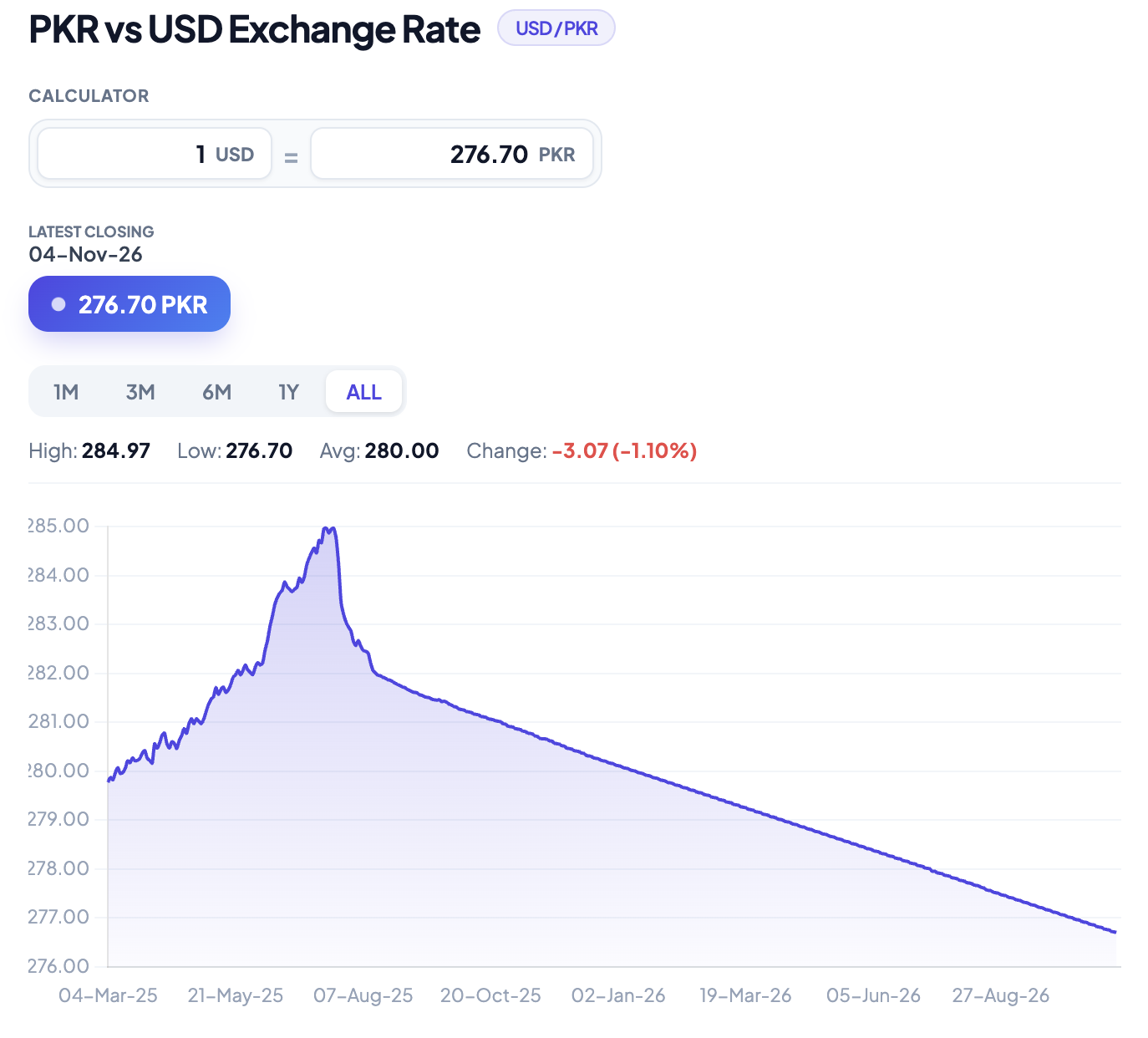
A small gain with a larger economic story
Pakistan's currency recorded another marginal gain against the US dollar on November 4, extending a gradual appreciation that has characterised its recent trading sessions.
The Pakistani rupee closed at 276.70 against the dollar in the interbank market, gaining one paisa from its previous closing rate of 276.71, according to Business Recorder.
The movement was modest, but its timing was significant. International currency markets were responding to the outcome of the United States midterm elections, which saw Democrats secure control of both chambers of Congress, while investors reassessed the implications for American economic growth, monetary policy and geopolitical strategy.
The dollar weakened against several major currencies, allowing other currencies to gain ground.
For Pakistan, an economy heavily dependent on imported energy and external financing, movements in the dollar carry consequences that extend well beyond the foreign-exchange market.
The country's currency stability is closely connected to its ability to finance imports, manage external debt obligations and maintain confidence among international investors.
Why the US midterm elections matter to Pakistan
The US midterm elections introduced a new political dynamic into financial markets.
Democratic victories in Congress raised questions about the direction of the Trump administration's economic and foreign policies. Investors also began considering whether stronger congressional opposition could affect the administration's approach to artificial intelligence regulation, data-centre expansion and other areas of economic policy.
One concern was the potential effect of tighter AI regulation and opposition to large-scale data-centre development on American investment and economic growth.
The US technology sector has become an important driver of market valuations and investment expectations. If political developments threaten to slow investment in artificial intelligence infrastructure, investors may reassess the growth outlook for the American economy.
Expectations about economic growth also influence currency valuations.
A weaker outlook can reduce demand for the dollar if investors anticipate lower interest rates or a less attractive return on American financial assets.
However, currency movements are rarely determined by a single political event. Interest-rate expectations, Treasury yields, inflation, economic data and international demand for safe-haven assets all influence the dollar.
The Pakistani rupee's modest appreciation therefore occurred within a broader international movement rather than as a direct consequence of the American election alone.
The oil connection: Why Pakistan is particularly exposed
Oil prices are especially important to Pakistan's economic outlook.
As a major importer of petroleum products and energy, Pakistan remains exposed to fluctuations in international crude prices.
When oil becomes more expensive, the country must spend more foreign currency to maintain its energy supply. This increases pressure on the import bill and can weaken the balance of payments.
Higher energy costs can also contribute to domestic inflation, increase transportation expenses and raise production costs for businesses.
The consequences can spread throughout the economy, affecting household purchasing power and the competitiveness of Pakistani industries.
On November 4, international oil prices declined as investors assessed developments surrounding the US-Israeli conflict with Iran and the possibility of a shift in Washington's geopolitical approach.
Brent crude fell by approximately 3.09 per cent to $100.40 per barrel during the reported trading session, while West Texas Intermediate declined approximately 3.13 per cent to $93.08.
For Pakistan, lower oil prices can provide some relief by reducing the cost of imported energy.
They can also ease pressure on foreign-exchange reserves and reduce the risk that expensive energy imports will undermine currency stability.
But the relationship is not automatic. The benefits depend on how long lower prices persist, the volume of imports, domestic energy pricing policies and the country's wider external financing position.
The rupee's gradual appreciation: Stability or a temporary advantage?
Pakistan's currency has demonstrated a relatively steady appreciation against the dollar in recent trading sessions.
On November 4, the rupee closed at 276.70, compared with 276.71 a day earlier. The currency had also been recording incremental gains in preceding sessions.
In the open market, the rupee gained three paisa on the buying rate and 19 paisa on the selling rate against the dollar, closing at 277.35 and 278.48 respectively.
These movements suggest a relatively stable trading environment, but they should not be mistaken for evidence that Pakistan has resolved its underlying currency challenges.
A currency can remain stable for an extended period while the economy continues to face structural weaknesses.
Pakistan's external financial position depends on several factors, including export earnings, remittances, foreign investment, external debt repayments and access to international financing.
The country also needs sufficient foreign-exchange reserves to maintain confidence in its ability to meet international payment obligations.
A stable exchange rate is therefore only one measure of economic health.
Without stronger export performance, sustainable external financing and improvements in productivity, maintaining currency stability can remain difficult.
Why emerging markets are vulnerable to Washington
Pakistan's experience illustrates a wider challenge facing emerging economies.
Countries with substantial external financing requirements and significant exposure to imported commodities are particularly sensitive to changes in global financial conditions.
When the US dollar strengthens, emerging-market governments and companies with dollar-denominated obligations can face higher repayment costs in domestic currency terms.
A stronger dollar can also encourage international investors to move capital towards American assets, reducing the availability of financing for emerging economies.
When the dollar weakens, some of those pressures can ease.
However, the benefits are uneven. Countries with stronger economic fundamentals, reliable institutions and diversified export sectors are generally better positioned to take advantage of favourable international conditions.
Pakistan's situation demonstrates why currency stability cannot depend entirely on developments in Washington or movements in oil prices.
External conditions can create opportunities, but domestic economic policy determines whether those opportunities translate into lasting improvements.
The bigger picture: Currency stability requires more than a weaker dollar
The Pakistani rupee's latest gain is a small development within a much larger economic story.
The US midterm elections influenced expectations about American growth and monetary policy. Those expectations contributed to movements in the dollar, while uncertainty surrounding the Middle East affected international oil prices.
For Pakistan, the combination created a more favourable external environment.
Yet the central economic challenge remains unchanged.
Pakistan needs a stronger export base, sustainable foreign-exchange earnings, improved productivity and a more resilient energy system. These are the foundations required to reduce its vulnerability to international financial shocks.
The latest movement against the dollar is welcome, but a gain of one paisa cannot establish a lasting recovery.
The real test will be whether Pakistan can turn temporary international advantages into domestic economic strength.
For emerging economies, the lesson is clear: global developments can determine the direction of a currency on any given day, but long-term currency stability is built at home.
 Analysis
Japan weighs emergency nuclear-entry exception in year-end security rewrite
 Briefing
One Life, Eight Second Chances: The Story of a 22-Year-Old South Korean Woman Who Saved Eight Lives Through Organ Donation
 Analysis