US Reveals China’s Secret Shenlong Spaceplane for the First Time: What Is It Doing in Orbit?
For years, China’s mysterious reusable spaceplane operated largely beyond public view. Now U.S. intelligence has released the clearest image yet of the spacecraft widely believed to be Shenlong — revealing open cargo-bay doors, a service module and striking similarities to America’s secretive X-37B. But the biggest mystery remains: what is China actually doing with it in orbit?
For six years, one of China’s most mysterious spacecraft has been circling Earth with remarkably little known about what it looks like or what it does.
Now the United States has given the world its clearest look yet.
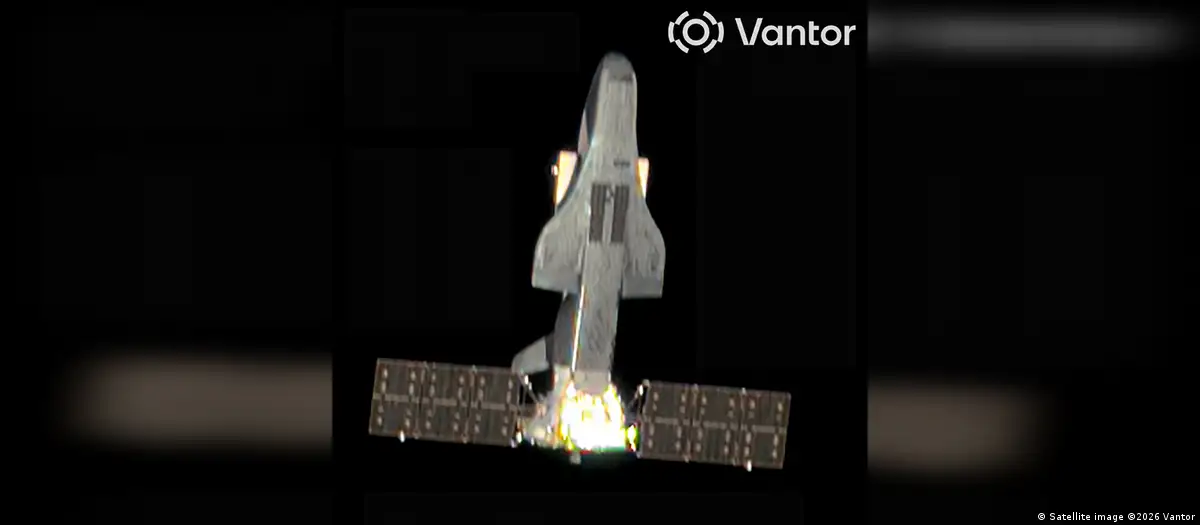
The U.S. Defense Intelligence Agency released a remarkably detailed photograph of a Chinese reusable spaceplane as part of its latest Challenges to Security in Space assessment.
The photograph was actually taken in May 2024 by WorldView-3, a commercial imaging satellite then operated by Maxar Technologies, now Vantor.
But the high-resolution image only became public in October 2026.
It shows a small winged spacecraft hundreds of kilometres above Earth, with its payload-bay doors apparently open and a service module with solar arrays attached to its rear.
The spacecraft looks strikingly similar to another mysterious vehicle already operated by the United States.
The X-37B.
But appearance is only part of the story.
Over four missions, China's reusable spacecraft has released objects into orbit, approached other spacecraft and apparently demonstrated the ability to release and later recapture a satellite.
Those capabilities could have peaceful applications.
They could also have military ones.
And that is why Washington is watching so closely.
Is This Really China's Shenlong Spaceplane?
Probably — but there is an important qualification.
The Defense Intelligence Agency's caption does not identify the vehicle specifically as Shenlong.
It calls it a Chinese spaceplane.
The DIA says China has two major spaceplane projects, Shenlong and Tengyun.
However, there have been no confirmed orbital launches of Tengyun, while the photographed spacecraft is consistent with the reusable vehicle China has repeatedly launched since 2020.
For that reason, outside experts widely believe the spacecraft in the photograph is Shenlong, meaning "Divine Dragon."
China itself does not generally use that name publicly for the spacecraft.
Chinese state media describe it more generically as a reusable experimental spacecraft.
That secrecy has helped turn Shenlong into one of the most intriguing objects in orbit.
The Photograph Was Taken From Space
The way America obtained the photograph is almost as interesting as the spacecraft itself.
It was not photographed by an astronaut.
And it wasn't photographed from the ground.
Another satellite photographed it.
Vantor says its WorldView-3 satellite captured the image on May 28, 2024, from a distance of just under 90 kilometres.
WorldView-3 was designed primarily to photograph Earth.
But modern commercial imaging satellites can increasingly turn their cameras away from Earth and observe other objects in orbit.
The practice is known as non-Earth imaging.
It effectively means satellites can inspect other satellites.
That opens an entirely new dimension of intelligence gathering.
Countries have spent decades using satellites to photograph military bases, missile installations, ships and aircraft on Earth.
Now they can increasingly use those same technologies to examine each other's spacecraft.
The Shenlong image may therefore represent something larger than a new photograph.
It offers a glimpse into what space-based reconnaissance is becoming.
What Does the Photograph Show?
Several important features are visible.
The spacecraft has a winged, shuttle-like configuration.
Its underside appears to contain the thermal protection required to survive re-entry through Earth's atmosphere.
Behind it is a service module equipped with solar arrays.
Most interestingly, the payload-bay doors appear to be open.
That matters because a cargo bay gives a reusable spaceplane considerable flexibility.
It can potentially carry experiments into orbit.
It can deploy satellites.
It could carry sensors.
It could potentially retrieve objects.
And depending on its design, it could accommodate payloads that governments never publicly disclose.
But the photograph does not tell us what was actually inside the bay.
That remains secret.
China Has Been Flying It Since 2020
China's reusable spaceplane program has developed remarkably quickly.
The first known orbital mission launched in September 2020.
It lasted only about two days.
The second mission, launched in August 2022, lasted approximately 276 days.
A third mission began in December 2023 and remained in orbit for 268 days before returning to Earth in September 2024.
The fourth mission launched in February 2026.
That spacecraft remains in orbit.
The progression is significant.
China went from keeping the vehicle in space for two days to operating it for many months at a time.
But duration alone isn't what has attracted the attention of American intelligence.
It is what the spacecraft appears capable of doing while it is up there.
Shenlong Has Been Releasing Mysterious Objects
During multiple missions, observers have detected objects being released from the Chinese spacecraft.
Exactly what those objects are remains unclear.
Some may simply be discarded hardware.
Others may be experimental satellites or test payloads.
But tracking data has revealed something more interesting than deployment alone.
The spaceplane has apparently interacted with some of these objects after releasing them.
During its 2022 mission, according to the DIA, the spacecraft maneuvered with a companion satellite.
At one point the two objects came within approximately 100 metres of each other.
The DIA said the spacecraft and satellite may have rendezvoused before the satellite was released again.
That means China wasn't necessarily just testing the ability to put a small satellite into orbit.
It may have been testing the ability to approach it again.
Possibly even capture it.
And It Appears to Have Done It Again
The current mission has produced more intriguing observations.
Open-source orbital tracking analyzed by astrophysicist Jonathan McDowell indicates that the spacecraft released a smaller object in June 2026.
It apparently approached and recaptured the object in July.
Then it released and recaptured it again during later operations.
If those observations are correct, China has demonstrated something strategically valuable:
the ability to release another spacecraft, maneuver around it and potentially retrieve it.
That capability has perfectly legitimate uses.
A spacecraft capable of rendezvous and capture could inspect damaged satellites.
It could repair them.
It could refuel them.
It could move them.
It could retrieve experiments.
These technologies could eventually help make satellites reusable rather than disposable.
But the same capability creates an uncomfortable military question.
If you can approach and manipulate your own satellite, could you do the same thing to someone else's?
Could Shenlong Be Used Against Satellites?
This is where speculation needs to be separated from evidence.
There is currently no public evidence proving that Shenlong is an anti-satellite weapon.
The new photograph does not show weapons.
Orbital tracking does not prove that the spacecraft is designed to attack satellites.
China says its reusable spacecraft program is intended to test technologies that could make access to space more convenient and affordable and support peaceful uses of space.
Those are entirely plausible purposes.
But technologies used to service satellites can also have military applications.
A spacecraft capable of approaching another satellite could inspect it.
It could potentially interfere with it.
A sufficiently capable vehicle could theoretically manipulate or disable another spacecraft.
That makes rendezvous and proximity operations particularly important to military planners.
The issue isn't necessarily what Shenlong is doing today.
It is what the technology could eventually allow China to do.
America Has Something Very Similar
There is another reason Washington has to be careful about portraying China's spacecraft as inherently threatening.
The United States operates its own secretive reusable spaceplane.
The Boeing X-37B has been flying for the U.S. military since 2010.
Like China's vehicle, the X-37B launches vertically aboard a rocket.
It spends long periods operating autonomously in orbit.
Then it re-enters Earth's atmosphere and lands on a runway like an aircraft.
Much of what the X-37B actually does remains classified.
The U.S. Space Force has revealed some experiments and mission objectives, but many of its activities remain secret.
And visually, the newly revealed Chinese spacecraft looks remarkably similar.
Both are small.
Both are uncrewed.
Both are reusable.
Both have cargo bays.
Both can maneuver in space.
And both operate missions whose full objectives their governments do not disclose.
The United States and China are therefore developing remarkably similar strategic capabilities.
It Is Becoming a Spaceplane Race
The similarities suggest that reusable spaceplanes may become increasingly important to military space operations.
Traditional satellites are generally launched for a specific mission.
Once deployed, they can remain in orbit for years but cannot simply fly home for upgrades.
Spaceplanes change that model.
A reusable spacecraft can carry experimental technology into orbit and bring it back.
Engineers can inspect it.
Upgrade it.
Install another payload.
And launch it again.
That makes spaceplanes valuable laboratories for technologies governments may not want to test aboard conventional satellites.
They also offer something militaries value enormously:
flexibility.
A spacecraft capable of changing orbits, deploying payloads and interacting with other objects becomes much harder for an adversary to understand.
The Bigger Story Is the Battle to Control Space
Shenlong should therefore not be viewed in isolation.
China has rapidly expanded its military and civilian space capabilities.
It operates reconnaissance satellites, navigation systems and communications networks while developing technologies capable of protecting — and potentially threatening — spacecraft.
The United States is simultaneously expanding the Space Force and investing heavily in resilient satellite constellations, missile-warning systems and technologies designed to operate in increasingly contested orbits.
Russia remains a major space power.
India, Japan and European states are also increasing their military space capabilities.
Modern militaries depend heavily on satellites.
GPS navigation depends on them.
Missile-warning systems depend on them.
Military communications depend on them.
Intelligence gathering depends on them.
Even precision-guided weapons frequently rely on information coming from space.
That means a future conflict between major powers would almost certainly extend beyond land, sea and air.
Space would matter from the opening hours.
And Now Satellites Are Watching Each Other
Perhaps the most revealing part of the Shenlong story isn't the spacecraft itself.
It is the fact that another satellite could photograph it with such clarity.
The WorldView-3 image reportedly achieved a resolution of roughly 4.5 centimetres per pixel from around 90 kilometres away.
That demonstrates how difficult hiding in orbit is becoming.
For decades, secret satellites could be tracked from Earth, but their exact design often remained hidden.
That is changing.
Commercial satellites can increasingly photograph spacecraft belonging to governments.
Private companies can track their orbital maneuvers.
Independent astronomers can analyze their movements.
Open-source researchers can identify when they deploy new objects.
The world's most secretive spacecraft may still conceal what they are doing.
But simply hiding what they look like is becoming much harder.
So What Is Shenlong Actually Doing?
We still don't know.
That is the most important answer.
China says its reusable spacecraft is testing technologies intended to support peaceful and economical access to space.
Its observed behavior is consistent with experiments involving satellite deployment, rendezvous and potentially retrieval.
Those technologies have legitimate civilian applications.
They also have obvious military value.
There is no public evidence showing that Shenlong is carrying weapons or attacking other spacecraft.
Calling it a Chinese "space weapon" would therefore go beyond the available evidence.
But dismissing its strategic importance would be equally misleading.
China has demonstrated a reusable spacecraft capable of spending months in orbit, maneuvering, releasing objects and apparently interacting with them.
America has developed many of the same capabilities with the X-37B.
And both countries keep much of what their spaceplanes actually do secret.
The new photograph has finally shown the world what China's mysterious spacecraft probably looks like.
It has not solved the much bigger mystery of what Beijing intends to do with it.
 Analysis
Japan weighs emergency nuclear-entry exception in year-end security rewrite
 Briefing
One Life, Eight Second Chances: The Story of a 22-Year-Old South Korean Woman Who Saved Eight Lives Through Organ Donation
 Briefing