The Three Sahel Countries That Walked Away from West Africa: How Mali, Burkina Faso and Niger Challenged ECOWAS
Mali, Burkina Faso and Niger have left ECOWAS to build their own regional alliance, challenging West Africa's political order. Their split raises fundamental questions about sovereignty, democracy, security and the future of African integration. Renewed talks in October 2026 may now determine whether cooperation can survive the separation.
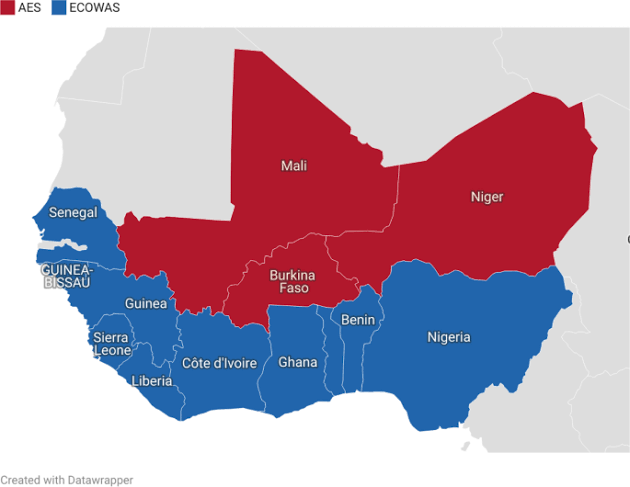
West Africa's political map has changed.
For nearly five decades, the Economic Community of West African States (ECOWAS) stood as one of Africa's most ambitious attempts to bring neighbouring countries together under a common regional framework. Established in 1975, the organisation was created to promote economic integration, trade and cooperation. Over time, it also became an influential political and security institution, intervening in regional conflicts and attempting to defend constitutional government.
But three countries have now walked away.
Mali, Burkina Faso and Niger, all governed by military administrations that came to power through coups, formally withdrew from ECOWAS on January 29, 2025. Their departure followed a prolonged confrontation with the regional organisation over military rule, sanctions, political transitions and the authority of regional institutions to intervene in national affairs.
Rather than simply returning to their previous diplomatic relationships, the three governments established a separate political and security arrangement: the Alliance of Sahel States, known by its French acronym AES.
The development represents more than a disagreement between three military governments and their neighbours. It has created a competing regional project in a part of Africa already struggling with violent extremism, economic vulnerability, political instability and growing international competition.
Yet the story is not entirely one of separation. In October 2026, ECOWAS and the AES reopened formal negotiations, agreeing to establish joint working groups to develop a framework for future cooperation.
The question now is whether West Africa can maintain a common regional future despite the emergence of two competing political structures.
Three countries, three coups and a common political direction
The origins of the crisis lie in a series of military takeovers that transformed the political leadership of the central Sahel.
Mali was the first of the three countries to experience the recent wave of coups. In August 2020, military officers overthrew President Ibrahim Boubacar Keïta following months of political protests and mounting dissatisfaction with his administration.
The military subsequently organised a transition process, but the arrangement collapsed in May 2021 when Colonel Assimi Goïta led another takeover, removing transitional civilian leaders and consolidating military control.
The second country was Burkina Faso.
In January 2022, military officers led by Lieutenant Colonel Paul-Henri Sandaogo Damiba removed President Roch Marc Christian Kaboré. The takeover came amid growing public anger over the government's inability to contain armed insurgencies that had devastated large parts of the country.
However, Damiba's government did not last long. In September 2022, Captain Ibrahim Traoré led another coup, removing Damiba and assuming leadership.
Niger followed in July 2023.
Members of the presidential guard detained President Mohamed Bazoum and announced that they had taken control of the government. General Abdourahamane Tchiani, the head of the presidential guard, emerged as the country's military leader.
These coups were not identical, and each country had its own political and security circumstances. However, they shared a common background: deteriorating security, public frustration with civilian governments, distrust of political elites and growing dissatisfaction with the established international security arrangements.
The three military governments increasingly presented themselves as alternatives to political systems that, in their view, had failed to protect their populations or defend national sovereignty.
Their relationship with ECOWAS deteriorated as the organisation demanded a return to constitutional government.
Why ECOWAS confronted the military governments
ECOWAS was not established merely as a trade organisation.
Although economic integration remains central to its mandate, the organisation has increasingly involved itself in defending constitutional government and responding to military takeovers.
The regional bloc has developed protocols intended to discourage unconstitutional changes of government. These principles became particularly important following the civil wars, political crises and military interventions that affected West Africa during the 1990s and early 2000s.
The coups in Mali, Burkina Faso and Niger therefore presented ECOWAS with a difficult institutional test.
If the organisation accepted military takeovers without consequences, it risked weakening its own rules on democratic governance. But if it relied heavily on sanctions and political pressure, it risked alienating populations and governments already frustrated with regional institutions.
The confrontation became particularly serious after Niger's July 2023 coup.
ECOWAS condemned the removal of President Bazoum, imposed sanctions and demanded the restoration of constitutional order. The organisation also threatened the possibility of military intervention if diplomatic efforts failed.
For Niger's military leadership, the response was unacceptable.
Mali and Burkina Faso, already under military governments and facing their own disagreements with the regional organisation, supported Niger. They warned that military intervention against Niger would be treated as an act of aggression against all three countries.
This transformed what began as a confrontation over Niger's coup into a wider regional dispute.
The military governments increasingly portrayed ECOWAS as an organisation willing to defend political institutions and leaders without adequately addressing the security challenges confronting ordinary citizens.
ECOWAS, meanwhile, faced a different concern: allowing military governments to disregard constitutional rules could encourage further coups across the region.
Both positions reflected genuine political questions, but the confrontation exposed the difficulty of balancing democratic legitimacy, national sovereignty and regional stability.
The creation of the Alliance of Sahel States
The three governments moved from political solidarity to institutional cooperation in September 2023, when they signed the Liptako-Gourma Charter, establishing the Alliance of Sahel States.
The agreement was initially designed as a mutual defence arrangement.
Its central principle was that an attack on the sovereignty or territorial integrity of one member would be treated as an attack on the others.
This was a significant commitment because the three countries faced overlapping security threats, particularly from armed organisations operating across their borders.
The alliance also provided a political response to ECOWAS's threat of military intervention in Niger.
Rather than allowing each country to confront external pressure independently, the three governments created a framework through which they could coordinate their security and diplomatic positions.
In July 2024, the project moved further when the three leaders agreed to establish the Confederation of Sahel States, giving their alliance a broader political and institutional identity.
The AES increasingly became more than a defence pact. It represented an attempt to develop an alternative model of regional cooperation based on sovereignty, military coordination and a shared political direction.
Its creation also sent a message beyond West Africa: the three governments intended to determine their own international relationships rather than rely exclusively on existing regional and Western-backed arrangements.
Why the three countries rejected ECOWAS
The dispute cannot be explained solely by the fact that their governments came to power through coups.
Their withdrawal reflected several overlapping grievances.
First, opposition to sanctions and political pressure.
The military governments argued that ECOWAS had responded to their political crises with punitive measures rather than addressing the underlying problems of insecurity and instability.
Sanctions imposed during the confrontation with Niger became a particularly powerful symbol of the dispute.
For the three governments, the organisation's response represented an unacceptable interference in national affairs.
Second, dissatisfaction with the regional political order.
The military leaders presented themselves as opponents of political systems that had failed to deliver security, economic opportunity and effective governance.
They questioned the legitimacy of regional institutions that demanded democratic transitions while, in their view, failing to respond adequately to the conditions that contributed to political instability.
Third, the question of sovereignty.
The AES governments increasingly emphasised the right of their countries to make independent decisions about security, political transitions and international partnerships.
They argued that West African countries should not have their political futures determined by external pressure or institutions dominated by neighbouring governments.
Fourth, opposition to France's historical influence.
The dispute also developed within a broader rejection of France's traditional political and military influence in the Sahel.
Mali, Burkina Faso and Niger have all reduced or terminated important military relationships with France and moved away from the security arrangements that previously shaped their relationships with Western powers.
Their leaders have presented this shift as part of a wider effort to reclaim national sovereignty.
However, rejecting French influence does not automatically mean achieving complete independence from foreign powers. The growing relationship with Russia demonstrates that the three countries continue to seek external partners for security, diplomacy and other strategic interests.
The central question is therefore not simply whether the AES is moving away from the West. It is whether the alliance can build the political, economic and security capacity necessary to make its declared sovereignty meaningful.
The changing relationship with France, Russia and the West
The political transformation in the Sahel has also changed the region's international relationships.
For decades, France maintained an extensive military presence in its former colonies, particularly Mali, Niger and Burkina Faso.
French forces participated in counterterrorism operations and supported regional governments confronting armed insurgencies. But the military partnerships became increasingly controversial as violence continued and public dissatisfaction grew.
The withdrawal of French forces from the three countries marked a major change in the region's security architecture.
Russia subsequently became a more prominent partner.
The AES governments have sought closer security relationships with Moscow, including military cooperation and support for their armed forces.
For Russia, the Sahel provides an opportunity to expand its diplomatic and strategic influence in a region where Western governments have traditionally maintained significant relationships.
But this realignment should not be interpreted as proof that Russia has resolved the security challenges confronting the three countries.
Despite the change in international partnerships, armed groups continue to operate across large areas of the Sahel. Governments remain under pressure to protect major cities, transport routes, rural communities and important economic infrastructure.
The experience raises a broader question about the effectiveness of external military partnerships.
Replacing one foreign security partner with another does not necessarily resolve the political, economic and administrative weaknesses that allow armed groups to operate.
For the AES, the real test is whether its new international relationships can produce measurable improvements in security and state authority.
The security crisis that threatens the alliance
The three countries share one of the most difficult security environments in Africa.
Armed organisations linked to al-Qaeda and the Islamic State have expanded their operations across parts of Mali, Burkina Faso and Niger.
In Mali, Jama'at Nusrat al-Islam wal-Muslimin (JNIM), an al-Qaeda-linked coalition, has been a major threat to government forces and civilian communities. The Islamic State Sahel Province has also maintained a presence in parts of the region.
Burkina Faso has experienced extensive violence, with attacks affecting rural communities, security forces and important transport routes.
Niger faces similar threats, particularly in its western regions and around areas bordering Mali and Burkina Faso.
The conflict is not simply a matter of armed groups fighting national armies. It involves weak state presence, local grievances, communal tensions, competition over resources, economic marginalisation and the ability of armed organisations to exploit political instability.
These problems cannot be resolved through military operations alone.
Governments must also restore public services, strengthen local administration, address community grievances and provide economic opportunities in areas where state authority has weakened.
This is where the AES faces its most important challenge.
The alliance has promised greater coordination and collective security, but the formation of a political and military bloc does not automatically translate into effective territorial control.
Its credibility will ultimately depend on whether it can protect the people it claims to represent.
Why Nigeria and the coastal countries should be concerned
The consequences of the ECOWAS-AES divide extend beyond the three landlocked Sahel countries.
Nigeria, Benin, Togo, Ghana, Côte d'Ivoire and other coastal states have important economic and security relationships with the Sahel.
Trade routes connect inland economies to Atlantic ports. Families, businesses and communities maintain cross-border relationships that existed long before the creation of modern political borders.
The withdrawal of Mali, Burkina Faso and Niger from ECOWAS therefore creates practical challenges for the wider region.
The three countries depend on transport corridors through neighbouring states to access international markets. Coastal countries also benefit from trade with inland economies.
If political disagreements disrupt these relationships, the consequences could include higher transport costs, delays in commercial transactions and uncertainty for businesses operating across borders.
Security cooperation is even more important.
Armed groups do not recognise the institutional boundaries separating ECOWAS from the AES. They operate across national borders, exploit weaknesses in regional coordination and can move between areas where governments have limited control.
A breakdown in intelligence-sharing and coordinated security operations could create opportunities for these groups.
This is particularly concerning for Nigeria, which faces its own security challenges involving Boko Haram, the Islamic State West Africa Province and armed criminal networks.
The Sahel crisis is therefore not a distant problem for coastal West Africa. Its security and economic consequences are interconnected.
The challenge for ECOWAS is to maintain practical cooperation with countries that no longer recognise it as their regional political organisation.
A different vision of African sovereignty
The emergence of the AES has also become part of a wider political debate about the meaning of independence in Africa.
For many years, African governments have formally enjoyed sovereignty while remaining dependent on external partners for financing, security assistance, military equipment and economic relationships.
The AES leaders argue that the region needs a different approach.
Their political language emphasises sovereignty, self-determination, anti-imperialism and greater control over national resources and strategic decisions.
These arguments have found support among sections of the population frustrated with corruption, insecurity, economic hardship and the perceived failure of established political elites.
But sovereignty is more than the ability to reject foreign influence.
It also requires institutions capable of delivering security, functioning public services, economic opportunities and accountability to citizens.
A government may remove foreign military forces and establish new diplomatic relationships, but its legitimacy will ultimately depend on whether people experience improvements in their daily lives.
The same principle applies to the AES as a regional project.
Its long-term success cannot be measured only by its ability to challenge ECOWAS or distance itself from France. It must demonstrate that an alternative regional structure can produce better outcomes for the populations of its member countries.
The democratic contradiction
There is also a fundamental contradiction at the centre of the AES project.
The three governments emerged from military coups, and their political transitions have been closely controlled by military authorities.
They have argued that security and national sovereignty must take priority over externally imposed political timelines.
Yet the question of democratic accountability remains unresolved.
Military governments can claim popular support, but that support does not automatically replace constitutional legitimacy or establish a permanent mandate to govern.
Elections, independent institutions, political competition and freedom of expression remain important measures of whether governments are accountable to their citizens.
ECOWAS has historically presented constitutional government as a central principle of regional integration. Its confrontation with the AES therefore reflects a deeper disagreement about the political standards that should govern West African cooperation.
However, ECOWAS also faces a credibility challenge.
If regional institutions are perceived as defending constitutional procedures selectively, or as being more effective at imposing sanctions than addressing insecurity and economic hardship, their political legitimacy will weaken.
The crisis therefore demands reflection from both sides.
The AES must demonstrate that military rule can deliver the security and political accountability it promises. ECOWAS must demonstrate that its commitment to democracy is accompanied by a credible response to the problems affecting ordinary citizens.
October 2026: The two sides begin talking again
Despite the political separation, geography and economic interdependence have made complete isolation impractical.
On October 17, 2026, ECOWAS and the AES held a ministerial-level meeting in Dakar, Senegal, marking an important step towards rebuilding structured relations.
The ECOWAS delegation was led by Senegalese Foreign Minister Cheikh Niang, while Burkina Faso's Foreign Minister, Karamoko Jean-Marie Traoré, led the AES delegation.
The two sides agreed to establish joint thematic working groups to develop a framework cooperation agreement.
The proposed discussions cover areas of common interest, including trade, security coordination and the movement of people and commercial goods.
Both delegations emphasised the importance of good-neighbourly relations, mutual respect, national sovereignty and the welfare of West African populations.
The development is significant because it acknowledges a political reality: the withdrawal of the three countries has not removed their economic, geographical and security connections with the rest of West Africa.
However, the negotiations should not be mistaken for an agreement to restore ECOWAS membership.
The AES governments continue to maintain their separate political identity, while the October discussions were directed towards establishing a framework for cooperation between the two organisations.
In other words, the immediate objective is to manage the separation rather than reverse it.
That distinction may define the future of regional integration in West Africa.
Can West Africa remain united without a single regional political structure?
The emergence of the AES has exposed the limits of regional integration when governments disagree fundamentally over political legitimacy, security and sovereignty.
ECOWAS cannot simply ignore the withdrawal of three countries. Nor can the AES avoid the economic and security realities that connect its members to their neighbours.
The three Sahel countries remain geographically and commercially tied to the rest of West Africa. Their landlocked economies depend on access to coastal ports, while neighbouring countries depend on stable trade and security relationships across their borders.
This creates a powerful incentive for cooperation, even where political trust is limited.
The October 2026 negotiations offer an opportunity to develop a more pragmatic relationship.
If successful, the two sides could establish arrangements that preserve cross-border commerce, improve security coordination and protect the movement of people without requiring an immediate return to a single political organisation.
But the deeper disagreements remain.
ECOWAS must decide how to engage with military governments without abandoning its constitutional principles. The AES must decide whether its pursuit of sovereignty can coexist with the practical compromises required for regional cooperation.
Neither challenge has an easy answer.
The real test is whether the people benefit
The departure of Mali, Burkina Faso and Niger from ECOWAS has become one of the most significant political developments in modern West African history.
It has challenged an organisation established to promote regional unity, created a competing political and security alliance and altered the relationships between the Sahel, coastal West Africa and international powers.
But the political symbolism of the breakaway alliance is only part of the story.
The people of the three countries continue to face insecurity, displacement, economic hardship and uncertainty about their political futures. The creation of a new regional organisation does not automatically solve those problems.
Likewise, preserving ECOWAS membership would not, by itself, guarantee security, democracy or economic prosperity.
The real measure of success must be whether the competing regional visions deliver better lives for ordinary West Africans.
For ECOWAS, that means proving that regional integration can protect citizens rather than simply defend institutional authority.
For the AES, it means proving that sovereignty and military independence can translate into security, accountable government and economic development.
West Africa now faces a choice between allowing political fragmentation to weaken its collective future or building a more flexible system of cooperation that recognises the region's disagreements without sacrificing its shared interests.
The three countries have walked away from ECOWAS. But they cannot walk away from geography, history or the people whose futures remain tied to the rest of West Africa.
The future of the region will depend less on which alliance claims to represent African sovereignty and more on which political arrangement can deliver security, dignity and prosperity to its citizens.