Is Nvidia Fueling the AI Bubble? Inside the Data Center Financing Loop
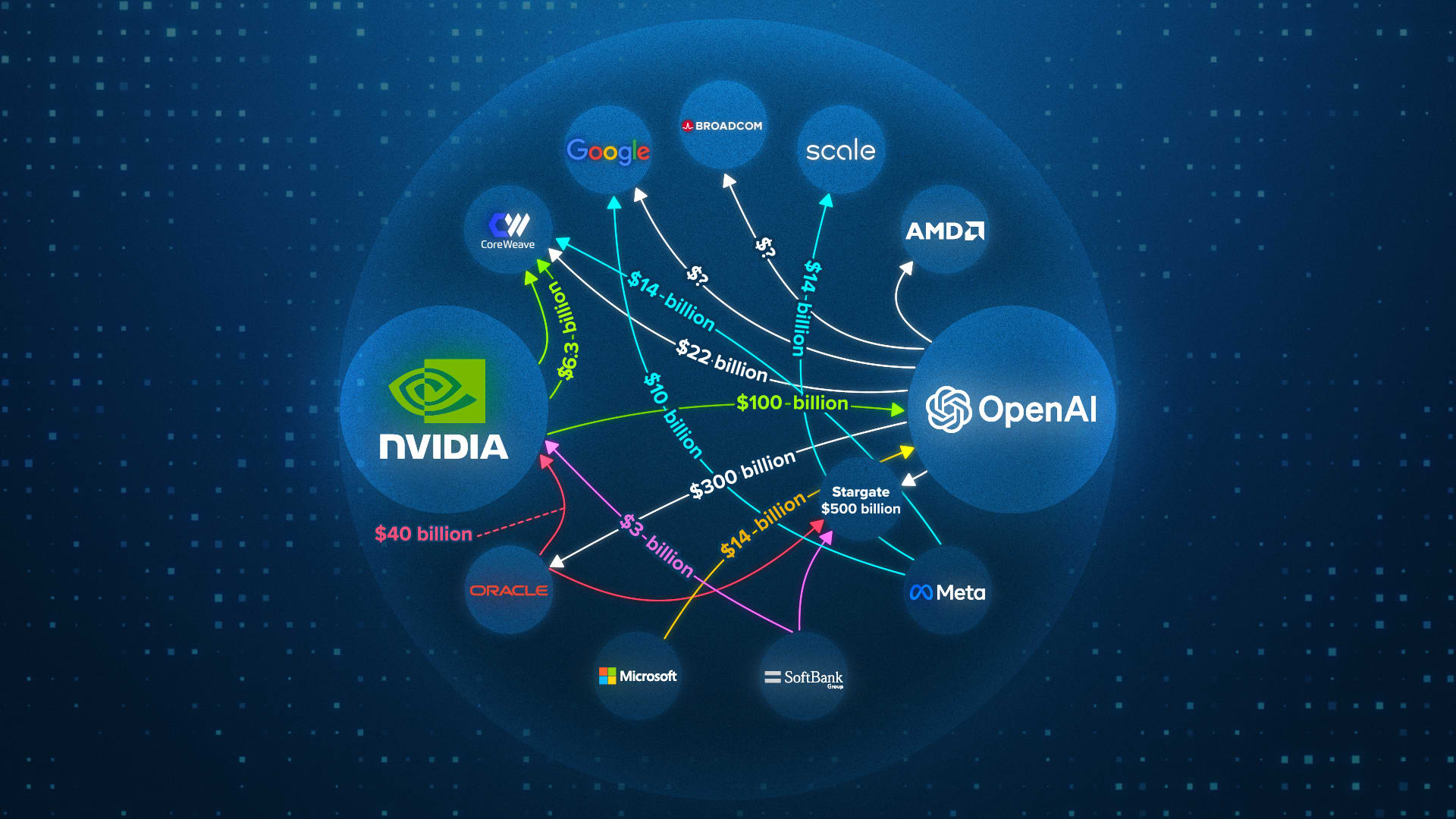
The AI boom has created a remarkable financial loop: Nvidia supplies the chips, invests in companies building data centers, and is now helping bring hundreds of billions of dollars of capital into the infrastructure that will run those chips. The question is no longer whether AI demand is real—but how much of today's infrastructure demand is being amplified by the financing system itself.
There is something unusual happening underneath the spectacular growth of artificial intelligence.
Companies are spending hundreds of billions of dollars building data centers. AI companies are signing enormous computing contracts. Specialized cloud providers are borrowing heavily to buy Nvidia hardware. Investors are pouring money into the companies operating those facilities.
And at the center of much of it sits one company: Nvidia.
Nvidia is, of course, the world's dominant supplier of the GPUs powering the AI revolution. But its role is expanding beyond simply selling chips.
It is becoming an investor, strategic partner and, increasingly, a facilitator of the financing needed to build the infrastructure that buys and deploys those chips.
That creates a fascinating question for the AI boom:
Could Nvidia's success be partly reinforcing the very demand that makes Nvidia so valuable?
The Nvidia loop
The basic model is easy to understand.
An AI company needs computing power.
It doesn't necessarily want to build its own enormous data center, so it rents computing capacity from an AI cloud provider such as CoreWeave.
The cloud provider needs billions of dollars of GPUs and infrastructure.
It raises capital and buys Nvidia equipment.
Nvidia gets the revenue.
But now consider what happens when Nvidia also invests in the cloud provider.
In January, Nvidia invested $2 billion in CoreWeave, while the companies announced plans to accelerate the development of more than 5 gigawatts of AI-factory capacity by 2030. Nvidia also agreed to help CoreWeave acquire land and power for its facilities. NVIDIA Newsroom
CoreWeave, meanwhile, had already become an important customer of Nvidia.
So the relationship isn't simply:
Customer → Nvidia → chips
It increasingly looks like:
Nvidia → investment → data-center operator → Nvidia chips → AI customers → computing revenue
That doesn't make the revenue fake.
But it does make the financial structure considerably more complicated.
Then Nvidia brought Wall Street into the loop
The story became much bigger in August.
Nvidia announced partnerships with Apollo, BlackRock, Blackstone, Brookfield, Goldman Sachs and KKR to create financing platforms designed to mobilize more than $500 billion of third-party capital for AI infrastructure over time.
Nvidia described the goal as turning AI compute and full-stack infrastructure into an investable asset class. NVIDIA Investor Relations
That is a remarkable evolution.
The AI industry used to have a relatively straightforward relationship with the semiconductor industry:
Companies buy chips.
Now the proposition is increasingly:
Institutional investors finance AI factories → AI factories buy Nvidia infrastructure → AI companies rent the resulting compute → AI revenue is expected to service the infrastructure.
Nvidia itself has described the philosophy bluntly: “In AI, compute is revenue.” NVIDIA Blog
That may prove correct.
But it also creates one of the most important questions surrounding the AI boom.
Who is ultimately paying for all this capacity?
The OpenAI example makes the question harder to ignore
In August, Nvidia agreed to provide a guarantee of up to $105 billion connected to OpenAI's lease of a massive Ohio data center being developed by SB Energy.
Nvidia also agreed to invest $1.5 billion in SB Energy.
The facility is expected to eventually reach as much as 8 gigawatts of capacity, while OpenAI is expected to lease the site for 20 years. Nvidia will be the facility's exclusive chip provider. Investing.com
Look at the structure.
OpenAI needs computing capacity.
A data-center developer builds the infrastructure.
Nvidia provides the chips.
Nvidia invests in the infrastructure developer.
Nvidia guarantees part of the economics surrounding the facility.
And Nvidia becomes the exclusive chip supplier.
That is not a simple customer-supplier relationship anymore.
It is an ecosystem.
Nvidia says the arrangement is not circular financing. Jensen Huang has argued that Nvidia is simply using its scale and long-term visibility to help secure infrastructure that will be useful across multiple generations of its technology. Investing.com
That distinction matters.
A circular financial arrangement does not necessarily mean fraud, manipulation or artificial demand.
It means that money can move between companies that are simultaneously customers, suppliers, investors and financing partners.
And that is increasingly what is happening across the AI infrastructure economy.
The bubble argument is therefore more subtle
The easiest version of the AI-bubble argument is:
AI companies are overvalued.
That may eventually prove true, but it isn't particularly interesting.
The more important question is whether capital expenditure is running ahead of economically proven demand.
Imagine a data center costs $10 billion.
Investors finance it because they expect AI companies to rent the computing capacity.
The data center buys $5 billion worth of Nvidia equipment.
Nvidia records revenue.
The AI company uses the GPUs to provide AI services.
But if those AI services don't ultimately generate enough cash to cover the cost of the infrastructure, someone eventually has to absorb the loss.
The GPUs don't disappear.
The data center doesn't disappear.
But the economics can deteriorate.
That is why the critical metric for the AI infrastructure boom isn't simply GPU utilization.
It is return on invested capital.
This is where the Nvidia model becomes fascinating
Nvidia has an enormous incentive to ensure that there is enough infrastructure in the world to use its chips.
That isn't sinister.
It is simply good business.
If customers cannot afford to build data centers, Nvidia sells fewer GPUs.
If financing becomes cheaper, more data centers can be built.
If more data centers are built, more GPUs can be installed.
If more GPUs are installed, more AI companies can rent computing capacity.
If AI companies receive more computing capacity, they can build larger models and AI applications.
And if those businesses succeed, demand for Nvidia hardware increases again.
That creates a self-reinforcing capital cycle.
The cycle can be extremely productive.
But cycles work in both directions.
What happens if AI revenue disappoints?
This is the real stress test.
Suppose AI companies fail to generate the enormous revenues investors currently expect.
Data centers would still have debt.
They would still have electricity bills.
They would still have buildings to operate.
They would still have expensive GPUs whose economic value depends partly on how much customers are willing to pay for compute.
The entire system therefore depends on a critical assumption:
AI demand must eventually become large enough to justify the infrastructure being built today.
If it does, today's enormous capital spending could look remarkably prescient.
If it doesn't, the industry could discover that it built too much computing capacity too quickly.
And Nvidia's involvement in financing the ecosystem could make that adjustment more complicated.
Nvidia is not the only company taking the risk
This is important.
It would be misleading to portray Nvidia as single-handedly manufacturing the AI boom.
Microsoft, Google, Amazon and Meta are spending enormous sums on AI infrastructure because they have existing businesses that can potentially benefit from the technology.
There are also genuine shortages of computing capacity.
AI models require extraordinary amounts of processing power, electricity, networking and storage.
And Nvidia's chips remain extraordinarily valuable because they sit inside a mature software ecosystem that developers already know how to use.
So there is a very real underlying AI infrastructure boom.
The question is whether financial engineering is amplifying it.
That is a different proposition.
The new AI infrastructure machine
The AI economy increasingly resembles something closer to infrastructure finance than traditional software.
There are chips.
There are data centers.
There are power plants.
There are long-term leases.
There are project-finance loans.
There are institutional investors.
There are guarantees.
There are cloud contracts.
And there are enormous expectations about future AI revenue.
Nvidia now wants Wall Street to treat computing infrastructure as a productive asset class.
The company says the more than $500 billion financing figure is not Nvidia revenue or a single fund. It represents third-party capital that the new platforms are intended to mobilize over time. NVIDIA Investor Relations
That distinction is important.
But it also highlights the scale of the bet.
The AI industry is no longer financing its expansion solely through venture capital and corporate cash.
It is increasingly pulling institutional capital and infrastructure finance into the equation.
The uncomfortable question
There is a temptation to ask whether Nvidia is creating an AI bubble.
That may be the wrong question.
Nvidia clearly isn't responsible for every dollar being invested in AI. Nor does its financing activity prove that demand for AI is artificial.
The better question is:
How much of the current AI infrastructure boom would exist without the financing mechanisms being built around Nvidia's ecosystem?
And an even harder question follows:
If AI companies eventually fail to generate the cash flows expected of them, who will be left holding the data centers, the debt and the GPUs?
That is where the bubble debate becomes serious.
Because bubbles don't necessarily begin with fake products.
Sometimes they begin with real technology, genuine demand and an extraordinary amount of capital arriving at the same time.
The technology can be revolutionary.
The demand can be real.
And the investment can still go too far.
Nvidia may ultimately prove to have correctly anticipated the biggest technological infrastructure buildout in decades.
But if the AI boom does turn into a bubble, history may look back at Nvidia not merely as the company that sold the picks and shovels.
It may see Nvidia as one of the companies that helped build the financial machinery that kept the mine expanding.
And that is a much more consequential role.