Buffett drinks five Cokes a day. He has not said that is why he has lived so long
A circulating claim has the 96-year-old investor crediting five daily Coca-Colas for a long life, but the quotes behind it describe a habit and a joke, not a medical finding. The remarks also sit on one of Berkshire Hathaway’s largest holdings, and on a long pattern of Buffett promoting the products his company owns.
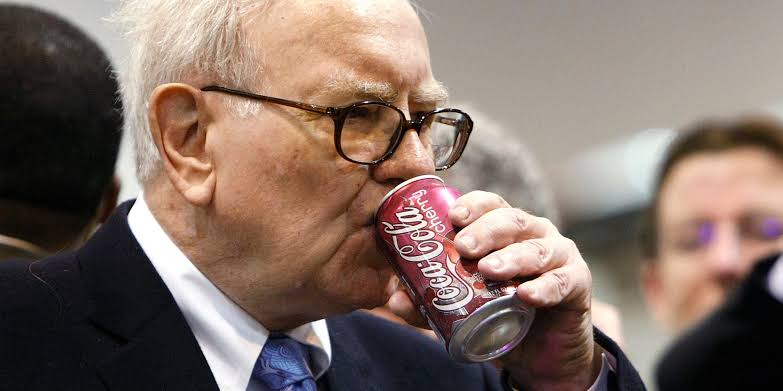
Warren Buffett does drink a lot of Coca-Cola. He has said so, for years, with numbers attached. What has been circulating again in early November 2026 is a stronger claim: that the 96-year-old investor says five Cokes a day contribute to, or account for, his long life. That leap is not what the primary remarks show. The habit is documented. The causal health claim is a media rewrite of a joke and a feeling-good riff—and it is delivered by a man whose company still owns 400 million Coca-Cola shares.
Verdict: Misleading. Buffett has repeatedly said he drinks at least five 12-ounce servings a day and that about a quarter of his calories are Coca-Cola. He has joked about eating like a six-year-old and has said he feels well and kept working after radiation for prostate cancer. In the primary interviews located for this article, he has not made a serious medical claim that the habit lengthens his life. Large studies of sugar-sweetened beverages associate high intake with higher mortality, not a longer life. The anecdotes also function as brand promotion for a core Berkshire Hathaway holding.
What he actually said
In a telephone interview with Fortune’s Patricia Sellers, published on 25 February 2015 after the death of Don Keough, the former Coca-Cola president and Buffett’s longtime Omaha neighbor, Buffett said: “I’m one quarter Coca-Cola.” He spelled out the arithmetic: “If I eat 2700 calories a day, a quarter of that is Coca-Cola. I drink at least five 12-ounce servings. I do it everyday.” He added that he has “three Cokes during the day and two at night,” regular Coke at the office and Cherry Coke at home.
The line that later hardened into a wellness slogan was a joke about actuarial tables, not a clinical claim. “I checked the actuarial tables, and the lowest death rate is among six-year-olds. So I decided to eat like a six-year-old,” he told Fortune. “It’s the safest course I can take.” Fortune framed the interview as a secret to staying young. The joke does not say that Coca-Cola produces longevity. It says he chose a child’s diet because six-year-olds have low death rates—an inversion that only works as humor.
Around the May 2015 Berkshire annual meeting he made the same point to CNBC, as reported by Business Insider on 4 May. “Speaking for myself, I’m 84, literally, one quarter of all the calories I’ve consumed myself have been Coca-Cola.” He said, “I don’t see how anybody can feel better than I feel,” and, “I’m one quarter Coca-Cola and I haven’t missed a day of work since I had the prostate cancer radiation three years ago.” He added, “I don’t think the prostate cancer was caused by the Coca-Cola.” That is a denial of harm in his own case, and a statement about how he feels and whether he has been at work. It is not a finding that five daily Cokes lengthen life.
An 8 November 2026 recap on 24/7 Wall St. said Buffett, now 96, “credits Coke and McDonald’s for his long life,” and that the claim had circulated after TheStreet gathered his earlier lines. The Coca-Cola quotations offered in that recap were the 2015 Fortune remarks. This desk found no new, on-the-record statement in which Buffett says five Cokes a day contribute to his longevity, and no primary quotation in which he credits McDonald’s with extending his life.
Age and the public health record
Buffett was born on 30 August 1930. In a letter to Berkshire shareholders dated 18 September 2026, when the board named him chairman emeritus and elected his son, Howard G. Buffett, as chairman, he wrote that he had recently celebrated his 96th birthday. He remains a director. “Father Time always wins,” he wrote. “He has, however, been generous with me.”
The public medical record that bears on the Coke comments is limited. On 17 April 2012, Berkshire announced that Buffett had been diagnosed with stage I prostate cancer, which the company said was “not remotely life-threatening.” He planned daily radiation for about two months beginning in mid-July, said his energy was “100 percent,” and said scans had not shown cancer elsewhere. In 2015 he told CNBC he had not missed a day of work since that radiation and that he did not think Coca-Cola had caused the cancer. He offered no medical evidence for that last point; it was a personal opinion. A single very long-lived, wealthy man with access to excellent medical care is not a study. The fact that Buffett is 96 and still drinking Coke does not establish that the drink contributed to the years. It also does not prove the opposite in his individual case. It is an anecdote.
What five cans contain, and what the studies show
The Coca-Cola Company’s U.S. nutrition FAQ lists a 12-ounce can of Coca-Cola as containing 39 grams of sugar and 140 calories. Five such servings contain 195 grams of sugar and 700 calories. That is consistent with Buffett’s 2015 arithmetic: a quarter of a 2,700-calorie diet is 675 calories; “at least five” 12-ounce servings sit at or just above that line.
The World Health Organization’s 2015 guideline on sugars intake for adults and children makes a strong recommendation that free sugars be reduced to less than 10 percent of total energy intake, and a conditional recommendation to reduce them further to below 5 percent. On a 2,700-calorie diet, those marks are about 67.5 grams and 33.75 grams of sugar. Five cans, at 195 grams, are roughly three times the 10-percent line and about six times the 5-percent line.
Population evidence on sugar-sweetened beverages points away from a longevity benefit. In a 2019 Circulation study led by Vasanti S. Malik of the Harvard T.H. Chan School of Public Health, researchers followed 80,647 women in the Nurses’ Health Study and 37,716 men in the Health Professionals Follow-up Study. After adjustment for major diet and lifestyle factors, people who drank two or more sugar-sweetened beverages a day had a 21 percent higher risk of death from any cause, and a 31 percent higher risk of death from cardiovascular disease, than those who drank them less than once a month. The Harvard Chan School’s summary of the paper also reported a graded association for all-cause mortality and found that each additional daily serving was associated with a 10 percent higher risk of cardiovascular death.
Those are associations from observational cohorts, not proof that the drinks caused the deaths. Residual confounding is possible. The findings are consistent with a large body of evidence linking sugar-sweetened beverages to weight gain, type 2 diabetes and heart disease. Buffett’s “at least five” 12-ounce servings a day sit well above the study’s top intake category, which grouped two or more drinks a day. This article does not invent a hazard ratio for five cans. It notes that the dose he has described is higher than the level already associated, in those cohorts, with elevated mortality.
The holding, the dividends, and a pattern of promotion
The health remarks did not arrive from a disinterested pensioner. They come from the investor who, for decades, controlled Berkshire Hathaway, Coca-Cola’s most famous shareholder since the late 1980s.
Buffett told shareholders, in his letter dated 2 March 1990, that he believed he had his first Coca-Cola in 1935 or 1936, and that in 1936 he was buying Cokes “at the rate of six for 25 cents from Buffett & Son, the family grocery store, to sell around the neighborhood for 5 cents each.” “In this excursion into high-margin retailing,” he wrote, “I duly observed the extraordinary consumer attractiveness and commercial possibilities of the product.” He watched those qualities “for the next 52 years” and “carefully avoided buying even a single share,” until “in the summer of 1988 did my brain finally establish contact with my eyes.” By the end of 1989 Berkshire held 23,350,000 Coca-Cola shares, acquired at a cost of about $1.02 billion.
In his letter dated 25 February 2023, Buffett wrote: “In August 1994 – yes, 1994 – Berkshire completed its seven-year purchase of the 400 million shares of Coca-Cola we now own. The total cost was $1.3 billion.” The cash dividend in 1994 was $75 million; by 2022 it had risen to $704 million, growing “every year, just as certain as birthdays.”
Greg Abel’s letter to shareholders, dated 28 February 2026 and reporting year-end 2025 figures, listed Coca-Cola among Berkshire’s concentrated U.S. holdings, with a 9.3 percent ownership stake, a cost basis of $1,299 million, a market value of $27,964 million, and $816 million of dividends received in 2025. The $816 million matches the arithmetic of 400 million shares at Coca-Cola’s then annual dividend of $2.04. On 19 February 2026, Coca-Cola’s board approved its 64th consecutive annual dividend increase, raising the quarterly payout from 51 cents to 53 cents a share, or $2.12 a year. At that rate, 400 million shares would generate $848 million a year. That is an annualized figure, not the cash booked in 2025.
Berkshire’s Form 13F-HR filed on 14 August 2026, covering U.S.-listed holdings as of 30 June 2026, still reported 400,000,000 Coca-Cola shares, with a reported value of $32,508,000,000. The share count was unchanged from the position completed in 1994 and from the year-end 2025 letter. The rise in reported value from $27.96 billion at the end of 2025 to $32.51 billion at mid-2026 reflects the market price used in the filing, not a purchase of more shares. This desk found no verified trim of the Coca-Cola position in the first half of 2026. A later 13F, for the quarter ended 30 September, was not yet due at the time of writing.
Buffett sat on Coca-Cola’s board for 17 years. On 14 February 2006 the company announced that he would not stand for re-election; his term ended at the annual meeting on 19 April. In the company’s release he said the decision followed “increased demands on his time resulting from Berkshire Hathaway’s acquisitions of new companies,” and “noted that Berkshire Hathaway intends to retain its holdings of Coca-Cola stock.” Chairman and chief executive E. Neville Isdell thanked him for “wise and sage counsel over the past 17 years.”
The same 2022 shareholder letter in which Buffett recounted the finished Coke purchase also described, without embarrassment, how Berkshire uses the annual meeting to sell the products it owns. Recalling the 2022 gathering, he wrote: “Charlie and I are shameless.” “From the opening bell, we went straight for your wallet.” See’s Candies, which Berkshire bought in 1972, sold “eleven tons of nourishing peanut brittle and chocolates” from a kiosk. “In our P.T. Barnum pitch, we promised you longevity. After all, what else but candy from See’s could account for Charlie and me making it to 99 and 92?” See’s rang up $400,309 of volume over two days at a single location, he said.
That joke is the same device as the six-year-old diet: a longevity promise offered as showmanship for a Berkshire product. International Dairy Queen, whose merger into a Berkshire subsidiary became effective on 7 January 1998, is part of the same theatre; Buffett has long been photographed eating the chain’s ice cream around meeting time, and Cherry Coke has been a fixture of the Omaha weekend. The meeting is an owners’ gathering. It is also a showcase.
The investment idea behind the stake is not mysterious, and Berkshire has stated it plainly. In the 1989 letter Buffett wrote that, in choosing securities, the firm limits itself “always to investment alternatives we think we understand.” He had watched Coca-Cola’s “extraordinary consumer attractiveness” since childhood; once Roberto Goizueta and Don Keough refocused the company in the 1980s, he saw “the world’s most ubiquitous product” regain momentum. Abel, in the letter reporting 2025 results, described Apple, American Express, Coca-Cola and Moody’s as “businesses we understand well” and said Berkshire expected them to “compound over decades,” with “limited activity in these holdings” unless fundamentals changed. That is the consumer-moat, circle-of-competence thesis in current management’s words: buy a simple product people keep paying for, hold it, and collect a rising dividend.
A conflict, in plain sight
Whether Buffett’s public health anecdotes also work as brand marketing is not a close question. They do. He is the most famous living advertiser Coca-Cola has ever had who was not on the payroll as a spokesman. The 2015 remarks were offered in a conversation about Don Keough, a Coca-Cola man. The meeting jokes about See’s and longevity were, by Buffett’s own account, a “P.T. Barnum pitch.” The financial interest is enormous and fully disclosed: a $1.3 billion cost, a holding worth $27.96 billion at the end of 2025 and $32.51 billion at mid-2026 in the 13F, and more than $800 million a year in dividends.
That is a conflict of interest in the ordinary sense that a reasonable reader cannot treat the anecdotes as independent health testimony. It is not evidence of a hidden scheme. Buffett has never been quiet about the stake, the board seat, or the habit. He sold Cokes as a child, bought the stock because he thought he understood the product, and has kept drinking it in public. The honest reading is that the comments are both a personal diet story and salesmanship, and that he has been more candid about the salesmanship—at least when the product is peanut brittle—than many of the headlines that now recycle the Coke lines as a longevity tip.
What the record does not support is the claim now moving around again: that Warren Buffett says five Cokes a day contribute to his long life. He has said he drinks them, that they are about a quarter of his calories, that he decided to eat like a six-year-old, that he feels well, and that he kept working after radiation for a cancer he does not believe the drink caused. Those statements are real. The further claim, that the habit is a reason he has lived into his mid-nineties, is a verdict the studies of sugar-sweetened beverages do not support and that Buffett, in the primary remarks located for this article, did not actually make.