India's Stock Market Gains Rs 8 Lakh Crore in a Day: How US Politics and Falling Oil Prices Triggered a Rally
India's stock market staged one of its strongest rallies in seven months after the US midterm election results reshaped investor expectations. Falling oil prices, renewed foreign investment and optimism about geopolitical de-escalation combined to lift Indian equities. But the rally also exposes how dependent emerging markets remain on developments beyond their borders.
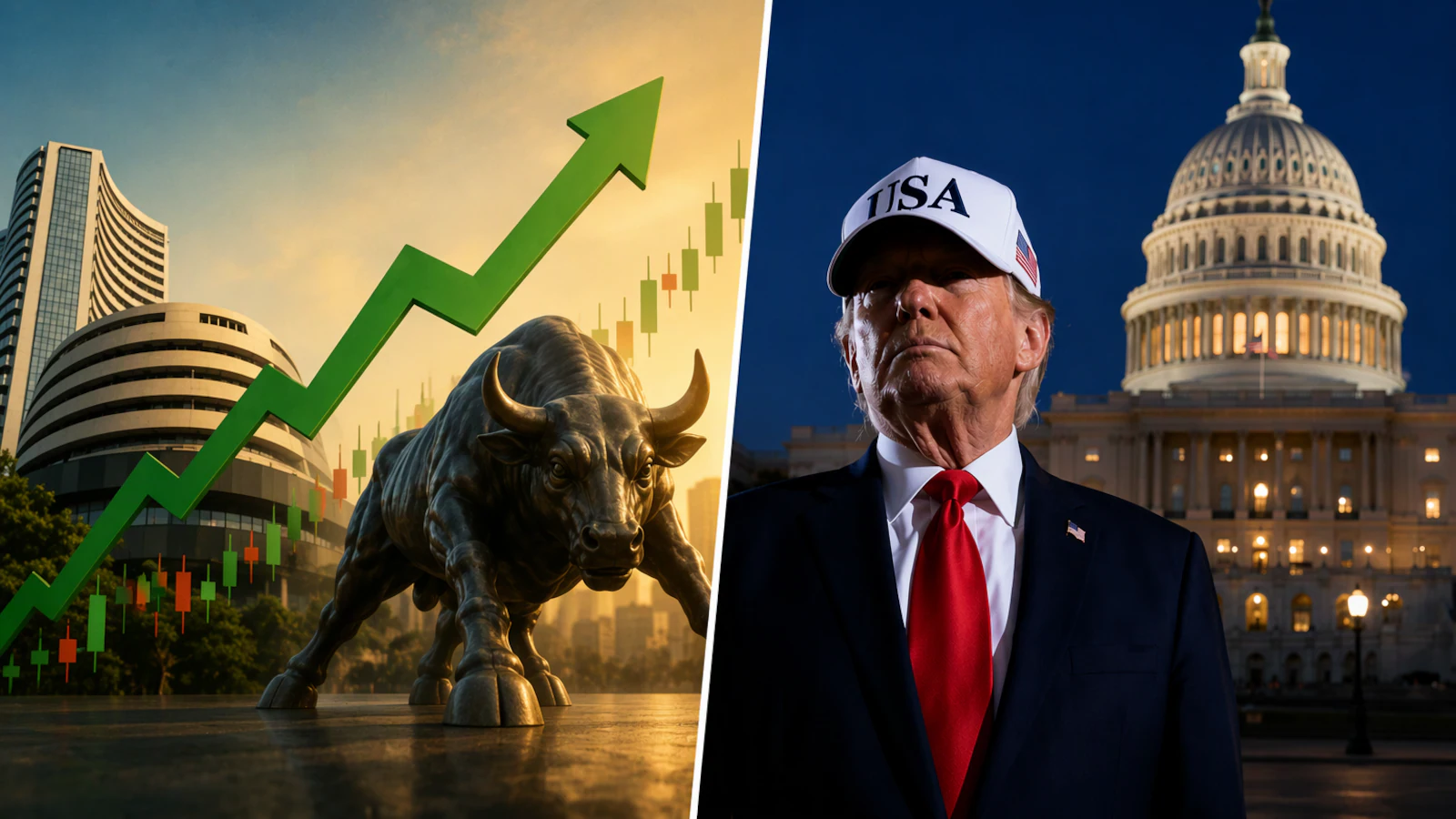
A remarkable day on Dalal Street
India's stock market delivered an extraordinary performance on November 5, 2026, adding approximately Rs 8.2 lakh crore to investors' wealth in a single trading session.
The benchmark BSE Sensex surged 2.62 per cent to close at 79,310.01, while the NSE Nifty 50 advanced 2.42 per cent to 24,536.60. Both indices recorded their strongest single-day gains in seven months.
The rally followed a sharp improvement in global investor sentiment after the Democrats secured victories in both chambers of the US Congress in the November midterm elections.
At first glance, the connection between an American congressional election and India's stock market might appear distant. In reality, it illustrates how interconnected financial markets have become. Political developments in Washington can influence expectations about international conflict, energy prices, monetary policy and the movement of capital across borders.
For India, those connections are particularly important because the country imports a substantial proportion of the oil it consumes and depends on international investment to support its financial markets.
The rally was therefore about more than investors celebrating a favourable trading session. It reflected changing expectations about the economic risks confronting the world's major economies.
Why the US election mattered to Indian investors
The Democrats' electoral success introduced a new political calculation into financial markets.
With the opposition gaining control of both chambers of Congress, investors began assessing whether the change in Washington's political balance could constrain President Donald Trump's policy agenda, particularly regarding the conflict involving the United States, Israel and Iran.
The possibility of increased congressional scrutiny and political pressure has encouraged speculation that Washington could face stronger incentives to pursue diplomatic alternatives and reduce geopolitical tensions.
That distinction matters because the conflict has had consequences far beyond the Middle East.
The region occupies a central position in global energy supply. Any prolonged disruption involving Iran and the surrounding Gulf region threatens oil transportation routes, increases uncertainty over production and raises the possibility of higher energy prices.
For countries that depend heavily on imported energy, such as India, those developments can quickly become economic problems.
Investors were therefore responding not simply to the election results but to what those results might mean for the geopolitical environment.
However, a change in congressional control does not automatically translate into a change in American foreign policy. The administration retains substantial authority over foreign affairs, and the political and strategic interests sustaining the conflict remain complicated.
The market's optimism reflects expectations, not an established diplomatic breakthrough.
Falling oil prices provided the immediate economic relief
The most direct economic trigger behind the rally was the sharp decline in international crude oil prices.
Brent crude fell approximately 8.7 per cent during the preceding trading session, moving towards $95 per barrel. US West Texas Intermediate crude also experienced a substantial decline.
The fall reflected growing expectations that the US political developments could improve the prospects for reducing geopolitical tensions and easing concerns about future oil supplies.
For India, cheaper crude is particularly significant.
India is one of the world's largest oil importers. When international oil prices rise, the country must spend more foreign currency to purchase the energy required by its economy.
That increases the import bill, places pressure on the rupee and can contribute to domestic inflation.
Higher energy costs also affect businesses throughout the economy. Airlines face more expensive fuel, manufacturers encounter rising production costs, transportation becomes more expensive and companies can find their profit margins squeezed.
A sustained decline in oil prices could reverse some of those pressures.
Lower crude prices would potentially reduce India's energy import costs, ease inflationary pressures, support the currency and improve the profitability of businesses exposed to fuel and transportation expenses.
This explains why falling oil prices can produce such a powerful response in Indian equities.
Nevertheless, the distinction between a temporary market decline and a sustained reduction in energy prices is important. Oil prices remain vulnerable to geopolitical developments, production decisions and changes in global demand.
Foreign investors are returning, but confidence remains fragile
Another important factor behind the rally was the return of foreign institutional investors.
Foreign investors purchased approximately Rs 7,284 crore worth of Indian equities on November 4, marking their largest single-day buying activity since October 2025, according to market reports.
The purchases represented an important improvement after months of substantial foreign selling.
Foreign institutional investors play an influential role in India's stock market because they manage large pools of international capital. Their investment decisions are influenced by interest rates, currency movements, economic growth expectations, corporate earnings and the relative attractiveness of different markets.
India had faced significant foreign capital outflows during the preceding months, as international investors reassessed emerging-market opportunities and directed money towards other investments.
The renewed buying suggests that some investors are becoming more comfortable with India's near-term economic outlook.
But one day of substantial purchases does not establish a lasting reversal.
International investors can move capital quickly when market conditions change. A renewed escalation in the Middle East, another surge in crude prices or a stronger dollar could reverse the recent improvement in sentiment.
India therefore needs more than favourable international developments to sustain foreign investment. Consistent economic growth, attractive company valuations and stronger corporate earnings will remain essential.
Wall Street's recovery added momentum
The Indian rally also received support from the performance of American equities.
Following the US election results, major American indices recorded strong gains. The S&P 500 rose approximately 1.6 per cent, the Dow Jones Industrial Average gained around 3 per cent and the Nasdaq Composite advanced approximately 1.4 per cent.
The improvement in American markets helped strengthen global risk appetite.
When investors become more confident about the global economic outlook, they are often more willing to purchase equities in emerging markets. Conversely, periods of uncertainty can encourage investors to move towards assets perceived as safer.
The relationship is particularly important for countries such as India, where foreign portfolio investment can significantly influence market valuations.
However, global capital allocation is becoming increasingly competitive. Investors are also directing substantial resources towards artificial intelligence, semiconductor manufacturing and other technology-related opportunities.
India must therefore compete not only with other emerging markets but also with the investment opportunities offered by established technology economies.
The bigger question: Can the rally last?
The most important question following November 5 is whether India's market recovery represents a genuine improvement in economic conditions or simply a temporary reaction to favourable international developments.
There are reasons for optimism.
Lower oil prices could improve India's external financial position, reduce pressure on inflation and strengthen corporate profitability. Renewed foreign investment could support market liquidity, while a more stable geopolitical environment would improve confidence in international trade and energy supplies.
But the risks have not disappeared.
The US midterm election results do not guarantee an end to the conflict with Iran. Oil markets could react sharply to renewed military escalation, and foreign investors could reconsider their positions if global economic conditions deteriorate.
Furthermore, a rising stock market does not necessarily mean that the underlying economy has improved at the same pace.
Share prices reflect expectations about future profits and economic conditions. They can rise substantially before improvements become visible in employment, household incomes or business activity.
For Indian investors, the sustainability of the rally will ultimately depend on whether favourable international conditions translate into stronger domestic economic performance.
What India's market rally reveals about the global economy
The events of November 5 offer a useful illustration of the relationship between politics, geopolitics and financial markets.
An election in Washington helped reshape expectations about American political constraints. Those expectations influenced perceptions of geopolitical risk in the Middle East. Changing perceptions contributed to a sharp movement in oil prices, which subsequently affected investor confidence in an energy-importing economy such as India.
The chain of events demonstrates that financial markets no longer operate within neatly separated national boundaries.
For India, the rally was a welcome development after months of uncertainty. For international investors, it provided another reminder that emerging markets can respond rapidly when global economic conditions change.
Yet the celebration should be measured.
The Rs 8.2 lakh crore increase in market value represents a substantial improvement in investor wealth on paper, not an equivalent injection of money into the Indian economy. Nor does it guarantee that the gains will be maintained.
India's challenge is to turn favourable international conditions into sustained economic strength.
The market may have received a Diwali gift, but whether it becomes the beginning of a longer recovery will depend on developments that remain far from settled.