Football Makes Billions. So Why Do So Many Clubs Struggle to Make a Profit?
Football has never been richer. Broadcasting deals, sponsorships and global fanbases pour billions into the game, yet many of its biggest clubs struggle to turn a profit. The explanation lies in football’s peculiar economics: the more money clubs make, the more fiercely they compete to spend it.
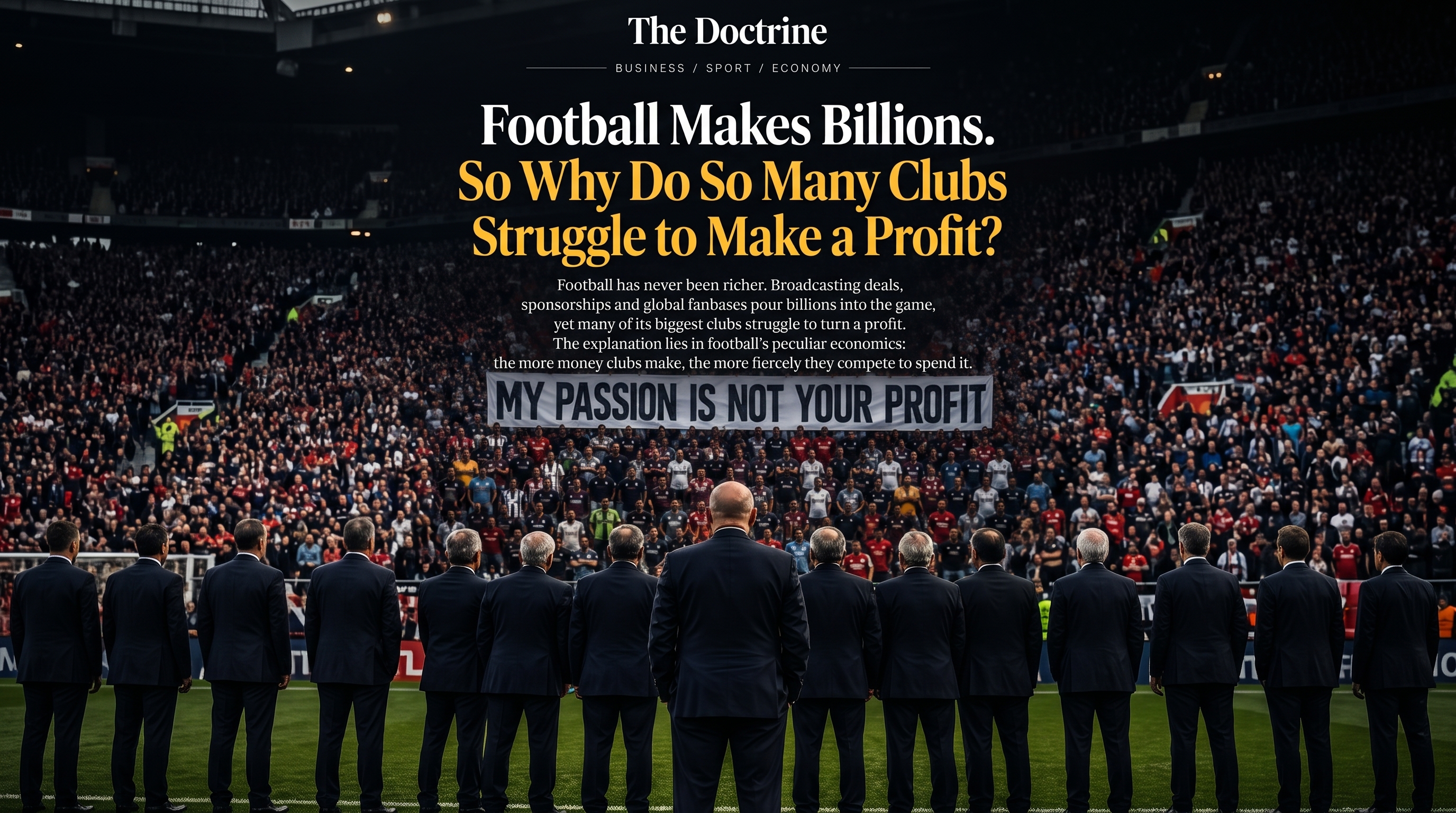
European football has become an enormous entertainment industry. Its stadiums are full, broadcasters pay billions for matches and the biggest clubs sell shirts from Manchester to Manila. Yet surprisingly few clubs behave like successful conventional businesses. The reason lies in football's peculiar economics: whenever more money enters the game, somebody usually finds a way to spend it.
There are few industries in which the employees arrive for work in Lamborghinis while their employers complain about financial sustainability.
Football is one of them.
At first glance, professional football ought to be a magnificent business. Its principal product—a match between two teams—is relatively simple. Hundreds of millions of people want to watch it. Supporters display a degree of customer loyalty that executives in almost every other industry would envy.
A Manchester United supporter is unlikely to switch to Liverpool because Liverpool offers a better product this year.
That devotion can last generations.
Broadcasters pay handsomely for access to it. Sponsors want their logos attached to it. Tourists cross continents to experience it. Streaming services, video games and social media have helped turn once-local clubs into international entertainment brands.
European football revenues have consequently grown enormously.
And yet many clubs routinely report losses.
The mystery disappears once one understands a peculiar feature of football economics.
Football clubs are extremely good at making money.
They are even better at spending it.
The £100m problem
Imagine a successful club suddenly receives an additional £100m every year from a new broadcasting agreement.
A normal company's finance department might celebrate.
Revenue has increased dramatically while many existing costs remain unchanged. Some of that £100m should therefore become profit.
Football works differently.
The club's sporting director now knows there is another £100m available.
Unfortunately, so does everybody else.
Players know.
Agents know.
Selling clubs know.
And, most importantly, rival clubs have probably received additional television money too.
A striker who might previously have commanded £150,000 a week can ask for £200,000.
His agent knows the club can afford it.
The club selling him can demand £70m instead of £50m.
Meanwhile, supporters see the additional television revenue and ask why their club isn't signing anybody.
Soon much of the new money has disappeared into transfer fees and salaries.
The football club has become richer without necessarily becoming much more profitable.
Economists have a useful concept for this: an arms race.
If one club spends heavily and everyone else refuses to respond, the spender may gain an advantage.
But everyone responds.
The result is an industry in which revenues rise spectacularly while costs chase them upward.
The workers have considerable power
There is another unusual characteristic of football.
The most important workers capture an enormous share of the industry's wealth.
Apple can sell vastly more iPhones without paying every engineer proportionately more.
A football club cannot expand quite so easily.
There are only so many footballers capable of changing the outcome of a Champions League match.
Kylian Mbappé cannot be manufactured in another factory.
Neither can Erling Haaland.
This gives elite players—and their representatives—considerable bargaining power.
When clubs become richer, players can demand some of the additional wealth.
And football provides an unusually transparent measure of employee performance.
Everybody knows who scores 30 goals.
Everybody knows which goalkeeper is exceptional.
Everybody knows which 20-year-old midfielder is being watched by Europe's richest clubs.
The best workers therefore know precisely how valuable they are.
This helps explain why wages tend to expand alongside revenues.
It also explains one of football's great financial ironies.
A new television deal designed to make clubs richer can eventually make footballers richer instead.
Then there are transfers
Football accounting makes the picture even stranger.
Suppose a club buys a player for £100m on a five-year contract.
For accounting purposes, the £100m transfer fee is generally spread across the five years of the player's contract.
The club therefore records roughly £20m of transfer-related amortisation annually.
Now imagine a squad containing several expensive players.
The annual amortisation expense quickly becomes enormous—before their wages have even been counted.
And buying the player is only the beginning.
There may be signing bonuses, agent fees, performance bonuses and salary increases.
Then comes the uncomfortable possibility that the £100m footballer simply isn't very good.
Unlike machinery, footballers are unpredictable assets.
They get injured.
They lose confidence.
Managers change.
Tactics change.
A brilliant winger in Germany can become an expensive substitute in England.
The club may then replace him with another expensive player while still carrying costs associated with the first.
Few industries combine such large capital commitments with such uncertain human performance.
Winning is terrible for financial discipline
There is an even deeper problem.
The objective of a football club is ambiguous.
For an ordinary corporation, success is reasonably straightforward.
Make money.
For a football club, making money while finishing tenth can reasonably be regarded as failure.
The thing supporters actually want is victory.
That changes everything.
Suppose a club's chief executive has two choices.
The first is to generate £50m in profit.
The second is to spend that £50m on two footballers who might help the club qualify for the Champions League.
From a conventional corporate perspective, the first option looks attractive.
From a football perspective, the second may be irresistible.
Because winning produces rewards that extend beyond money.
It brings trophies, prestige and political capital with supporters. It raises the status of owners. It can increase future commercial revenue. It may also preserve the jobs of executives and managers.
Football clubs therefore don't merely compete for customers.
They compete for relative position.
That distinction matters enormously.
If every supermarket becomes 10% more efficient, they can all benefit.
If every Premier League team becomes 10% better, the league table still contains a first place and a twentieth place.
Someone still gets relegated.
Someone still misses the Champions League.
Football is ultimately a contest for scarce positions.
That encourages overspending.
The Champions League makes things worse
European competition adds another incentive.
Qualifying for the Champions League can bring enormous additional revenue from broadcasting, prize money and matchday income.
Missing it can leave a painful hole in the budget.
Clubs therefore sometimes spend today in anticipation of tomorrow's success.
Buy three expensive players.
Finish fourth.
Collect Champions League money.
The calculation looks perfectly reasonable.
Until the team finishes sixth.
The expected revenue disappears.
The wages do not.
This is how sporting disappointment becomes a financial problem.
The same dynamic becomes considerably more dangerous farther down the pyramid.
Promotion can transform a club's finances. Relegation can devastate them.
Owners therefore gamble on avoiding relegation or securing promotion by spending more on players.
Sometimes the gamble succeeds.
Sometimes it produces a very expensive team playing in a much poorer division.
Why billionaires keep buying clubs
All of this creates another puzzle.
If football clubs are so difficult to run profitably, why do billionaires, private-equity firms and sovereign investors keep trying to buy them?
Because annual profit is only one way of making money from an asset.
Consider Manchester United.
The Glazer family's takeover in 2005 valued the club at roughly £790m.
By the time Sir Jim Ratcliffe acquired a minority holding almost two decades later, the transaction implied a valuation running into several billion pounds.
That is an extraordinary increase in asset value.
The club did not need to generate enormous profits every year for its owners' equity to become considerably more valuable.
This is partly because genuinely elite football clubs are extraordinarily scarce.
A billionaire can build another hotel.
He can launch another airline.
He can establish another technology company.
He cannot create another Real Madrid.
One can establish a new football club, of course. But one cannot purchase a century of history, dozens of trophies and hundreds of millions of accumulated emotional attachments.
There are only a handful of truly global football brands.
And there are considerably more billionaires than there are Manchester Uniteds.
Scarcity does the rest.
A football club is not quite a company
This helps explain why conventional business analysis sometimes struggles with football.
Manchester United is technically a business.
But emotionally it resembles something closer to a public institution.
Its customers believe they possess moral claims over it despite owning no shares.
Supporters speak of "our club".
Owners speak of "our investment".
Those two sentences contain much of football's modern conflict.
The supporter wants ticket prices kept reasonable, the stadium improved and every available pound spent strengthening the team.
The investor may want financial discipline and a return on capital.
The manager wants another midfielder.
The midfielder wants £250,000 a week.
His agent wants a commission.
The television company wants more matches.
The governing body wants financial sustainability.
Everybody wants something from the same pile of money.
No wonder so little remains at the bottom.
The paradox may be permanent
Football's administrators have spent years attempting to impose financial discipline through rules limiting losses and linking spending to revenue.
These measures may restrain the most extreme behaviour.
They cannot easily eliminate the incentive behind it.
Imagine that every Premier League club suddenly receives an unexpected £50m tomorrow.
Within hours, supporters would begin discussing which players their club should buy.
Within days, agents would adjust expectations.
Within months, transfer prices and wages would begin absorbing some of the new wealth.
And by the following summer, club executives would probably once again complain that football had become too expensive.
That is not necessarily evidence that the industry is failing.
It may simply be how the industry works.
Football has discovered something remarkable: an entertainment product capable of generating billions while maintaining an almost unlimited appetite for consuming those billions.
The stadium gets bigger.
The television contract gets richer.
The sponsorship deal becomes more lucrative.
Then someone discovers a 21-year-old Brazilian winger.
And the money disappears again.