Ethiopia Buys Russian Su-35 Jets and S-400s in Multibillion-Dollar Military Push While Relying on a $3.4 Billion IMF Loan
Ethiopia is borrowing billions of dollars to stabilise an economy struggling with debt, inflation and shortages of foreign currency. At the same time, it is assembling what could become one of the most formidable air forces in sub-Saharan Africa.
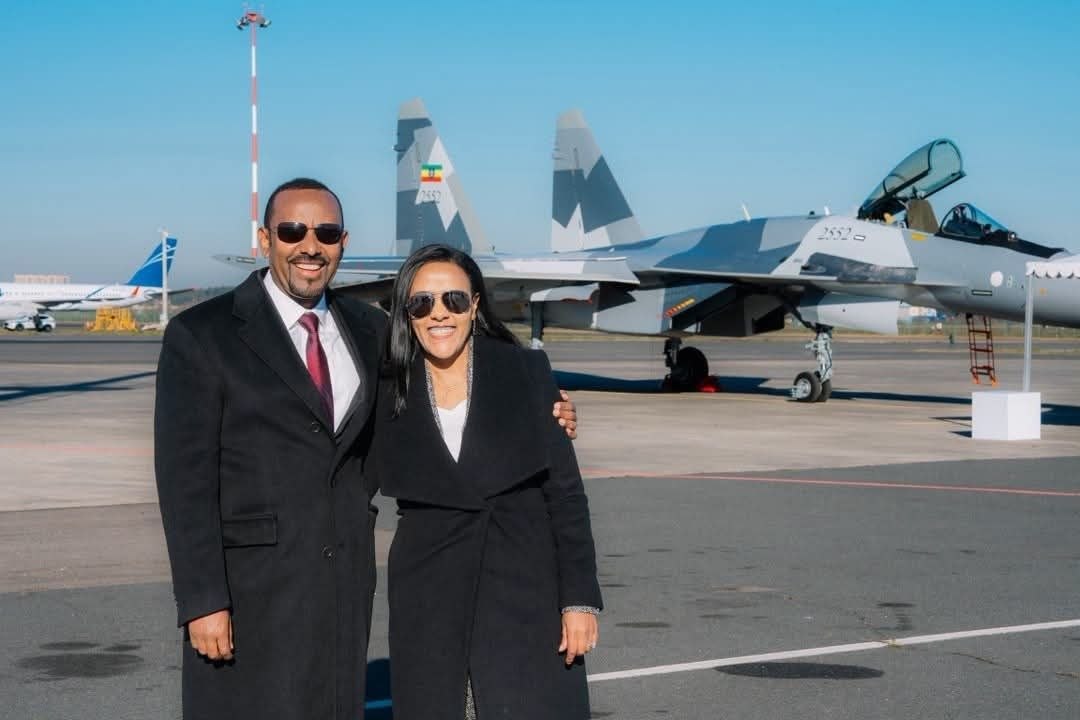
The contrast became difficult to ignore on Wednesday when Prime Minister Abiy Ahmed announced that Ethiopia had received 12 Russian Su-35 fighter aircraft and would later acquire four S-400 air-defence systems. The government has not disclosed what it is paying for the package, meaning claims about its exact cost should be treated cautiously. But comparable international purchases suggest that aircraft and air-defence systems on this scale can involve several billion dollars once missiles, training, maintenance and support are included.
That is an extraordinary commitment for a country simultaneously relying on international lenders to repair its finances.
In 2024, the International Monetary Fund approved a four-year, $3.4 billion programme for Ethiopia. The money was intended to help address severe macroeconomic imbalances, rebuild foreign-exchange reserves, restore debt sustainability and support reforms after years of economic strain.
Yet Ethiopia's military modernisation has continued.
The Su-35 is not simply another replacement fighter. It is among Russia's most capable combat aircraft available for export, giving Ethiopia a significant improvement in air-to-air combat capability. The planned S-400 acquisition is potentially even more consequential. A sufficiently equipped S-400 network would give Ethiopia a long-range air-defence capability possessed by relatively few countries.
The government presents these purchases as deterrence. Abiy said the new capabilities were intended to help Ethiopia “pre-emptively deter aggression”, an argument that cannot simply be dismissed in a region with genuine security threats. Ethiopia has experienced a devastating civil war, continues to confront armed insurgencies and sits in a Horn of Africa increasingly shaped by military competition, unstable neighbours and competing foreign powers.
But deterrence has a price—and Ethiopia's economic circumstances make that price politically significant.
The country is not purchasing advanced military equipment from a position of abundant public finances. Its IMF programme was negotiated precisely because the existing economic model had become unsustainable. Ethiopia has had to reform its foreign-exchange system, confront inflation, restructure debt and seek billions of dollars from international institutions and development partners.
For ordinary Ethiopians, those reforms have tangible consequences. Currency adjustment and inflation can quickly translate into more expensive food, fuel, transportation and imported goods. The IMF programme itself emphasises the need for stronger social protection precisely because economic adjustment can fall hardest on vulnerable households.
Against that background, a multibillion-dollar military modernisation raises an uncomfortable question: what does Ethiopia consider its most urgent national emergency?
A country repeatedly preparing for the next conflict
There is another dimension to the story. Ethiopia has spent much of the past several years either fighting wars or preparing for the possibility of another one.
The 2020-22 Tigray war devastated northern Ethiopia and cost an enormous number of lives. Peace brought only a fragile respite. Armed conflict subsequently intensified in Amhara, while tensions within Tigray and between Ethiopia and Eritrea continued to create fears of renewed regional warfare.
Those fears are no longer theoretical. Renewed fighting in northern Ethiopia has again placed military power at the centre of national politics.
This helps explain why Addis Ababa wants stronger air power. During the previous Tigray war, drones and aircraft became increasingly important to the federal government's battlefield strategy. Ethiopia appears to have drawn a clear lesson from that conflict: control of the skies can compensate for vulnerabilities on the ground.
The Su-35 and S-400 purchases take that lesson much further.
Together, they are designed not merely for fighting insurgents. They provide capabilities associated with conventional interstate warfare: controlling national airspace, intercepting sophisticated aircraft, striking targets at distance and making hostile air operations substantially more difficult.
That inevitably changes how Ethiopia's neighbours interpret the country's military ambitions.
Security or development?
There is a danger in reducing the choice to a simplistic question of fighter jets versus hospitals. Governments have legitimate security responsibilities, and Ethiopia exists in a difficult neighbourhood. A state of more than 100 million people cannot assume that development spending alone will protect its sovereignty.
But military expenditure also carries an opportunity cost.
Every dollar of scarce foreign exchange committed to imported aircraft, missiles, spare parts and military training is a dollar that cannot simultaneously finance another import. For a country struggling to accumulate reserves and manage external financing requirements, that trade-off matters enormously.
And this is where the IMF comparison becomes politically powerful.
Ethiopia sought a $3.4 billion IMF programme because it needed outside assistance to stabilise its economy. If the eventual Russian military package proves comparable in scale—or larger—it would mean that the country is simultaneously receiving billions from international institutions to repair its economic foundations while committing billions to advanced military capabilities.
That does not mean IMF money is literally being used to purchase Russian weapons. There is no public evidence supporting such a claim, and the financing mechanisms are separate.
The significance is instead about priorities.
International institutions are helping Ethiopia create fiscal and foreign-exchange breathing room. The Ethiopian government must decide what it does with the broader economic space that eventually emerges. Its willingness to pursue one of Africa's more ambitious air-force modernisation programmes tells us something about where national security sits in that hierarchy.
The real cost may not appear on the invoice
There is also a larger cost that cannot be measured in the price of an Su-35.
Countries that expect peace invest differently from countries that expect war.
Ethiopia's acquisition of advanced fighters, drones, trainers and long-range air defences suggests a government preparing for a security environment in which military power will remain central. Perhaps that calculation will prove prudent. A sufficiently credible military can deter adversaries and prevent wars rather than cause them.
But the opposite possibility deserves equal attention.
An arms build-up can make neighbouring governments more nervous, encourage counter-purchases and gradually transform political disputes into military calculations. In the Horn of Africa—where Ethiopia's relationships with Eritrea, Somalia, Sudan and Egypt have all experienced periods of serious tension—that risk cannot be ignored.
For Ethiopia, therefore, the question is larger than whether it can afford 12 Su-35s and four S-400 batteries.
It is whether a country still dependent on concessional international financing, struggling with the consequences of previous wars and asking its population to endure painful economic reforms can afford to make preparation for the next conflict such an expensive national priority.
The answer will not be found in the specifications of a Russian fighter jet.
It will be found in what Ethiopia chooses to build when the aircraft have landed.