Cameroon’s Long Biya Problem: How Does a Country End Up Being Run Like This?
At 93, Paul Biya remains Cameroon’s president after more than four decades in power, but his prolonged stays in Geneva and the growing uncertainty over who will eventually succeed him are exposing the deeper fragility of Cameroon’s political system.
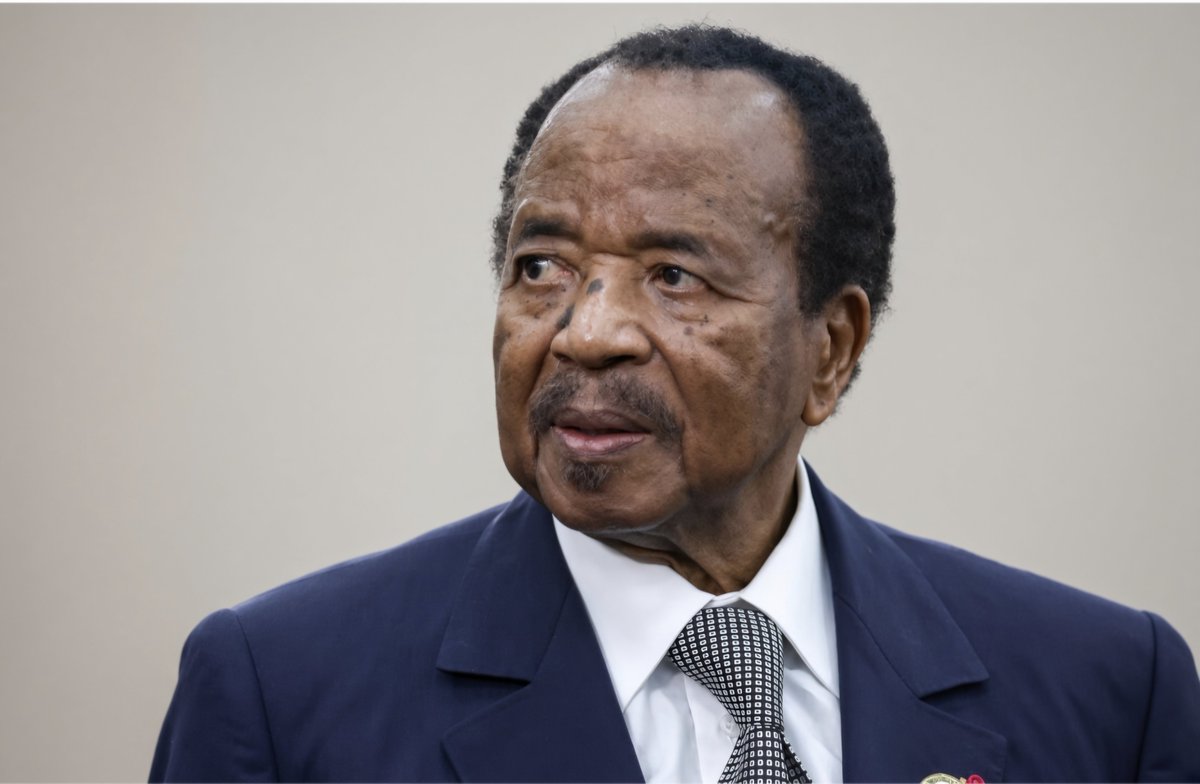
At 93 years old, Paul Biya has been president of Cameroon for more than four decades. He has now spent longer in power than most Cameroonians have been alive. Yet the extraordinary part of the Biya era is no longer simply its length. It is the extent to which the country’s political system has become organized around one man — and how difficult it appears to be for that system to imagine what comes after him.
Biya returned to Cameroon on August 20, 2026, after spending 73 days in Geneva, his longest absence from the country during his presidency. His government described the trip as a private stay. His prolonged absence nevertheless triggered intense speculation about his health, his ability to govern and, most importantly, who would eventually succeed him.
The strange thing is that Biya did not need to disappear from power in order to expose the weakness of the system. His absence did it for him.
While he was in Geneva, official business continued. His government insisted that he remained in charge and continued to sign decrees. But the fact that a 93-year-old president could spend more than two months outside the country without a clearly designated successor exposed a deeper institutional problem: Cameroon has built a political order in which continuity depends heavily on the continued presence — and decisions — of one individual.
And even after his return, the uncertainty did not disappear.
As of October 2026, Biya had still not appointed a new government or filled the newly restored position of vice president. The presidency was reintroduced through a constitutional amendment in April, specifically creating a formal mechanism for succession in the event of the president's death, resignation or permanent incapacity. Yet the position remains vacant.
That raises the obvious question:
How did Cameroon get here?
The answer is not simply Paul Biya
It is tempting to explain Cameroon through the personality of its president. Biya is extraordinarily powerful, extraordinarily old and extraordinarily long-serving.
But that explanation is incomplete.
Biya's longevity is possible because an entire political system has developed around preserving the existing order.
He inherited power in 1982 from Ahmadou Ahidjo, Cameroon's first president. Since then, the system has progressively concentrated political authority around the presidency and the ruling Cameroon People's Democratic Movement, or CPDM.
Freedom House describes the system as one in which the ruling party has maintained power through state patronage, restrictions on opposition activity and manipulation of elections, while freedom of expression and civil-society activity remain heavily constrained.
That matters because authoritarian longevity is rarely about one politician simply refusing to leave.
It is about creating a system in which too many powerful people have an interest in the politician staying.
Why would the political elite want Biya to remain?
Because Biya is not merely the president.
He is the central distributor of political power.
Appointments, access to government, influence over security institutions and control over the political machinery have accumulated around the presidency. A system built this way produces an unusual incentive: political elites may fear the uncertainty of succession more than they dislike the existing ruler.
This helps explain why Biya's departure has become such a sensitive subject.
If the president leaves, the question is not merely:
Who becomes president?
It is:
Who gets everything that comes with controlling the presidency?
That includes the security establishment, government appointments, access to resources, party machinery and influence over the country's political institutions.
The result is a political environment in which succession itself can become dangerous.
Carnegie's recent analysis points to Biya's experience during the 1984 coup attempt as an important turning point. After the coup attempt, Biya reorganized presidential security around officers he trusted, and the personalization of military loyalty became an important feature of his rule.
That is one of the central lessons of long authoritarian governments:
the longer a leader stays, the harder it becomes to create a neutral mechanism for replacing him.
So why does Biya keep doing this?
There are several possible explanations — and they should not be confused with proven facts about his private thinking.
First, power protects itself.
After 44 years in office, leaving power would not simply mean retiring. It could expose the political network surrounding Biya to enormous uncertainty.
Second, succession creates enemies before the successor takes office.
The moment a successor becomes obvious, political factions begin aligning around that person. Other factions immediately have an incentive to stop them.
That can make a sitting president reluctant to designate a clear heir.
And Cameroon appears to have entered precisely this territory.
The newly restored vice presidency was supposed to provide a clearer succession mechanism. Instead, Biya has left the position vacant. Al Jazeera reported in October that politicians and citizens were waiting for the appointment, while the government continued to emphasize that the choice belongs to the president.
There is therefore a paradox:
The older Biya becomes, the more urgent succession becomes — but the more valuable control over succession also becomes.
The Geneva question
Biya's relationship with Switzerland makes the story even stranger.
His latest 73-day absence was not an isolated incident. In 2024, he also spent an unusually long period outside Cameroon, prompting the government to restrict discussion of his health after speculation intensified. His 2026 absence was even longer.
The government insists that Biya remains capable of governing.
And technically, his absence does not automatically mean that Cameroon has no government.
The president continued issuing decisions from abroad, and officials insisted that state institutions remained functional.
But this misses the larger point.
A country should not have to rely on speculation about whether a 93-year-old president is healthy enough to govern from a Geneva hotel.
A mature political system should make the question almost boring.
There should be institutions capable of saying:
The president is temporarily unavailable. Here is who is exercising executive authority. Here is the constitutional process. Here is the timetable for succession.
Instead, Cameroonians were left waiting for news.
During Biya's absence, one resident told Al Jazeera that he listened to the state broadcaster's evening bulletin every day hoping to hear news of political change.
That is an extraordinary picture of a modern state.
The problem is not merely that the president is old.
The problem is that the political system still revolves around whether the president will make a decision.
And Cameroon is paying for it
This is where the story moves beyond political theatre.
Cameroon is not a country without resources.
It has oil and gas, mineral resources, timber and substantial agricultural potential. Yet its economy has struggled to translate those resources into broad prosperity. Carnegie notes that Cameroon has maintained roughly 3 percent annual economic growth over the past decade while large parts of the population remain economically vulnerable.
At the same time, the country's governance institutions remain weak.
The World Justice Project ranked Cameroon 134th out of 143 countries in its 2025 Rule of Law Index, according to Carnegie's analysis. Corruption remains deeply entrenched, while anti-corruption institutions have struggled with a lack of political will and inconsistent enforcement.
This is what makes the Biya story so frustrating.
Cameroon is not poor because it lacks everything.
It is struggling despite having considerable resources.
And political centralization has become part of that problem.
Then there is the Anglophone crisis
Perhaps nowhere is the cost of the country's political structure more visible than in Cameroon's English-speaking regions.
Cameroon is an unusually complicated country historically. Its territory was divided between French and British colonial administrations. After independence, the country's English- and French-speaking regions were brought into a federal arrangement.
But that federal structure was dismantled.
The 1972 constitution centralized the country, leaving the Anglophone population increasingly subordinate to the Francophone-dominated political center. Protests by teachers and lawyers in 2016 eventually developed into an armed separatist conflict beginning in 2017.
The conflict continues.
Hundreds of thousands have been displaced, and the crisis has become one of the country's defining political failures. Cameroon also faces the Boko Haram insurgency in the Far North.
This is the paradox of the Biya model:
The state has been centralized in the name of preserving national unity, yet some of the country's deepest internal divisions have grown under that centralized system.
The frightening part is what happens next
Biya will eventually leave office.
There is no political system that can prevent that forever.
The real question is whether Cameroon has built institutions strong enough to survive the departure of the man around whom those institutions have been organized.
That is why the vacant vice presidency matters.
It is why the succession debate matters.
And it is why Biya's long stays in Geneva matter.
The issue isn't whether he is literally governing from Switzerland. His government says that he has continued to do so.
The issue is why the country remains so dependent on his personal authority that his physical absence creates a national political crisis.
In April 2026, Cameroon restored the vice presidency precisely to create a clearer mechanism for succession. Yet Biya has not filled it. The constitution does not impose a deadline for doing so.
That leaves Cameroon in an extraordinary position.
The country has spent decades preparing for Biya's continued rule.
It has spent far less time preparing for the possibility that he will no longer be there.
The Biya system's greatest achievement may also be its greatest weakness
Paul Biya has survived attempted coups, political opposition, economic crises, constitutional changes, elections and armed conflicts.
He has mastered the politics of endurance.
But endurance is not the same thing as institution-building.
A government can survive for decades while its institutions gradually become weaker, more personalized and more dependent on informal relationships.
That is the danger Cameroon now faces.
The question is no longer simply:
Why does Paul Biya refuse to leave?
It is:
Why has Cameroon built a political system in which the departure of one 93-year-old man has become such a consequential event?
And perhaps that is the most uncomfortable conclusion of all.
Biya's longevity is not merely the story of one man who stayed too long.
It is the story of a political class, a ruling party, security institutions and state structures that learned how to survive by keeping the same man at the center.
Eventually, however, every personalized system encounters the same problem:
the person at the center is mortal.
And when that day comes, Cameroon will discover whether it has a state strong enough to outlive Paul Biya — or merely a political system that has been waiting for him to disappear before deciding what comes next.
Congo’s referendum law blocks amendment during the war but leaves room for a new constitution
 Analysis
DR Congo's military court sentences 66 soldiers to death as Kinshasa tries to stop retreats
 Analysis