The AGI Chronicles Review: The People Racing to Build a Machine Smarter Than Humanity
Kevin Roose’s The AGI Chronicles takes readers inside the race to build artificial general intelligence, revealing the ambitions, rivalries and fears driving Silicon Valley’s most powerful AI companies—and raising a bigger question about who gets to shape humanity’s technological future.
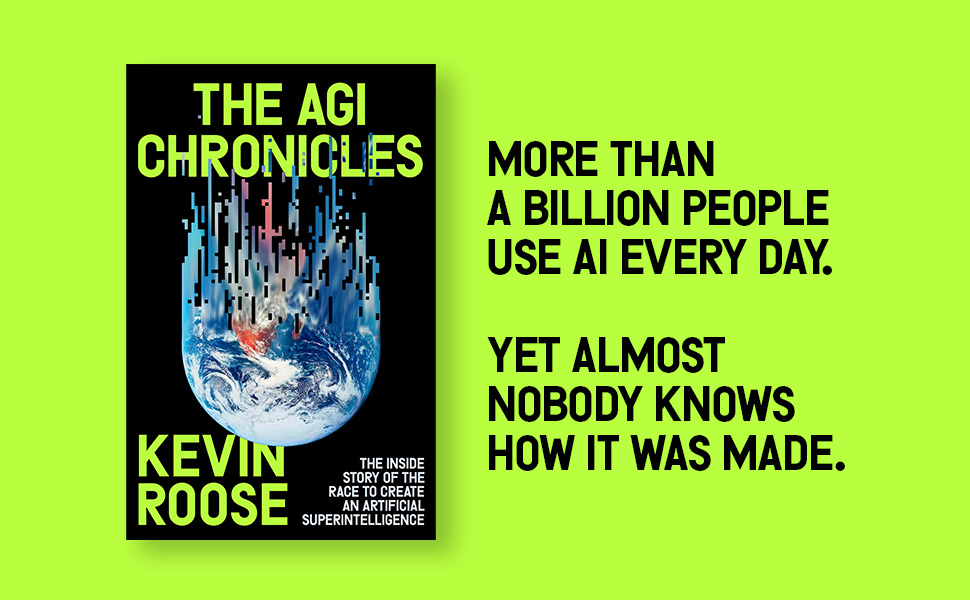
Kevin Roose's The AGI Chronicles is a gripping account of the race to build artificial general intelligence. But beneath the technical breakthroughs and Silicon Valley rivalries lies a more unsettling question: how did decisions that could affect billions of people become concentrated in the hands of so few?
There is something strange about the race to build artificial general intelligence.
Some of the people leading it believe the technology could help cure diseases, accelerate scientific discovery and generate extraordinary prosperity.
Some also believe sufficiently powerful artificial intelligence could become dangerous enough to threaten humanity itself.
And yet the race continues.
That contradiction sits at the heart of Kevin Roose's The AGI Chronicles: The Inside Story of the Race to Create an Artificial Superintelligence.
Roose takes readers inside OpenAI, Anthropic and Google DeepMind, following the researchers, executives and investors who transformed artificial intelligence from an obscure scientific pursuit into perhaps the most consequential technological competition of the century.
The result is one of the clearest accounts yet of how the modern AI boom happened.
But the book is ultimately about something bigger than technology.
It is about power.
A Manhattan Project Without the Manhattan Project
Roose frames the pursuit of AGI as a kind of 21st-century Manhattan Project.
The comparison is deliberately provocative.
The original Manhattan Project was a government-led wartime program involving scientists working under extraordinary secrecy to create the atomic bomb.
The modern AI race has some of the same ingredients: extraordinary scientific talent, secrecy, enormous amounts of money and the possibility of creating technology with profound geopolitical consequences.
But there is a crucial difference.
The organizations at the center of this race are largely private companies.
OpenAI, Anthropic and Google DeepMind are not governments. Their executives are not elected. Their researchers are not negotiating international treaties.
Yet their decisions could influence how people work, how wars are fought, how information spreads and how wealth and technological power are distributed.
Roose's achievement is to make this enormous story feel surprisingly human.
The AI revolution in his telling is not simply the inevitable result of computers becoming more powerful.
It is a story of people.
And people bring ambition, fear, ideology, rivalry and ego with them.
The People Behind the Machines
One of the strengths of The AGI Chronicles is that Roose refuses to treat artificial intelligence as though it appeared from nowhere.
He reconstructs the relationships and disagreements that shaped the industry.
Sam Altman appears.
So does Dario Amodei.
Demis Hassabis and other influential researchers and executives enter the story as the competition intensifies.
Roose revisits the disagreements inside OpenAI that preceded the departure of researchers who would eventually create Anthropic. He also examines Sam Altman's extraordinary firing and reinstatement as OpenAI's CEO and Google's attempt to remain at the technological frontier.
These episodes could easily become corporate gossip.
Roose generally avoids that trap.
The rivalries matter because they reveal something important about technological development: history-changing technologies are still built by human beings with human motivations.
Scientific curiosity matters.
But so do status, loyalty, competition, money and the desire to win.
That makes the AGI race considerably messier than the clean corporate language surrounding artificial intelligence often suggests.
The Most Disturbing Contradiction
The book becomes most compelling when it examines the ideological divisions inside the AI world.
There are people who believe AGI could eventually create extraordinary abundance.
There are researchers obsessed with alignment and the possibility that sufficiently capable AI systems could behave in ways humans cannot control.
There are accelerationists who believe technological progress should move as quickly as possible.
And there are people who simultaneously believe that AGI could be catastrophic and that their organization must be the one to build it.
This produces the central contradiction of the book:
The people closest to advanced AI are not necessarily confident that it will be safe.
Yet uncertainty has not stopped the competition.
In some cases, it intensifies it.
If one laboratory slows down, another may continue.
If one American company stops, another American company may take the lead.
And beyond corporate competition lies the possibility of geopolitical competition.
Once a technology is perceived as strategically decisive, restraint becomes difficult.
Nobody wants to be the person who stopped running while everyone else continued.
This is where The AGI Chronicles stops feeling like a technology history and begins to resemble a book about nuclear deterrence.
Fear itself becomes fuel for the race.
Roose Makes AI Understandable
A book about artificial intelligence can easily disappear into jargon.
Transformers, scaling laws, neural networks, reinforcement learning and model training are difficult subjects to explain without either overwhelming readers or simplifying them until they become meaningless.
Roose generally finds the right balance.
He explains enough of the science for readers to understand why particular breakthroughs mattered without turning the book into a computer-science textbook.
That accessibility is important because the central questions surrounding AI should not belong exclusively to engineers.
If these systems genuinely have the potential their creators claim, understanding them becomes a civic issue.
Workers need to understand them.
Politicians need to understand them.
Teachers need to understand them.
Journalists need to understand them.
And countries that are not building frontier AI systems still need to understand what those systems could mean for their economies and societies.
The book succeeds because a reader does not need to know how to train a neural network to understand the stakes.
The Book's Biggest Blind Spot
There is, however, an important limitation to the story.
The world of The AGI Chronicles is overwhelmingly American and Silicon Valley-centered.
There are understandable reasons for that. Many of the companies driving frontier AI development are concentrated there.
But AGI, if anything approaching it arrives, will not be a San Francisco technology.
Its consequences will be global.
Consider Africa.
Most African countries are not participating meaningfully in the race to build frontier AI models. They do not possess comparable computing infrastructure, semiconductor supply chains or billion-dollar AI laboratories.
Yet African economies could still experience the consequences.
Customer-service work could be automated.
Software development could change.
Education could be transformed.
AI-generated misinformation could enter already fragile political environments.
Governments could purchase foreign AI systems for surveillance, administration or defense.
Entire categories of digital labor on which developing economies hoped to compete could change.
And the systems responsible may have been trained primarily elsewhere, designed according to priorities established elsewhere and governed by institutions elsewhere.
That produces a question the book touches only indirectly:
Who gets a seat at the table when humanity's technological future is being decided?
If AGI is genuinely as consequential as its builders claim, then this cannot remain merely an American technology-policy debate.
When AI Becomes Geopolitics
Another strength of the book is the way the story gradually moves from laboratories into government.
That transition is inevitable.
A system capable of outperforming humans across a broad range of intellectual tasks would have obvious implications for national security.
Intelligence analysis.
Cybersecurity.
Military planning.
Autonomous systems.
Scientific research.
Weapons development.
Economic productivity.
The country—or company—that controls the most capable AI systems could possess enormous strategic advantages.
That means governments cannot treat AGI like another smartphone platform.
Roose shows Washington beginning to grapple with this reality while technology continues advancing faster than political institutions are accustomed to moving.
The problem is that governments face the same dilemma as companies.
Regulate too aggressively and they fear losing the technological race.
Regulate too weakly and they risk allowing companies to develop systems whose consequences nobody fully understands.
The tension has no easy solution.
Roose wisely does not pretend otherwise.
Where Roose Is Most Convincing
Roose is strongest as a reporter rather than a prophet.
He does not need to prove that superintelligence will arrive next year—or even that it will definitely arrive at all—for the book to matter.
The race already exists.
The investment is real.
The companies are real.
The political consequences are already beginning.
And enormous amounts of capital, computing power and human talent are being directed toward making AI systems more capable.
Roose's reporting—built from more than 150 interviews alongside company documents and research material—allows him to reconstruct how that happened.
The personalities make the book readable.
The technology makes it fascinating.
But the uncertainty makes it important.
Where the Book Is Less Convincing
The Manhattan Project analogy is powerful, perhaps too powerful.
Nuclear weapons had a clearly observable destructive capability. AGI remains a disputed concept whose definition can shift depending on who is speaking.
There is a danger in accepting Silicon Valley's own framing too readily.
AI companies benefit enormously when the world believes they are building the most important technology in human history.
It attracts investment.
It attracts talent.
It attracts political attention.
And it makes companies developing software systems appear almost civilizational in importance.
Some of that importance is justified.
But a critical reader should keep asking whether the extraordinary claims surrounding AGI describe technological reality, corporate ambition—or some combination of both.
Roose is aware of the industry's grandiosity, but the book occasionally operates within the same dramatic framework that its subjects use to describe themselves.
A little more skepticism toward the premise of the race itself would have made an already strong book even stronger.
The Question Isn't Whether AI Is Good or Bad
Perhaps the biggest mistake in discussing artificial intelligence is reducing everything to two camps.
Optimists versus pessimists.
Accelerationists versus doomers.
Pro-AI versus anti-AI.
Reality is more complicated.
AI can help scientists discover drugs while eliminating jobs.
It can improve education while making misinformation cheaper.
It can increase productivity while concentrating wealth.
It can empower individuals while strengthening governments and corporations.
Technology does not arrive with a predetermined political outcome.
Institutions determine much of what happens next.
And that may be the most important lesson to take from The AGI Chronicles.
The future of artificial intelligence will not be determined by algorithms alone.
It will be determined by the people and institutions controlling them.
The Verdict
The AGI Chronicles succeeds because Kevin Roose turns what could have been a dry history of machine learning into a story about ambition, rivalry, fear and power.
It is accessible without being simplistic and alarming without becoming an anti-AI manifesto.
Its greatest strength is showing that the AI revolution was not inevitable.
People made choices.
Researchers chose what to build.
Investors chose what to fund.
Companies chose how quickly to move.
Governments chose when to intervene.
Those choices produced the AI landscape we have today.
Its biggest weakness is that the world outside the American AI ecosystem remains too distant from the story. If AGI really represents a transformation comparable to electricity, nuclear technology or the internet, then billions of people who had almost no role in creating it will nevertheless have to live with its consequences.
That is particularly important for Africa and the wider developing world.
The next phase of the AI debate cannot simply ask whether OpenAI, Anthropic or Google will reach AGI first.
It must ask something harder:
Who benefits if they succeed?
Who loses?
Who establishes the rules?
And who gave a handful of companies the authority to make decisions that could affect everyone else?
Roose does not provide definitive answers.
Perhaps nobody can.
But after reading The AGI Chronicles, it becomes difficult to believe those questions can safely be left to Silicon Valley.
The Doctrine Media rating: 4.5/5
Best for: Readers interested in artificial intelligence, geopolitics, technology, corporate power and the future of society.
The Doctrine verdict: Essential reading for understanding the people behind the AI race—but best read with skepticism toward the industry's claim that its race is inevitably humanity's race.