The Elements of Power asks who pays for a cleaner economy
Nicolas Niarchos follows battery materials from extraction to geopolitical competition, challenging the idea that clean technology arrives without a social bill. His account is most revealing when the people and infrastructure behind the energy transition disrupt its great-power narrative.
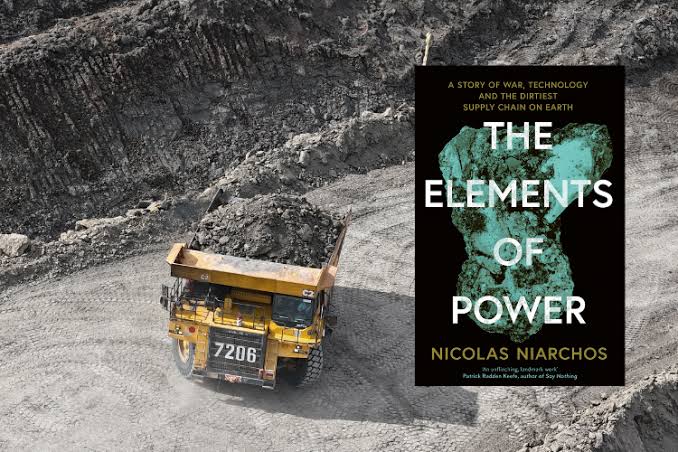
A battery does not abolish extraction. It changes what is extracted, where the work happens and who can profit from it. That distinction drives Nicolas Niarchos’s The Elements of Power, a book whose subject is less the cleanliness of a device than the distribution of the costs behind it.
For readers following the Democratic Republic of Congo, this is a useful reversal of perspective. Instead of starting with foreign governments’ need for secure mineral supplies, Niarchos asks what that demand does to the societies supplying them. The published extracts make clear that his argument concerns the organisation of an industry, not a claim that climate action should stop.
Penguin Press published the American hardcover on 20 January 2026. Its relevance extends beyond a season of technology announcements: batteries connect consumer convenience, industrial strategy and the conditions under which minerals leave producing countries. The book was named a finalist for the Orwell Prize for Political Writing in May, recognition worth distinguishing from a claim that it won.
Power As A Relationship
In the opening extract published by the Orwell Foundation, Niarchos moves from the familiar usefulness of phones and electric vehicles to the international arrangements that make them possible. Materials cross borders between extraction, refining, manufacturing and sale. No single national label adequately describes the finished product.
The passage works because it changes the scale without abandoning the object. A phone becomes an entry point into a political economy. Niarchos describes the resulting power as measurable in “dollars, strategic influence, and volts”: a compact statement of the book’s organising idea, linking physical capability to control over resources and revenue.
There is also a risk in the moral shorthand. Contrasting cleaner consumption with suffering elsewhere can make a complicated industry sound like a single transaction between beneficiaries and victims. The more persuasive question is which arrangements distribute gains and harms, and whether those arrangements can be changed. A catalogue of abuses alone cannot answer that.
A Railway Against The Simple Story
An extract adapted for Rest of World in April supplies a more concrete test. Niarchos examines the Lobito transport corridor linking the Central African mineral belt to Angola’s Atlantic coast. In his telling, Washington’s effort to establish an alternative export route depended on a railway that Chinese companies had previously rebuilt.
That detail does more analytical work than another declaration of American–Chinese rivalry. Infrastructure has a history. A government cannot wipe away existing financing, engineering and commercial relationships simply by giving a project a new strategic purpose. Nor does a different route to the sea necessarily produce a different bargain for people living beside it.
Niarchos also brings the discussion down from official announcements to the roads used to move ore. His account of being involved in a truck collision gives the transport argument a material consequence: routes affect safety and daily life, not merely export capacity. The episode is his reported experience, not a scene independently witnessed for this review.
The extract’s strongest move is to make competing descriptions of development coexist. A railway can offer practical benefits while still serving an extractive economy. Those propositions are not mutually exclusive. Treating them as such is how both official publicity and blanket denunciation become inadequate.
What The Reporting Can, And Cannot, Settle
Other reviewers have identified the value of this human focus. Writing in Foreign Affairs in February, Zachariah Mampilly praised the way Niarchos connects technological and geopolitical developments to individuals across the chain. That is Mampilly’s assessment, but it describes a quality visible in the published material: power becomes more legible when traced through actual decisions and encounters.
The harder issue is remedy. In Physics World in April, James Dacey welcomed the investigation while finding its institutional cast difficult to follow at times and its discussion of alternatives short of a fully scalable solution. That criticism matters because exposing a chain’s failures is not the same task as designing a better one.
It would nevertheless be unfair to demand that a reporter solve every problem an industry has failed to resolve. The appropriate test is whether scrutiny reaches the mechanisms that reproduce the harm. For readers concerned with Congo, that means keeping contracts, transport, public revenue and workers’ bargaining power in view, rather than treating the country as scenery for foreign competition.
This is where the available extracts make their clearest contribution. Changing the nationality of a buyer is not, by itself, evidence that a producing community has secured a better outcome. A cleaner product and a fairer production system require separate scrutiny. Niarchos’s account gives readers a way to insist on both.
Edition: The Elements of Power: A Story of War, Technology, and the Dirtiest Supply Chain on Earth, Nicolas Niarchos. Penguin Press, hardcover, 480 pages; published 20 January 2026; publisher-listed US price $32; ISBN 9780593492017.
Reading scope: This review draws on the Orwell Foundation extract and the book adaptation published by Rest of World, alongside publisher information and the attributed reviews above. It is not an assessment based on access to the complete book.