America's Minimum Wage Is Still $7.25. Tax Cuts Won't Fix That.
As living costs rise, Washington faces a critical choice: cut taxes or raise the minimum wage. While tax deductions offer relief to some households, America's $7.25 federal wage floor has remained unchanged since 2009. Can tax cuts solve a deeper problem of stagnant wages and declining purchasing power?
The problem Washington has avoided for 17 years
The United States has a problem hiding in plain sight. Its federal minimum wage remains $7.25 an hour, a figure that has not changed since July 2009. In the 17 years since Congress last increased it, the cost of housing, healthcare, transportation and everyday necessities has changed dramatically. Yet the minimum hourly wage established by federal law has remained the same.
The consequences are increasingly difficult to ignore. A full-time worker earning the federal minimum wage makes approximately $15,080 annually before taxes, assuming a 40-hour working week throughout the year. That is a gross income that leaves little room for financial security, particularly in areas where housing and transportation costs consume a substantial portion of household earnings.
The minimum wage was never intended to guarantee prosperity. Its purpose, however, was to establish a basic legal protection against excessively low compensation. When that protection remains unchanged while the broader economy evolves, its purchasing power steadily deteriorates.
An analysis published by the Economic Policy Institute in May 2026 estimates that the federal minimum wage has lost approximately 30% of its purchasing power during its 17-year freeze. Adjusted for inflation, the $7.25 minimum would need to be approximately $10.60 today merely to recover the purchasing power it had when Congress last raised it.
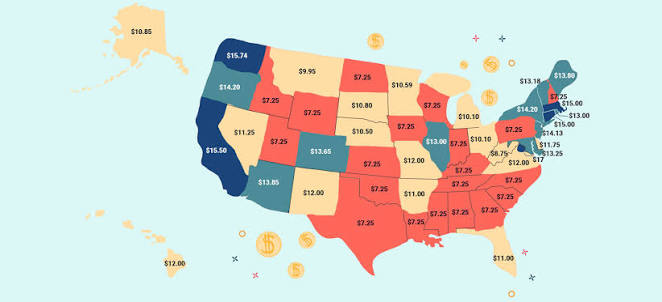
The issue is not that every American worker earns $7.25. Many states and cities have established substantially higher wage floors. The problem is that federal protection remains inadequate in places that have not independently increased their minimum wages.
According to the Department of Labor's July 2026 figures, 30 states and the District of Columbia have minimum wages above the federal rate. Meanwhile, several states continue to rely on the federal standard.
This has created a fragmented labor market in which a worker's legal wage protection depends significantly on where that person lives.
Why tax cuts have become an attractive alternative
The argument for reducing taxes is straightforward: workers should keep more of the money they earn.
For households struggling with inflation and the cost of living, additional take-home income can make an immediate difference. Unlike a minimum-wage increase, tax relief does not require employers to increase hourly compensation, making it politically attractive to businesses concerned about labor costs.
The United States has already moved in this direction.
The Working Families Tax Cuts legislation introduced several new deductions affecting workers, including provisions commonly described as no tax on tips and no tax on overtime. For the 2025–2028 tax years, qualifying tipped workers can deduct up to $25,000 in eligible tips, while qualifying workers can deduct up to $12,500 in overtime compensation, or $25,000 for joint filers.
These provisions come with eligibility requirements and income-based phaseouts. Importantly, the overtime deduction applies to the qualifying premium portion of overtime compensation, not the entire overtime payment.
The legislation also increased the standard deduction for the 2026 tax year to $16,100 for single filers and $32,200 for married couples filing jointly.
These changes can improve the financial position of eligible households. But they do not address the underlying question of whether employers are paying workers enough in the first place.
There is also a fundamental distinction between a tax deduction and additional wages.
A deduction reduces the amount of income subject to taxation. Its financial value depends on a person's taxable income and marginal tax rate. A worker who receives a $5,000 deduction does not receive $5,000 in additional money. Someone in a 12% marginal tax bracket, for example, would generally save $600 in federal income tax if the entire deduction reduces income taxed at that rate.
More importantly, workers with very low earnings may already owe little federal income tax. Additional deductions therefore offer them limited assistance.
Tax relief can help people retain more of their earnings, but it cannot guarantee that those earnings are adequate.
The minimum wage debate is about more than $7.25
One of the strongest arguments for reform is that the current federal wage floor no longer reflects the economic realities of the country.
The Economic Policy Institute's May 2026 research presents a more ambitious alternative: establishing a federal minimum wage equivalent to two-thirds of the national median hourly wage.
Under its projections, this approach would raise wages for approximately 39.6 million workers by 2030, representing about one-quarter of the wage-earning workforce.
The estimate is significant because the minimum-wage debate is often framed around the relatively small number of people earning exactly $7.25. That misses the much larger population earning more than the federal minimum but still below a proposed higher wage floor.
A higher federal minimum would affect workers beyond those currently earning the lowest legal wage. It could also influence pay scales for employees earning slightly more, as employers adjust compensation to maintain differences between entry-level and more experienced positions.
The distribution of potential benefits is equally important. EPI estimates that women would be more likely than men to benefit from the proposed increase, reflecting their greater representation in lower-paid occupations. Black workers would also experience substantial gains.
This makes minimum-wage reform a question of economic opportunity as well as household income.
However, the proposed two-thirds-of-median benchmark is an analytical policy recommendation, not an enacted federal wage standard. Its estimated effects depend on projected wage growth, employment and the assumptions used in the research.
The economic cost of raising wages cannot be ignored
There is a legitimate argument against imposing a substantial minimum-wage increase too quickly.
Businesses employ workers based on the relationship between labor costs, productivity, demand and profitability. If governments substantially increase the cost of employment without allowing businesses time to adjust, some employers may respond by reducing hiring, cutting working hours, increasing prices or accelerating automation.
The Congressional Budget Office has examined these trade-offs in its minimum-wage research.
Its 2019 analysis of a proposal to increase the federal minimum wage to $15 by 2025 estimated that approximately 17 million workers would directly receive higher earnings, with another 10 million potentially benefiting indirectly.
However, the CBO also estimated that the policy could reduce employment by a median of approximately 1.3 million workers in an average week in 2025. It projected that higher wages would lift some families out of poverty, while some of those benefits would be offset by employment losses, reduced business income and higher prices.
These are historical projections from a specific legislative scenario, not a measurement of what would happen under a new 2026 proposal.
The CBO's subsequent analysis of the Raise the Wage Act of 2023 examined a gradual increase to $17 by July 2029, followed by adjustments linked to median hourly wage growth. Its research emphasizes that employment effects depend on the size and speed of increases, as well as how responsive businesses are to higher labor costs.
Other research has found smaller employment effects from some minimum-wage increases. The disagreement reflects differences in local labor markets, business conditions, research methods and the size of the increases being examined.
This is why a national increase should not be treated as a simple legislative adjustment. It requires careful consideration of regional differences, small-business capacity and the possibility of unintended consequences.
The missing alternative: Give workers refundable tax credits
The choice between increasing wages and reducing taxes is also incomplete because the tax system offers another instrument: refundable tax credits.
The Earned Income Tax Credit, or EITC, is designed to support low- and moderate-income working households. Unlike an ordinary deduction, a refundable credit can provide a payment even when the recipient's federal income-tax liability is zero.
For the 2026 tax year, the maximum EITC is $664 for qualifying workers without children, $4,427 for those with one qualifying child, $7,316 for those with two, and $8,231 for those with three or more.
The actual credit depends on income, filing status and other eligibility requirements.
This distinction matters because a refundable credit can reach workers who receive little benefit from additional deductions.
It also allows the government to target support toward households with children and people earning relatively low incomes, without requiring employers to finance the entire increase through higher payroll costs.
Nevertheless, the EITC has limitations. It does not establish a minimum hourly wage, and its benefits are generally received through the annual tax-filing process rather than being reflected immediately in every paycheck.
Expanding refundable credits would therefore complement wage reform rather than replace it.
What America should implement
A more sustainable approach would combine a gradual federal minimum-wage increase with targeted tax relief.
First, Congress should establish a realistic path toward a $15 federal minimum wage, allowing businesses several years to adjust. The amount and timetable should be evaluated against wage growth, regional economic conditions and the effects on employment.
Second, the federal minimum wage should be indexed to inflation or an appropriate wage-growth benchmark once it reaches the new target. This would prevent Congress from repeating the mistake of allowing another decade or more to pass without an adjustment.
Third, lawmakers should strengthen refundable tax credits, particularly for low-income workers without children, whose maximum EITC benefits remain substantially smaller than those available to families with children.
Finally, small businesses should receive carefully targeted transitional support where evidence shows that a rapid wage adjustment would create significant financial pressure. Such assistance should be temporary and designed to facilitate higher wages rather than permanently subsidize low-paying employment.
This approach recognizes that workers need both adequate compensation and protection from excessive living costs, while employers need a predictable environment in which to operate.
The real question is what kind of economy America wants
America's minimum-wage debate exposes a broader disagreement about the responsibilities of government, employers and the tax system.
One approach emphasizes reducing the amount government takes from workers. Another argues that employers should be legally required to provide a higher baseline of compensation. Both approaches can improve household finances, but they address different parts of the problem.
Tax deductions can help workers retain more of their earnings. Refundable credits can provide additional support to households with limited tax liabilities. Neither, however, guarantees that an employer pays an adequate hourly wage.
A minimum-wage increase, on the other hand, establishes a legal compensation floor but carries potential costs for businesses, employment and consumers that policymakers must take seriously.
The United States does not have to choose between higher wages and targeted tax relief. But if Congress must prioritize one structural reform, the case for updating the federal minimum wage is stronger.
A tax deduction can reduce a worker's tax bill. It cannot turn an inadequate hourly wage into an adequate one.
After 17 years without a federal increase, the more important question is no longer whether $7.25 is outdated. It is why the world's largest economy has allowed its basic wage protection to fall so far behind the economy it is supposed to serve.
FAA ground stop: the air traffic network that failed is one the FAA said in August could no longer cope
 Essay