Trump Reportedly Blocked Netanyahu's Plan for a New War With Iran
Israeli Prime Minister Benjamin Netanyahu reportedly prepared for a major new bombing campaign against Iran in October, only for Donald Trump to oppose restarting large-scale combat weeks before the U.S. midterm elections. Conflicting Israeli reporting, however, raises questions about how advanced the operation really was.
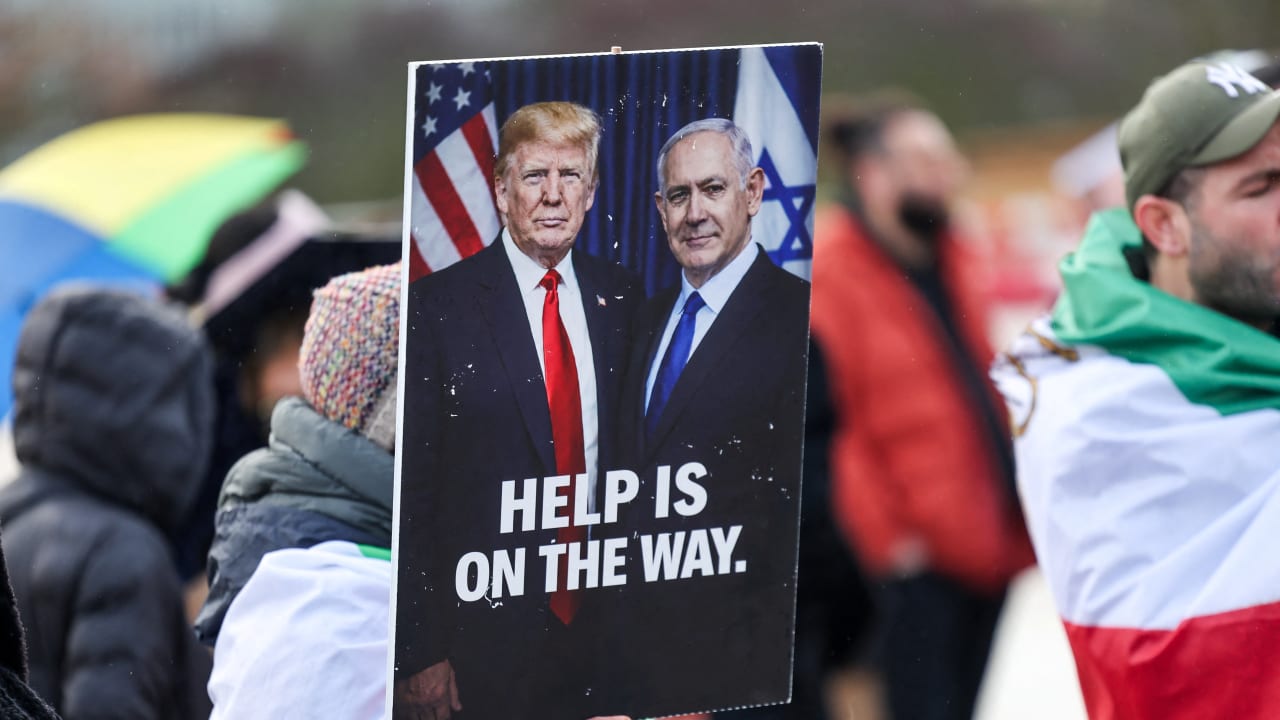
The Middle East may have come considerably closer to another major escalation with Iran this month than was publicly understood.
Israeli Prime Minister Benjamin Netanyahu instructed preparations for a multi-day offensive against Iran that could have begun around the weekend of October 10, according to a Financial Times report citing three people familiar with the matter.
The reported target list went far beyond a limited military raid.
Iranian nuclear facilities were among the potential targets, but so were energy installations and other civilian infrastructure, alongside targets associated with Iran's government and military establishment.
The operation was ultimately shelved after U.S. President Donald Trump opposed reopening major hostilities before America's November 3 midterm elections, according to the report.
If accurate, the episode reveals something more consequential than a disagreement over the timing of another Israeli strike. It suggests that Washington and Jerusalem are already confronting the question of whether their confrontation with Iran has actually ended—or merely entered an intermission.
The October 10 Plan
According to the Financial Times, Israeli military preparations envisioned several days of attacks.
The proposed operation would reportedly have struck nuclear facilities, power plants and other infrastructure, as well as targets connected to the Iranian regime.
The scale matters.
An attack on a nuclear installation can be framed as an operation intended to degrade a specific military capability. Simultaneously attacking nuclear facilities, energy infrastructure and government targets would carry much broader implications.
It could potentially provoke another major Iranian retaliation and restart a cycle of strikes and counterstrikes across the region.
But there is an important dispute over exactly how far the plan progressed.
On October 21, The Jerusalem Post reported, citing its own sources, that the Israel Defense Forces had not actually been planning to attack Iran on October 10, contradicting the Financial Times account.
That distinction is important. Governments routinely develop military options and prepare target packages that are never approved for execution. There is therefore a substantial difference between Netanyahu discussing or requesting preparations for an operation and the IDF having a finalized attack scheduled for a particular date.
What is much better established is that renewed military action against Iran was being seriously discussed.
Axios reported on October 13 that Netanyahu and Trump had discussed the possibility of another major operation against Iran, potentially involving both countries. According to its sources, Netanyahu raised Israeli intelligence concerns that Iran was attempting to rebuild elements of its nuclear program.
The Pentagon had also instructed U.S. Central Command to complete preparations for the possibility of renewed major combat operations.
The question was increasingly becoming not whether the military could strike, but whether the political leadership wanted it to.
Trump Draws a Line Before the Midterms
Trump publicly supplied part of the answer on October 8.
The president said the United States would not attack Iran before the November 3 midterm elections.
That announcement came as military preparations were continuing and speculation about another confrontation was intensifying.
The political calculation is difficult to separate from the military one.
Another major conflict with Iran could have consequences far beyond Tehran and Tel Aviv. Iranian retaliation could threaten American forces and regional allies. Fighting around the Persian Gulf could affect shipping through the Strait of Hormuz. Even the possibility of serious disruption to oil supplies could push energy prices higher.
That would be particularly dangerous for an American administration immediately before an election in which affordability and the cost of living are already major issues.
Reuters reports that Republicans enter the November elections defending narrow congressional majorities while economic concerns remain central to voters.
Restarting a Middle Eastern war weeks before those voters go to the polls would therefore represent an enormous political gamble.
Trump's opposition should not, however, be confused with a fundamental rejection of further military action.
His stated red line has largely concerned timing.
Netanyahu's Clock Is Different
Netanyahu faces his own election on October 27.
And Israel's strategic calculation is not necessarily synchronized with Washington's political calendar.
Israeli officials have expressed concern about Iran rebuilding capabilities damaged during previous fighting. Axios reported that Netanyahu specifically raised concerns about what Israel believes are attempts to reconstitute parts of Iran's nuclear program.
From an Israeli perspective, waiting carries its own risks.
If Iranian nuclear and military infrastructure is being rebuilt, every additional month could make another operation more difficult. Facilities can be repaired, equipment dispersed, air defenses reorganized and vulnerable assets moved underground.
But attacking creates an entirely different set of risks.
Iran could respond with missiles and drones against Israel. American installations across the Middle East could become targets. Maritime traffic could come under additional pressure. Iranian-aligned armed groups could escalate elsewhere.
And an operation launched immediately before an Israeli election would inevitably raise domestic political questions.
Netanyahu publicly rejected the suggestion on October 14 that he was seeking a pre-emptive attack before the Israeli vote.
That denial now sits alongside reports suggesting that extensive discussions and preparations had nevertheless been taking place.
This Would Not Have Been Just Another Nuclear Strike
Perhaps the most consequential element of the reported plan is the breadth of its targets.
Nuclear installations are one thing.
Power plants and civilian infrastructure are another.
A sustained campaign against energy infrastructure could impose costs far beyond Iran's military and nuclear establishment. Electricity generation is connected to industry, communications, transportation, water systems and ordinary civilian life.
Targeting senior government or military figures would further expand the objectives.
At that point, the strategic question becomes considerably larger:
Is the objective to delay Iran's nuclear program?
To degrade Iran's military capabilities?
To impose economic costs?
To weaken the state itself?
Or to create conditions under which Iran's political system becomes increasingly vulnerable?
Those are fundamentally different objectives, and they carry fundamentally different risks.
A campaign attempting several simultaneously could become difficult to contain.
Washington and Israel Want the Same Thing—but Not Necessarily at the Same Time
The episode illustrates an important feature of the Trump-Netanyahu relationship.
Washington and Jerusalem can share a strategic adversary without sharing the same timetable.
Both governments have repeatedly insisted that Iran cannot be allowed to acquire a nuclear weapon. Both have demonstrated a willingness to use military force.
But the political costs are different.
For Netanyahu, delaying action could allow Iran additional time to rebuild.
For Trump, acting immediately before November 3 could transform the U.S. midterms into a referendum not only on his domestic record but on another major Middle Eastern confrontation.
Trump's reported intervention therefore appears less like a fundamental strategic split with Netanyahu than a disagreement over when the next escalation should occur.
That is arguably more concerning for Tehran.
A cancelled October operation does not necessarily mean the military option has disappeared.
It may simply have been postponed.
The Military Machinery Has Not Stopped
Recent developments reinforce that possibility.
U.S. Defense Secretary Pete Hegseth made an unannounced visit to Israel on October 19 and met Netanyahu at Uvda Air Force Base. Israeli officials told Reuters that Iran and joint offensive and defensive planning were among the issues discussed.
Axios had already reported that American and Israeli forces remained at heightened readiness while political leaders debated their next move.
That creates an unusual situation.
The immediate political incentive may favor restraint, while the military infrastructure required for escalation remains in place.
November therefore matters.
Israel votes on October 27.
The United States votes on November 3.
Once those elections are over, one of the strongest political arguments for postponing military action disappears.
That does not mean another attack is inevitable. Diplomacy, deterrence and the risks of Iranian retaliation remain powerful constraints.
But it changes the calculation.
Iran Is Watching the Calendar Too
Tehran is almost certainly aware of that dynamic.
If Iranian leaders conclude that Washington's restraint is primarily electoral rather than strategic, they have little reason to interpret October's events as evidence that the threat has passed.
Instead, the coming weeks become a window.
Iran must decide how aggressively to rebuild damaged capabilities, how much to reveal, what military assets to disperse and whether negotiations can produce something more durable before the political calendars in Washington and Jerusalem change.
The danger is that all three governments can arrive at rational decisions individually that collectively produce escalation.
Israel can conclude that waiting strengthens Iran.
Iran can conclude that preparing for another attack is necessary for survival.
Washington can conclude that military action becomes politically easier after November 3.
Each calculation makes sense from the perspective of the government making it.
Together, they can create the conditions for another war.
What We Know—and What We Don't
The October 10 story needs to be treated carefully.
There is credible reporting that Netanyahu pushed for renewed action against Iran and that substantial military preparations were underway. There is also credible evidence that Trump publicly opposed U.S. military action before the midterms.
But the specific claim that Israel had a finalized multi-day operation ready to begin on the weekend of October 10 rests principally on anonymous-source reporting and is now disputed by other Israeli sources.
That uncertainty should not obscure the larger development.
The United States and Israel are actively considering what comes next with Iran.
Military preparations have continued. Netanyahu remains deeply concerned about Iran's nuclear capabilities. Trump has ruled out—or at least attempted to rule out—another attack before the midterms rather than indefinitely.
The most important date, therefore, may not have been October 10.
It may be November 4.
Because if electoral politics was one of the principal barriers preventing another major confrontation, the question after the votes are counted will be whether that barrier was merely temporary.