The Middle East Is Being Redrawn — And the New Battle Lines Reach Deep Into Africa
The Middle East is no longer divided along familiar lines. New partnerships linking Türkiye, Saudi Arabia and Pakistan are emerging alongside Iran’s battered but enduring network and a deepening Israel–UAE relationship. As these rival alignments stretch across the Red Sea into the Horn of Africa, a new regional order may be taking shape—one in which Africa is no longer on the sidelines.
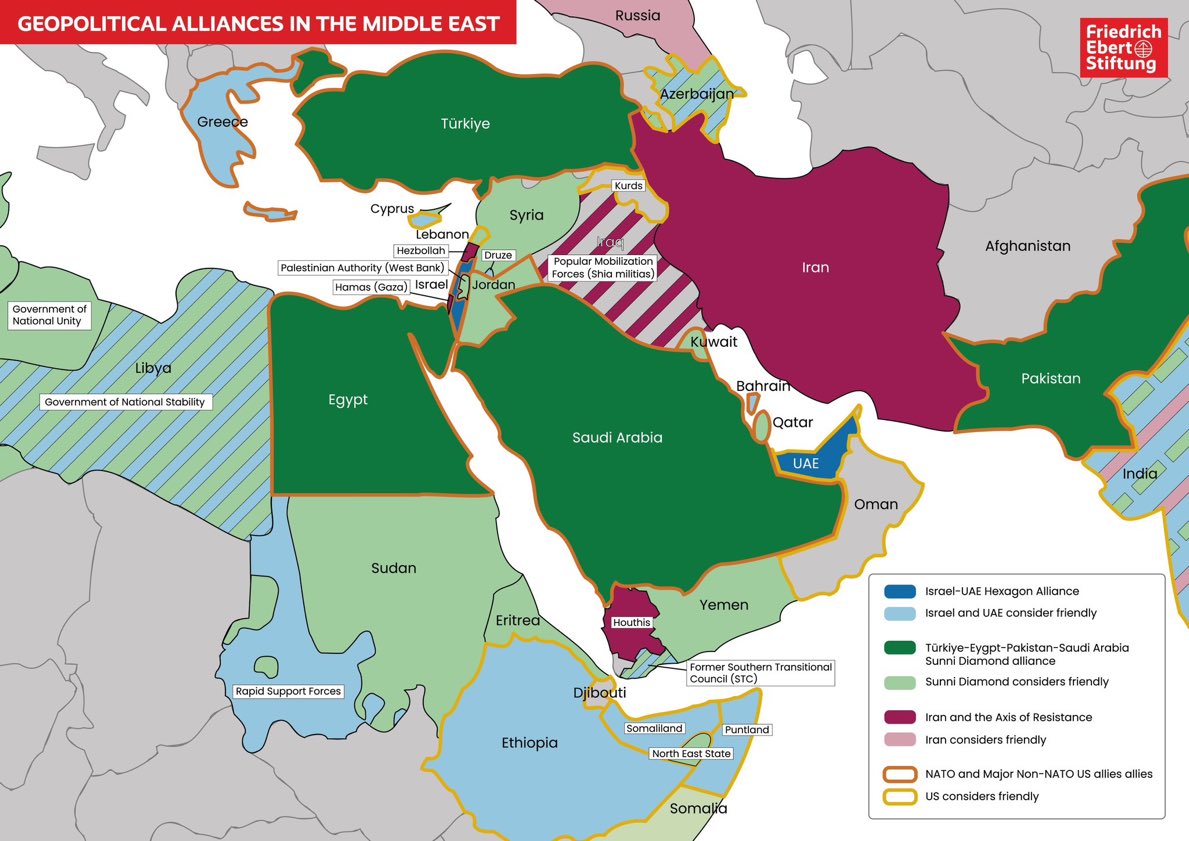
From Türkiye and Saudi Arabia to Iran, Israel, and the Horn of Africa, an emerging network of rival partnerships is transforming the geopolitics of the Red Sea and the Middle East.
In politics, as in cartography, there is a seduction to clean lines and solid colors. When the German think tank Friedrich-Ebert-Stiftung (FES) published its widely circulated map, Geopolitical Alliances in the Middle East, in May 2026, it offered a strikingly neat visual thesis for a region in upheaval: the post-American Middle East was hardening into three competing, color-coded blocs.
In deep crimson sat Iran and its battered but defiant "Axis of Resistance". In dark green stretched a vast territorial arch—dubbed the "Sunni Diamond"—uniting Türkiye, Egypt, Saudi Arabia, and a nuclear-armed Pakistan. In royal and sky blue stood the "Israel-UAE Hexagon Alliance," an unorthodox maritime and technological coalition linking Tel Aviv and Abu Dhabi to Greece, Cyprus, India, and deep into the Horn of Africa through Ethiopia and Somaliland.
The map went viral among diplomats and strategists because it captured an undeniable truth: the old regional order is dead. Between the October 2023 Gaza war, the collapse of Bashar al-Assad’s regime in Syria in December 2024, the Saudi-Pakistani mutual defense treaty of September 2025, Israel’s stunning recognition of Somaliland in December 2025, and the outbreak of the direct US-Israel war with Iran in February 2026, the tectonic plates of West Asia and Northeast Africa have violently shifted.
Yet if one treats the FES map as a starting hypothesis rather than gospel, its tidy geometry quickly dissolves upon contact with reality. By October 2026, the Middle East is not reorganizing into three disciplined, Cold War–style blocs. Instead, it is fracturing into a fluid, multipolar system of overlapping—and often contradictory—alignments. More importantly, the primary theater of this competition has spilled out of the Persian Gulf and the Levant. From Port Sudan and Asmara to Addis Ababa and Berbera, the Red Sea has ceased to be a boundary between two continents; it has become the central highway of a single, interlocked Middle Eastern–African security system.
1. The Myth and Reality of the "Sunni Diamond"
The map’s boldest assertion is the existence of a "Türkiye–Egypt–Pakistan–Saudi Arabia Sunni Diamond alliance" (colored dark green), radiating influence across a light-green periphery covering Syria, Jordan, Yemen, Sudan, Eritrea, and Somalia.
To understand why cartographers drew this shape, one must look at the shockwaves of 2025. Following Israeli strikes that spilled into Gulf airspace and heightened anxieties over the reliability of the American security umbrella, Riyadh made a historic pivot. On September 17, 2025, Saudi Arabia and Pakistan signed the Strategic Mutual Defense Agreement (SMDA), a pact declaring that aggression against either nation would be treated as aggression against both. For the first time, Riyadh formalized an implicit Pakistani nuclear and conventional deterrence guarantee. Simultaneously, Saudi Arabia deepened defense-industrial ties with Ankara, while Cairo and Ankara buried a decade of bitter ideological rivalry over the Muslim Brotherhood to coordinate on stabilizing post-Assad Syria, supporting the Sudanese Armed Forces (SAF), and defending Somalia’s territorial integrity.
Why the "Bloc" Label Oversimplifies Reality:
Calling this quadrumvirate an "alliance"—let alone a sectarian "Sunni Diamond"—conflates bilateral hedging with collective security.
No Multilateral Treaty Exists: The SMDA is strictly a bilateral Saudi-Pakistani pact. While negotiations were floated in late 2025 and early 2026 to expand this framework toward Ankara and Cairo, Egypt explicitly declined to enter a binding military bloc, wary of being dragged into Gulf-Iranian or South Asian conflicts.
Divergent Core Priorities: For Riyadh, the alignment is about insulating Vision 2030 and deterring both Tehran and unilateral Israeli military adventurism. For Cairo, which remains dependent on US military aid and Gulf bailouts, the priority is existential water security (vis-à-vis Ethiopia) and preventing state collapse on its Sudanese and Libyan borders. For Ankara, the goal is expanding its defense export market, neutralizing Kurdish autonomy in northern Syria and Iraq, and projecting neo-Ottoman diplomatic clout.
The Pakistan Fallacy: Portraying Pakistan as a pillar of a Middle Eastern bloc misreads Islamabad's strategic calculus. Pakistan’s existential preoccupation remains India. Islamabad signed the SMDA with Riyadh to secure vital financial lifelines and energy deferrals, and in April 2026, Pakistan leveraged its unique relationship with both Washington and Tehran to host the Islamabad ceasefire talks between US Vice President JD Vance and Iranian Parliament Speaker Mohammad Bagher Ghalibaf. Pakistan is acting as a transactional security provider and diplomatic bridge, not a sectarian crusader against Iran—a country with which it shares a volatile 900-kilometer border.
2. The "Hexagon Alliance" and the Saudi–Emirati Schism
Equally provocative is the map’s depiction of the "Israel–UAE Hexagon Alliance". The label originates from a strategic doctrine unveiled by Israeli Prime Minister Benjamin Netanyahu in early February 2026. Seeking to break Israel's wartime diplomatic isolation and counter both what he termed the "radical Shia axis" and an "emerging Sunni axis," Netanyahu proposed a hexagonal geometry of cooperation linking Israel, the UAE, India, Greece, Cyprus, and partners in the Horn of Africa (specifically Ethiopia and Somaliland).
The foundation of this grouping is real, built on the 2020 Abraham Accords, the EastMed energy forum, the India-Middle East-Europe Economic Corridor (IMEC), and joint counter-drone and intelligence networks. However, the map’s rendering of this network as a unified geopolitical camp obscures deep structural fractures:
The Limits of the Israel–UAE Partnership: Abu Dhabi views its relationship with Tel Aviv through a cold, unsentimental lens of regime survival, counter-Islamism, advanced technology, and defense procurement. Yet the prolonged devastation in Gaza and the February 2026 US-Israeli war on Iran—which exposed Gulf states hosting US bases to retaliatory Iranian missile fire—have tested the domestic and regional limits of Emirati normalization. While voices close to Abu Dhabi's establishment have openly criticized Iran, the UAE leadership has refused to become a staging ground for offensive Israeli strikes.
The India and Greece Caveat: Noticeably, the map shades India in triple stripes (blue, light green, and pink)—one of its most accurate nuances. New Delhi buys Israeli weapons and Emirati oil, and frets over the Saudi-Pakistani SMDA. Yet India also relies on Iranian connectivity (such as Chabahar port) and Russian military hardware, and fiercely guards its strategic autonomy. India will never subordinate its foreign policy to an Israeli-led security bloc. Similarly, Greece and Cyprus cooperate with Israel to counterbalance Türkiye in the Eastern Mediterranean, not to fight Israel's wars in the Gulf or Africa.
Why Riyadh and Abu Dhabi Parted Ways: Perhaps the most consequential dynamic captured by the map is the placement of Saudi Arabia and the UAE in rival camps. Once joined at the hip in the post-2011 counter-revolutionary surge, the two Gulf heavyweights now pursue fundamentally incompatible regional blueprints. Saudi Arabia, a continental landmass with a large population, favors centralized nation-states, sovereign borders, and regional de-escalation to protect its domestic economic transformation. The UAE, a nimble maritime federation, operates as a networked "spartan commercial empire"—investing in ports, logistics corridors, and agile non-state or secessionist proxies.
Nowhere has this divergence been clearer than in Yemen, Sudan, and the Horn of Africa. In Yemen, tensions between Saudi-backed Presidential Leadership Council forces and the UAE-backed Southern Transitional Council (STC) boiled over until Riyadh moved decisively in late 2025 and early 2026 to dismantle the STC's autonomous security apparatus in Aden, prompting an Emirati military withdrawal in January 2026—a shift the map notes by labeling the area "Former Southern Transitional Council (STC)". In Sudan, Riyadh backs the state military (SAF) in Port Sudan, while Abu Dhabi has funneled support to the paramilitary Rapid Support Forces (RSF).
3. Iran and the Battered "Axis of Resistance"
For two decades, Iran’s "forward defense" doctrine relied on asymmetric proxies to project power to the Mediterranean and the Red Sea while keeping war away from Iranian soil. By October 2026, that doctrine lies in ruins, even if the network itself remains lethal.
The Decapitation of the Levant Corridor: The devastating Israeli campaigns against Hamas in Gaza and Hezbollah in Lebanon in 2023–2024 severely degraded Tehran's premier deterrents. Then came December 8, 2024: an offensive spearheaded by Hay'at Tahrir al-Sham (HTS) toppled Bashar al-Assad in Damascus. Overnight, Iran lost its land bridge to Lebanon, and Damascus flipped from an Iranian satellite into a Turkish- and Saudi-aligned Sunni state (accurately colored light green on the map).
The 2026 Iran War: Deprived of its forward shield, Iran itself became the battlefield. On February 28, 2026, the United States and Israel launched a massive air campaign targeting Iranian nuclear facilities and command infrastructure. Although an uneasy, open-ended ceasefire brokered via Pakistan and nudged by China took hold in April 2026—accompanied by a US naval blockade of Iranian-linked shipping in the Strait of Hormuz—the Iranian state is heavily damaged and inward-looking.
The Houthi Inversion: Ironically, the least sophisticated member of the Axis has become its most autonomous and disruptive force. Yemen’s Houthis (Ansar Allah) survived years of Saudi bombing and American-British airstrikes to establish a stranglehold over the Bab el-Mandeb strait. By August 2026, Houthi threats to Saudi oil tankers forced Riyadh to cobble together a 14-state maritime coalition. No longer a mere Iranian pawn, the Houthi movement now operates as an independent regional extortionist and ideological magnet, trading maritime disruption for Russian and Iranian military technology.
Iraq’s Dual Reality: The map shrewdly shades Iraq in alternating stripes of Iranian crimson and Sunni-Diamond green. While the Popular Mobilization Forces (PMF) remain deeply embedded in the Iraqi state and loyal to Tehran’s security calculus, Baghdad’s political leadership is desperately trying to avoid being pulverized in the US-Iran crossfire, courting Saudi investment and Turkish trade corridors (the "Development Road" project) to anchor Iraq in the Arab fold.
4. The Hedgers: Why the Map's Gray Zones Matter
A binary or tripolar map inevitably struggles with the middle powers whose entire statecraft rests on refusing to choose sides:
Qatar (Colored Gray): Doha is a Major Non-NATO US Ally (outlined in orange) hosting CENTCOM’s forward headquarters at Al Udeid, yet it maintains functional ties with Tehran (sharing the world's largest gas field), ideological affinities with Ankara, and restored diplomatic warmth with Riyadh. Coloring Qatar gray is an admission that its mediation-first foreign policy defies bloc politics.
Oman (Colored Gray) and Kuwait (Colored Gray): Muscat remains the Gulf's indispensable backchannel to Tehran and Sanaa, while Kuwait stays fiercely neutral to preserve internal sectarian harmony and sovereignty between its larger neighbors.
Jordan (Colored Light Green): Placing Amman in the "Sunni Diamond friendly" camp captures its alignment with Riyadh and Cairo, yet Jordan remains structurally dependent on US security guarantees and Israeli water and gas supplies, even as Israeli actions in the West Bank pose an existential demographic and political threat to the Hashemite monarchy.
Türkiye’s Contradictions: While the map anchors Türkiye as the northern pole of the Sunni Diamond, Ankara’s regional posture is far too ambitious to be contained within a Saudi-led status quo. President Erdoğan’s government has broken off trade with Israel and backed Damascus’s new rulers, aligning with Riyadh. Yet in the Horn of Africa, Ankara plays a complex double game: maintaining its largest overseas military base in Mogadishu (TURKSOM) and signing maritime defense pacts with Somalia, while simultaneously selling Bayraktar drones to Ethiopia and mediating the December 2024 Ankara Declaration between Addis Ababa and Mogadishu.
5. The Horn of Africa: The New Center of Gravity
The most revealing portion of the FES map is its bottom third. For decades, diplomats in Washington and European capitals treated the Middle East and Sub-Saharan Africa as separate bureaucratic silos, divided by the Red Sea. The map demolishes that artificial barrier, illustrating how Middle Eastern rivalries have fused with African fault lines into a single conflict ecosystem.
Why the Horn and the Middle East Have Fused
Three structural forces have bound the Horn of Africa to the Middle East by late 2026:
The Choke-Point Imperative: With the Houthis weaponizing the Bab el-Mandeb and the US blockading Iranian shipping in the Strait of Hormuz, littoral real estate along the Red Sea and the Gulf of Aden has become priceless strategic currency. Ports are no longer mere commercial terminals; they are military insurance policies.
Ethiopia’s Quest for the Sea and the Somaliland Shock: Landlocked since Eritrea’s independence in 1993, Ethiopian Prime Minister Abiy Ahmed made securing sovereign access to the Red Sea an existential national doctrine. After his January 2024 Memorandum of Understanding with Somaliland triggered a furious backlash from Mogadishu, Cairo, and Asmara—allowing Egypt to deploy troops and weaponry to Somalia—Türkiye stepped in to broker a tactical truce between Addis Ababa and Mogadishu in late 2024.
However, the chessboard was upended on December 26, 2025, when Israel became the first UN member state to formally recognize the Republic of Somaliland as an independent nation. For Tel Aviv, recognizing Hargeisa secured a strategic perch directly across from Houthi-controlled Yemen, alongside its Emirati partners who operate the port of Berbera. This move fractured Northern Somalia further: as depicted with remarkable granularity on the FES map, unionist Dhulbahante territories around Las Anod broke away from Hargeisa's claim and were formally constituted in July 2025 as Somalia's North East State (colored light green on the map, wedged between Somaliland and Puntland).
The 2026 Ethiopia–Eritrea Brinkmanship: By classifying Ethiopia in sky blue ("Israel and UAE consider friendly") and Eritrea in light green ("Sunni Diamond considers friendly"), the map captures the combustible polarization of the Horn as of October 2026. The UAE has been Prime Minister Abiy Ahmed’s lifeline, supplying weaponry and financial liquidity, while Israeli President Isaac Herzog visited Addis Ababa in February 2026 to cement ties. Yet mapping Ethiopia strictly as an Israeli-Emirati satellite overstates the case: Addis Ababa resisted publicly endorsing Israel’s recognition of Somaliland to avoid alienating the African Union (headquartered in Addis) and jeopardizing the Ankara-mediated détente with Mogadishu.
Meanwhile, relations between Addis Ababa and Asmara have completely collapsed. Viewing Ethiopia’s maritime ambitions as a direct plot to seize the Eritrean port of Assab, Eritrean President Isaias Afwerki forged a tight security axis with Egypt, Saudi Arabia, and Sudan’s SAF. On October 1, 2026, Ethiopia and Eritrea severed diplomatic relations amidst escalating border mobilization and renewed conflict in northern Ethiopia—turning a bilateral African dispute into a proxy fault line between the Cairo-Riyadh axis and Abu Dhabi.
6. The Great Power Overlay: Post-Pax Americana
Look closely at the borders on the FES map: thick orange and yellow lines snake around states across all rival camps, denoting "NATO and Major Non-NATO US allies" and countries the "US considers friendly".
Those overlapping borders tell the story of American hegemony in twilight. Notice that Washington’s formal partners—Israel, the UAE, Saudi Arabia, Egypt, Qatar, Türkiye, and Pakistan—are actively organizing into competing regional coalitions against one another. The United States remains the only actor capable of waging large-scale high-tech warfare, as demonstrated in the February 2026 strikes on Iran and the subsequent naval blockade of the Strait of Hormuz. Yet Washington can no longer dictate the diplomatic alignments of its clients. When Saudi Arabia concluded that US security guarantees were conditional and unpredictable, it did not wait for Washington; it signed a defense treaty with nuclear-armed Pakistan.
Meanwhile, China and Russia operate in the spaces between the map’s colors:
China is notably absent from the map’s legend, yet Beijing is the primary economic partner for nearly every state depicted. Having brokered the 2023 Saudi-Iranian détente and nudged Tehran to accept the April 2026 ceasefire with Washington, China avoids costly military alliances in favor of geo-economic omnipresence—operating its naval base in Djibouti (colored gray on the map) while trading with Riyadh, Tehran, Tel Aviv, and Addis Ababa alike.
Russia, shaded pink ("Iran considers friendly"), has shifted from a regional kingmaker in Syria—where it lost its prestige after Assad's fall in late 2024—to a spoiler power. Moscow has deepened military-technical integration with Tehran, courted the Houthis, and hedged in Sudan and the Red Sea in relentless pursuit of a warm-water naval logistics hub.
7. Looking Toward 2030: Four Plausible Scenarios
Because the alignments depicted on the FES map are driven by opportunistic hedging rather than deep ideological solidarity, they will not remain static. Over the next four years through 2030, the regional order will likely evolve along one of four trajectories:
Scenario 1: The Interlocked Red Sea War (High Risk, Near-Term)
The diplomatic rupture of October 2026 between Ethiopia and Eritrea escalates into full-scale conventional war over Red Sea access and northern Ethiopia. Because Sudan’s civil war is already integrated into this theater, the conflict triggers direct external intervention: Egypt and Saudi Arabia funnel airpower, intelligence, and munitions to Eritrea and the SAF, while the UAE backs Ethiopia and the RSF. The Bab el-Mandeb becomes contested from both shores—Yemen on the east, Eritrea/Djibouti/Somaliland on the west—choking Europe-Asia maritime trade and forcing a reluctant US and China into joint crisis management.
Scenario 2: Pragmatic De-Escalation and "Competitive Coexistence" (Most Plausible)
Recognizing that a full-scale Red Sea war and a renewed Persian Gulf conflict would bankrupt Saudi Arabia’s Vision 2030 and threaten Emirati commercial hubs, Riyadh and Abu Dhabi establish a quiet modus vivendi by late 2027. Simultaneously, the April 2026 US-Iran ceasefire hardens into a long-term "freeze-for-freeze" arrangement brokered via Islamabad, Muscat, and Beijing. The "Sunni Diamond" and "Hexagon" never solidify into rigid military blocs; instead, middle powers continue to practice promiscuous multi-alignment—cooperating with Israel on technology, Türkiye on defense manufacturing, Saudi Arabia on capital investment, and China on trade.
Scenario 3: Consolidation of the "Sunni Security Architecture"
If the Iranian regime either collapses under post-war internal pressure or races toward a nuclear weapon after the breakdown of the 2026 ceasefire, and if Israel’s government pursues further unilateral annexations and regional strikes, the loose "Sunni Diamond" hardens into a formal, institutionalized treaty organization. Egypt and Türkiye formally accede to an expanded Saudi-Pakistani Strategic Mutual Defense Agreement. This creates an indigenous, nuclear-backed Islamic security architecture stretching from the Aegean to the Arabian Sea, permanently marginalizing both American security patronage and Israeli regional integration.
Scenario 4: Fragmentation of the Littoral States
Rather than great-power blocs triumphing, state fragility wins. Prolonged proxy competition by Middle Eastern powers overwhelms the institutional capacity of the Horn and the Levant. Sudan partitions permanently into an RSF-controlled west and an SAF-controlled east; Somalia fractures irreparably between an Israeli-backed Somaliland, an Emirati-aligned Puntland, and a Turkish-garrisoned Mogadishu; and Yemen remains split between a Houthi north and a fractured south. In this scenario, the Gulf and Middle Eastern powers find they have not built spheres of influence, but rather a ring of ungovernable maritime warlordisms along the world's most vital trade artery.
Ultimately, the Friedrich-Ebert-Stiftung map is a brilliant artifact of strategic anxiety. It captures the exact moment in 2026 when the post-Ottoman and post-colonial borders of the Middle East and Northeast Africa ceased to contain the ambitions and fears of their states. The mistake is to view its green, blue, and crimson zones as permanent empires. They are shifting coalitions of survival in a world where the American policeman has stepped back, the Red Sea has become a single theater of war, and every middle power is learning to fend for itself.