Lissu’s treason acquittal leaves a prison sentence—and a dispute over political speech
Tanzania’s High Court cleared the CHADEMA leader of treason but imposed four years for incitement. His party plans an appeal and a bail application, keeping the legal treatment of opposition speech at the centre of a wider accountability dispute.

Tanzania’s High Court acquitted opposition leader Tundu Lissu of treason on Friday, 6 November, but convicted him of incitement and sentenced him to four years in prison. The split verdict removes the most serious accusation without ending his detention or the dispute over whether his campaign for electoral reform was unlawfully criminalised.
A three-judge panel at the Dar es Salaam Sub-Registry, led by Justice Dunstan Ndunguru, delivered the decision. The Citizen and The EastAfrican reported that prosecutors failed to prove the intention to intimidate the government required for the treason charge, while the judges found the evidence sufficient for a lesser offence.
CHADEMA says it will challenge the sentence and seek bail pending appeal. Those are announced legal steps, not a granted release order or an overturned conviction. The sources examined did not establish that a bail application had been decided or an appeal hearing scheduled by Saturday.
Why acquittal did not mean release
According to The Citizen’s account of the judgment, the judges relied on Section 319 of the Criminal Procedure Act to convict on a lesser offence even if it was not separately included in the charge sheet. They found incitement under Section 390 of the Penal Code, concluding that Lissu’s remarks urged the public to prevent or disrupt the 2025 election.
Lissu disputed that route to conviction. The BBC reported his objection that he had been charged with treason, not incitement, and his accusation that the judges had created the offence on political instructions. That is his allegation, not a finding about the court’s independence. The full written judgment was not obtained for this article; the description of the court’s reasoning rests on local courtroom reporting.
The appeal could therefore test more than the length of the sentence. The reported dispute encompasses the use of an alternative offence and the boundary between political advocacy and criminal incitement. Those issues require examination of the actual record and legal arguments, rather than treating the treason acquittal as either complete vindication or proof of the prosecution’s broader case.
CHADEMA chief legal officer Rugemeleza Nshala told journalists that the party would consult Lissu and prepare the appeal, The Citizen reported. He also challenged the treatment of time already spent in custody and said the lesser offence permitted a bail application. His interpretation is the party’s legal position; the available accounts do not establish a final release date or precisely how remand time will be credited.
A reform campaign became a criminal case
The case arose from remarks at an April 2025 rally during CHADEMA’s campaign for electoral changes. Reuters reported that prosecutors said Lissu had promised to block the election and mobilise rebellion. Lissu pleaded not guilty and maintained that his speech was lawful political advocacy, not a criminal threat.
His party’s demands included independently appointed electoral commissioners, freedom to campaign without police intimidation and the ability to challenge presidential election results in court, according to the BBC. Describing those demands does not resolve whether particular statements met a criminal threshold; it identifies the political dispute from which the prosecution emerged.
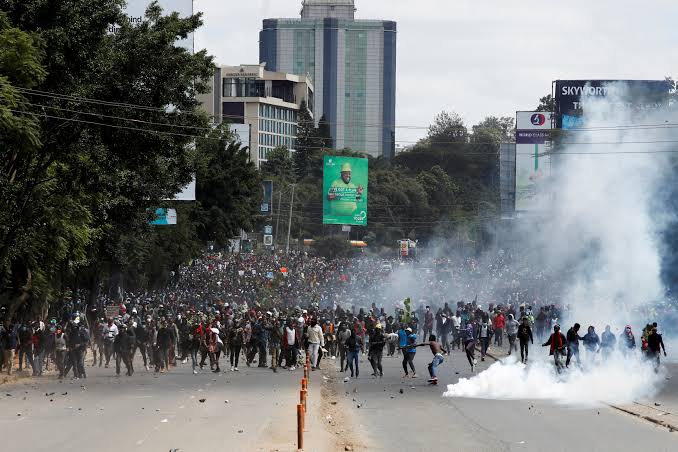
Lissu was arrested in April 2025 and remained in custody through the trial. Reuters reported a heavy police presence around Friday’s courtroom and a guarded convoy bringing him to the hearing. His detention and CHADEMA’s exclusion from the October 2025 vote helped fuel the protests surrounding the election, the news agency reported.
The government has denied accusations of suppressing dissent and said protesters initiated the violence. Human Rights Watch, in a statement on the verdict, described the prosecution as part of a broader pattern of using criminal proceedings against opponents. Its criticism is a rights organisation’s assessment, not a judicial finding.
The deaths remain an accountability question
A presidentially appointed commission reported in April 2026 that 518 people died during the post-election violence. The BBC’s account of the inquiry said chairman Mohamed Chande Othman did not identify responsibility for the deaths and warned that the total could be higher because some burials were unreported.
That number is the commission’s count, not an independently verified toll established by this article. CHADEMA rejected the inquiry as a cover-up, while President Samia Suluhu Hassan defended the security agencies and announced further criminal investigation. The sentence against Lissu does not settle responsibility for those deaths.
Washington’s review predates the verdict
The diplomatic context is documented but should not be overstated. On 4 December 2025, the US State Department announced a comprehensive review of relations with Tanzania, citing restrictions on religious freedom and speech, investment obstacles and violence against civilians around the election. Reuters’ verdict report also noted that the US ambassador was following the trial’s rule-of-law implications.
There was no verified announcement in the sources examined of new US sanctions, an aid decision or a completed bilateral review resulting from Friday’s judgment. The verdict supplies another event against which Washington may assess its stated concerns; it does not establish a specific diplomatic penalty.
The immediate tests are whether Lissu obtains bail, what grounds his lawyers place before the appellate court and whether that court upholds the conviction and sentence. The broader question is whether demands for political reform can be pursued without the prolonged detention of their principal advocates. Acquittal on one charge has narrowed the prosecution’s result, but has not answered that question.