Princes and Thieves: Jared Kushner and Mohamed bin Zayed’s Secret Plot to Remake the Middle East
Matthew Cole’s Princes and Thieves examines the extraordinary relationship between Jared Kushner, UAE President Mohamed bin Zayed and Saudi Crown Prince Mohammed bin Salman, tracing allegations of secret financial arrangements, intelligence operations and political influence that reached deep into the Trump White House.
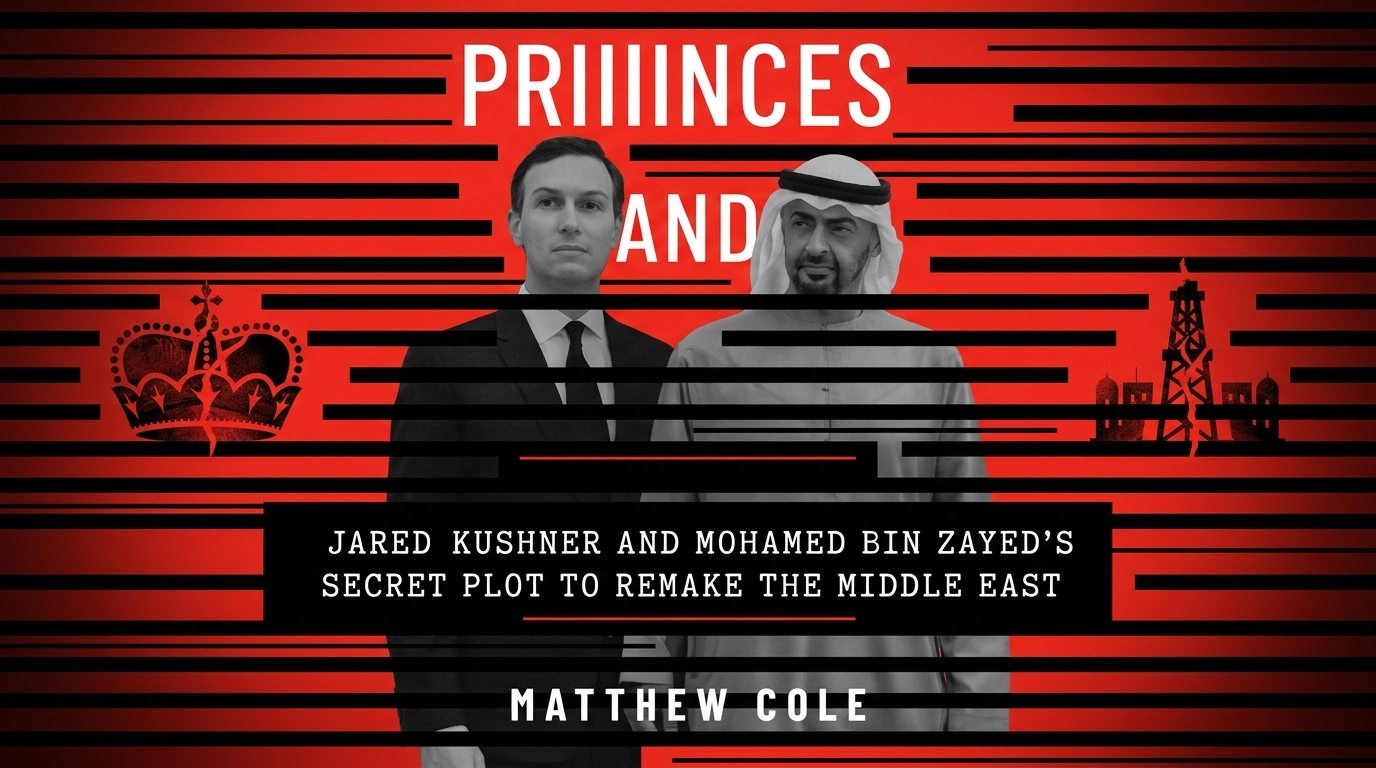
Matthew Cole's forthcoming book follows an extraordinary trail of intelligence operations, Gulf money, secret bank accounts and White House influence—beginning with the alleged compromise of Jared Kushner's iPhone and ending with a much larger story about how Saudi Arabia, the UAE, Israel and Washington sought to reshape the Middle East.
Matthew Cole's Princes and Thieves begins with a proposition that sounds almost too strange to be true: while Jared Kushner was serving as Donald Trump's senior adviser, foreign intelligence services were allegedly watching his phone—and what they saw, according to Cole, opened a window into a hidden financial and diplomatic network involving some of the most powerful figures in the Middle East.
At the center of Cole's story are three men: Jared Kushner, the son-in-law of Donald Trump; Mohamed bin Zayed, the ruler of the United Arab Emirates; and Mohammed bin Salman, Saudi Arabia's crown prince.
Around them is a much larger cast that includes Erik Prince, Israeli Prime Minister Benjamin Netanyahu, intelligence officials, Gulf businessmen and intermediaries.
Cole's argument is not simply that these men knew one another.
It is that they developed relationships in which political access, money and foreign-policy objectives became deeply intertwined.
And according to the book, some of the most extraordinary evidence came from a place Kushner probably never expected: his iPhone.
The phone that allegedly opened the door
According to Cole, the story begins with Russian intelligence.
In 2017, Dutch intelligence reportedly obtained access to a Russian military intelligence operation after a Russian hacker working for the GRU was captured and became an informant.
The hacker had allegedly compromised Kushner's iPhone X.
What the Dutch reportedly discovered was remarkable.
The Russian operation had obtained screenshots from Kushner's phone, allowing Dutch intelligence to reconstruct the method used to penetrate the device. Cole says the Dutch eventually developed their own access and began monitoring the phone.
By early 2018, according to the book, Dutch intelligence could effectively observe Kushner's phone screen.
They could see what he was doing.
They could see applications being opened.
And, crucially, they allegedly watched him access a bank account.
That account became the beginning of Cole's financial investigation.
The $750 million account
Cole calls it Alpha.
According to the book, Alpha was held at First Abu Dhabi Bank, the UAE's largest bank.
The bank was chaired by Tahnoon bin Zayed, the brother of Mohamed bin Zayed.
The account allegedly received approximately $750 million beginning in 2017.
But the strangest part was not the amount of money.
It was who could access it.
According to Cole, Kushner was not the owner of Alpha.
The account allegedly belonged to the UAE-based Watani Al Emarat Foundation, a government-funded Emirati charity.
Yet Kushner was allegedly authorized to conduct transactions through the account.
That distinction is central to Cole's story.
The money, according to the book, was not simply sitting in a personal bank account bearing Kushner's name.
It was allegedly inside an account controlled through a UAE institution, while Kushner had transactional authority.
Cole says the arrangement was effectively a foreign-policy fund.
Why would Kushner have access to it?
This is where the story becomes much bigger than a mysterious bank account.
According to sources cited by Cole, MBZ and MBS had been discussing the creation of a huge pool of money that could be used to advance their shared political objectives.
The proposed fund was allegedly worth more than $10 billion.
The ambitions were enormous.
The money could potentially be used to support initiatives connected to Trump's political objectives, including efforts surrounding the Middle East peace process.
Cole reports that one idea involved helping Trump secure a second term, including a proposal that could have helped pay for Trump's proposed border wall.
That larger plan eventually fell apart.
But according to the book, the Gulf leaders did not abandon the underlying strategy.
Instead, smaller and more specialized arrangements allegedly followed.
Alpha was one of them.
MBZ, MBS and the Middle East they wanted
Cole portrays MBZ as the senior architect of a regional strategy and MBS as a younger Saudi partner whose enormous financial resources could help make that strategy possible.
Their objectives went beyond simply maintaining good relations with Washington.
The Gulf leaders wanted to reshape the regional balance of power.
Iran was the central enemy.
The Palestinian issue was increasingly seen as an obstacle to a broader strategic realignment.
And Israel could become a partner rather than an adversary.
Kushner, in Cole's telling, became an unusually useful intermediary because he had something most diplomats did not:
direct access to Donald Trump.
He was not merely another White House official.
He was the president's son-in-law.
That personal relationship gave him extraordinary value to foreign governments.
The Watani foundation
One of the more obscure pieces of Cole's story is the organization that allegedly sat behind Alpha.
The Watani Al Emarat Foundation presented itself as a charitable organization.
But Cole's sources describe a much more complicated role.
The book alleges that the foundation had connections to UAE covert activities, including secret weapons-purchasing programs.
One confidential source reportedly told Cole that the foundation's charitable status could make international transfers less conspicuous.
If that account is accurate, the organization would have provided something extremely valuable:
a respectable institutional cover for movements of money that might otherwise attract attention.
Cole alleges that MBZ and his brother Tahnoon designated Kushner as an authorized person on Alpha.
That meant Kushner could potentially conduct transactions even though the account was not officially his.
And that creates one of the book's central questions:
Why would a senior White House official have access to a foreign-government-linked account containing hundreds of millions of dollars?
Four senior officials allegedly knew nothing about it
Cole says he asked former senior Trump administration officials whether Kushner had presidential authorization to use a foreign government bank account.
According to the book, the answer was essentially no.
Two former national security advisers, a former White House chief of staff and a former CIA director reportedly told Cole they knew of no presidential authorization permitting Kushner to access or administer such an account.
That distinction is crucial.
If the account existed and Trump had explicitly authorized Kushner to use it as part of an official covert policy operation, the legal and institutional implications would be very different.
But if Kushner was independently accessing foreign government money while serving as a senior presidential adviser, the situation would raise much more serious questions.
Cole argues that Kushner's position required financial disclosure and that access to such accounts could also raise issues under U.S. ethics law.
A former Mueller prosecutor cited by Cole went further, saying that if Kushner promised to perform favors for Saudi or Emirati officials in exchange for their money, the arrangement could potentially implicate federal bribery law and the Foreign Agents Registration Act.
Those are allegations and legal assessments—not findings that Kushner committed a crime.
Then there was Beta
Alpha is only half of Cole's financial story.
The book describes a second arrangement called Beta.
This one is even stranger.
According to Cole, approximately $1 billion was moved through Azerbaijan into an account associated with Israel's central bank.
Unlike Alpha, which Cole describes as a foreign-policy fund, Beta was allegedly established for Kushner's personal benefit.
That distinction could be enormously important.
Cole says the money passed through Azerbaijani banks, which he describes as providing established but relatively obscure mechanisms for moving large amounts of money.
The alleged trail therefore became:
Gulf money → Azerbaijan → Israel → an account allegedly connected to Kushner's interests.
And then another extraordinary character enters the story.
Benjamin Netanyahu.
Netanyahu allegedly becomes part of the financial chain
According to Cole, Netanyahu recommended that Kushner use the Israeli banking system for the Beta arrangement.
The book alleges that Kushner was then required to notify Netanyahu before making withdrawals or transactions involving the account.
That would mean, if the allegation is accurate, that the prime minister of Israel had knowledge of and some form of oversight over a financial arrangement involving a senior adviser to the U.S. president.
Cole further alleges that Kushner communicated information about transactions to Netanyahu through the U.S. ambassador to Israel, David Friedman.
The implications are enormous.
But again, these are among the claims that Kushner and people associated with him categorically deny.
The third deal: Israeli protection for the UAE
Cole's story goes beyond bank accounts.
He describes another alleged financial arrangement involving the UAE and Israel.
According to the reporting, Kushner helped negotiate a deal in which the UAE effectively purchased a commitment of Israeli military support in the event of an Iranian attack.
That is significant because it reveals what Cole believes the financial network was ultimately designed to accomplish.
The money was not simply about enrichment.
It was allegedly being used to buy political and strategic outcomes.
Iran was the common threat binding the Gulf states and Israel together.
And Kushner was positioned in Washington as the person who could help turn those interests into American policy.
The $10 billion dream
The smaller accounts become more understandable when placed alongside the much larger proposal Cole describes.
MBZ and MBS allegedly discussed putting more than $10 billion into a broader fund.
The scale is extraordinary.
A billion dollars can influence a business.
Ten billion dollars can influence markets, governments and entire industries.
Cole's reporting suggests the proposed fund was conceived as a mechanism for pursuing major geopolitical objectives.
The idea eventually failed to materialize in its original form.
But the book argues that its failure did not end the underlying project.
Instead, the strategy fragmented into smaller arrangements.
Alpha.
Beta.
Other transactions.
Political relationships.
And deals involving Israel, Saudi Arabia and the UAE.
Where Erik Prince enters
Then comes another remarkable character: Erik Prince, the founder of Blackwater.
Prince had already established himself as one of the most controversial figures in the intersection between American national security, private military contracting and foreign governments.
Cole places him within the same broader network.
The publisher describes Prince as one of the allies surrounding MBZ and MBS, alongside Kushner and a former CIA assassin.
This is important because it expands Cole's story beyond conventional diplomacy.
He is describing a world where foreign policy is not conducted only through ambassadors and ministries.
It is conducted through businessmen, intelligence veterans, private contractors, political families and wealthy intermediaries.
The Abraham Accords become part of the story
Kushner's Middle East diplomacy eventually produced one of the most consequential foreign-policy achievements of Trump's first presidency: the Abraham Accords.
The UAE and Bahrain normalized relations with Israel in 2020.
That agreement is publicly documented.
But Cole's book asks readers to view the normalization process through a different lens.
What if the Abraham Accords were not simply the result of conventional diplomacy?
What if they were one piece of a much larger strategic project involving the UAE, Saudi Arabia, Israel and the Trump administration?
Cole's answer appears to be yes.
His argument is that the common strategic threat of Iran helped create a new regional coalition.
Palestine became less central to the Gulf states' calculations.
Israel became a strategic partner.
And Kushner became one of the principal American intermediaries connecting these interests.
The Palestinian question
This is one of the book's most politically consequential arguments.
For decades, Washington and Arab governments publicly treated Palestinian statehood as central to a comprehensive Middle East peace.
But the regional landscape was changing.
For MBZ and MBS, according to Cole's account, Iran represented a far more immediate strategic threat.
Israel possessed military and intelligence capabilities that could help counter Iran.
Washington possessed the diplomatic and military power necessary to maintain the regional order.
And the Gulf monarchies possessed money and strategic access.
The Palestinian issue could therefore become something to manage rather than something that had to be resolved first.
That shift helped make the Abraham Accords possible.
But Cole argues that it also contributed to a regional order in which Palestinian interests became increasingly secondary.
Did Trump know?
Eventually, the story returns to Donald Trump.
The question is unavoidable.
How much did the president know?
Cole says several senior Trump officials told him they were unaware of any authorization allowing Kushner to operate a foreign-government bank account.
Kushner's legal team, however, says that any agreements he entered into with foreign governments were approved by Trump and were undertaken in the interests of the United States.
That creates two fundamentally different interpretations.
One is that Kushner was an unusually aggressive diplomat operating with the president's knowledge.
The other is that foreign governments found a way to build extraordinary financial and political relationships around the president's son-in-law.
The evidence presented in the full book will ultimately determine how convincing either interpretation is.
The most explosive implication
The most serious implication of Cole's story is not actually that Kushner knew Gulf leaders.
Everyone already knows that.
It is not even that Saudi Arabia and the UAE wanted influence in Washington.
That is also hardly surprising.
The explosive claim is that money may have been placed under arrangements accessible to a sitting White House official while foreign-policy objectives were being negotiated at the same time.
If proven, that would represent a radically different kind of foreign influence.
It would mean that the boundary between diplomatic negotiation and private financial access had become dangerously blurred.
That is why the alleged bank accounts matter so much.
Kushner's response
Kushner rejects the entire story.
After the Vanity Fair excerpt appeared, he described the allegations as completely false and accused Cole of presenting fabrication as investigative journalism.
His lawyer told Vanity Fair that there were no such accounts and never had been.
The defense also challenged the lack of publicly presented bank statements, wire records, account numbers and transaction dates.
That criticism is important.
The allegations are extraordinary.
And the public evidence currently available is largely based on Cole's reporting, intelligence information described by his sources and the material contained in the book excerpt.
The existence of the allegations is established.
The truth of every allegation is not.
Why the story is still important
That distinction does not make Princes and Thieves unimportant.
Quite the opposite.
Even if some of the book's most sensational allegations ultimately prove incorrect, the underlying relationships are historically significant.
Kushner really did become one of Trump's principal Middle East advisers.
MBZ really did become one of Washington's most influential Arab partners.
MBS really did develop an unusually close relationship with the Trump family.
Saudi Arabia really did commit $2 billion to Kushner's private-equity firm after he left government.
The UAE really did normalize relations with Israel.
Iran really did become the central strategic concern linking Israel, Saudi Arabia and the UAE.
The interesting question is how all these pieces fit together.
Cole believes they form a much darker picture than the public record suggests.
The book's central story
Ultimately, Princes and Thieves is not simply a story about a hacked phone.
The phone is the doorway.
Behind it, Cole finds a world of Gulf money, Israeli strategy, American political access, intelligence operations and private relationships.
His central characters are not traditional diplomats.
They are political heirs, crown princes, billionaires, intelligence operatives and businessmen.
And their ambitions extend far beyond any single administration.
The story Cole tells is about the emergence of a new Middle Eastern power structure—one in which Saudi Arabia and the UAE increasingly operate as independent geopolitical actors, Israel becomes a strategic partner against Iran, and Washington becomes a battleground for influence.
At the center of that transformation stands Jared Kushner.
According to Cole, Kushner was not merely negotiating peace.
He was allegedly helping construct a new system of relationships between Washington, Riyadh, Abu Dhabi and Jerusalem.
The most explosive part of the story is the alleged money behind those relationships.
The most consequential part may be what happened to Middle Eastern policy as a result.
And the biggest unanswered question is whether Donald Trump understood the full extent of what was happening inside his White House.
That is the mystery Princes and Thieves sets out to solve.
Whether every allegation survives scrutiny is another question. But the story Cole has assembled is undoubtedly one of the most extraordinary accounts yet of the money, personal relationships and geopolitical ambitions that converged around the Trump White House.