Goodbye Bibi: Eisenkot gets first chance to form Israel’s government
Benjamin Netanyahu remains Israel’s caretaker prime minister after his bloc lost its majority in the October 27 election. President Isaac Herzog has given Gadi Eisenkot the first mandate to form a government, but 67 recommendations do not yet amount to a coalition.
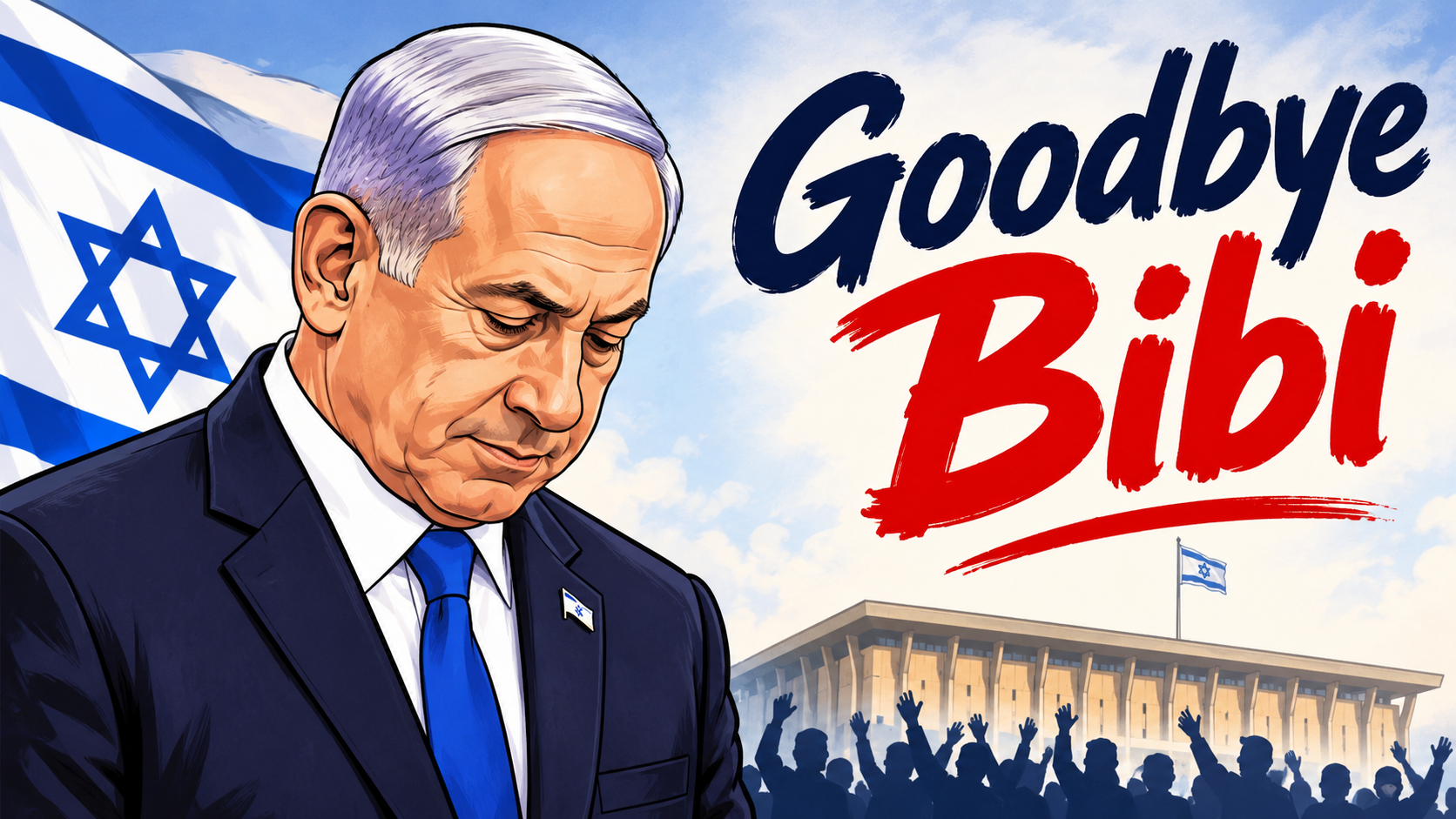
President Isaac Herzog formally gave Gadi Eisenkot the task of forming Israel’s next government on Sunday, 8 November, passing over Benjamin Netanyahu after an election that deprived the incumbent’s bloc of its majority. The ceremony at the President’s Residence in Jerusalem transferred the initiative, not the premiership.
That distinction makes “Goodbye Bibi” a politically charged description of the moment rather than an accomplished fact. Netanyahu remains caretaker prime minister. Eisenkot has 28 days, with a possible extension of up to 14 more, to turn the support that secured his mandate into a government capable of winning the Knesset’s confidence.
The central question is no longer simply whether enough lawmakers want Netanyahu replaced. Parties representing 67 of the incoming parliament’s 120 members recommended Eisenkot. The harder question is whether those parties can agree on an alternative—or whether their divisions will give Netanyahu another opportunity.
What did Israel’s October 27 election actually decide?
The Central Elections Committee’s official final results show Likud remained the largest party with 27 seats, followed by Eisenkot’s Yashar with 21 and Naftali Bennett’s B’Yachad, or Together, with 12. The Joint List won 11 seats and Ra’am eight, giving the two Arab-led lists a combined 19.
The remaining seats went to the Democrats, with eight; Yisrael Beytenu, Otzma Yehudit and United Torah Judaism, with seven each; and Shas and Religious Zionism, with six each. The committee’s final turnout figure is 77.98%, rather than the lower figures carried in some earlier accounts.
Those results produced three distinct political groupings: 53 seats for Netanyahu’s right-wing and religious bloc, 48 for Eisenkot’s four-party opposition bloc and 19 for the Arab-led parties. Neither of the first two groupings reached the 61 seats constituting an outright parliamentary majority.
The arithmetic explains why a Likud plurality did not settle who would govern. Israel’s election was not a direct presidential contest between Netanyahu and Eisenkot. It distributed parliamentary seats among parties that must now negotiate support. Netanyahu won the largest individual faction; he did not win an automatic entitlement to remain prime minister.
Why did Herzog give Eisenkot the mandate?
During presidential consultations, parties representing 67 lawmakers recommended Eisenkot, compared with 46 for Netanyahu. The seven-member United Torah Judaism faction endorsed neither candidate. Its abstention explains the gap between Netanyahu’s 53-seat electoral bloc and his smaller recommendation tally.
As reported by Ynet and The Jerusalem Post, Herzog acknowledged Likud’s position as the largest faction but said Eisenkot had the stronger support on the question of who could assemble a government commanding parliamentary confidence. The decision was announced on Saturday; Sunday’s ceremony formally conferred the task.
The governing principle is not new. The Israel Democracy Institute’s guide to government formation explains that the president is not obliged to choose the largest party’s leader. In 2009, Netanyahu himself received the mandate despite Likud finishing behind Tzipi Livni’s Kadima. The institutional logic that now disadvantages him once worked in his favour.
But a recommendation is not a coalition agreement. The Arab-led parties’ support brought Eisenkot’s total to 67 without resolving whether they would join a cabinet, support it from outside or accept its programme. The mandate establishes who tries first. It does not bind the recommending parties to approve every compromise that follows.
What happened to the “stolen election” claims?
After the vote, Likud alleged that Arab parties had stolen the election through bribery, intimidation, forgery and prohibited voter-mobilisation software. Ynet reported the party saying it was submitting hundreds of testimonies and items of evidence to police, the Shin Bet security service and the elections committee. These were party allegations, not established findings.
There were specific matters for investigators to examine. Ynet reported arrests in a suspected vote-buying case involving cash and Ra’am ballot slips. The suspects denied wrongdoing, and Ra’am rejected the accusations as politically motivated. An investigation into particular suspected offences is not proof of coordinated manipulation sufficient to change a national result.
The official review did not substantiate that wider claim. When the committee certified the results on 4 November, it said its examination had found no irregularities compromising election integrity or affecting the outcome, according to reports in The Guardian and The Jerusalem Post. Committee chair Justice Noam Sohlberg said outstanding suspicions did not cast doubt on the election as a whole or justify delaying its results.
Police separately said there was “no investigative or intelligence support” for the vote-theft claims, Ynet reported. Their statement described relatively few unusual election-integrity incidents, even compared with previous elections.
A separate Shin Bet inquiry into suspected foreign funding continued. The agency described potentially extensive activity but said further intelligence and investigation were necessary; Ynet reported that it presented no supporting evidence publicly with that assessment. Suspicion of foreign influence was not a finding that such influence changed the result.
Attorney General Gali Baharav-Miara also blocked a request to interrogate senior Arab-party politicians because the necessary evidentiary basis had not been presented, The Guardian and The Jerusalem Post reported. That dispute concerned lawful investigative thresholds, not a judicial ruling that every possible offence had been disproved.
The distinction is essential: certification does not prohibit investigating specific misconduct, but unresolved allegations do not erase certified votes. Treating the two as equivalent would let the existence of an inquiry become a veto on government formation. Herzog’s condemnation of racist expressions against Arab society when receiving the results underscored another stake: citizens’ participation cannot itself be treated as evidence of wrongdoing.
Who is Gadi Eisenkot, and what government does he want?
Eisenkot is a former Israeli military chief and the leader of Yashar, the largest party in the 48-seat opposition grouping. His military background gives his candidacy a different public identity from a conventional coalition broker. It does not remove the parliamentary constraints facing him.
At Sunday’s ceremony, he called for a national emergency government and said forming it would require creative and unconventional political steps. According to Associated Press reporting, he set four conditions for partners: support for Israel as a Jewish and democratic state, its Declaration of Independence, military or national service, and recognition of Hamas as a terrorist organisation.
These principles are simultaneously an offer and a filter. They seek to give a prospective coalition a common basis beyond opposition to Netanyahu. They also expose disagreements among the parties whose support Eisenkot needs.
The service requirement bears directly on ultra-Orthodox parties’ demands over exemptions. The conditions concerning the state’s identity and Hamas create difficulties with Arab-led parties. Accepting Eisenkot as the first candidate to attempt a government does not mean those parties have accepted his entire platform.
Eisenkot also explicitly invited Likud and Religious Zionism lawmakers to support a government under his leadership, The Jerusalem Post reported. His effort is therefore not confined to assembling the parties already counted in his bloc. It includes trying to loosen Netanyahu’s remaining alliances.
Can Eisenkot turn 67 recommendations into a coalition?
The clearest numerical route involving Netanyahu’s former allies would bring United Torah Judaism’s seven seats and Shas’s six together with Eisenkot’s 48, reaching exactly 61. Axios reported that United Torah Judaism had signalled openness to an Eisenkot-led government. Openness is not a signed agreement, and Shas’s participation cannot be assumed.
The policy contradiction is substantial. Eisenkot and his partners campaigned on a more equal service burden; ultra-Orthodox parties have defended military exemptions for their community. Any arrangement must address that conflict, not merely distribute ministries.
The Arab-party route presents a different obstacle. Yisrael Beytenu leader Avigdor Liberman said on Sunday that he would not support a minority government dependent on Ra’am and the Joint List, Ynet reported. A coalition strategy that gains external support while losing one of Eisenkot’s existing partners may fail to improve his position.
There is also an important legal qualification to the familiar 61-seat shorthand. The Israel Democracy Institute explains that an initial government can win confidence with more votes for than against; its coalition need not itself contain 61 lawmakers. Outside support or abstentions can therefore matter. That makes a minority arrangement legally conceivable, not politically agreed or necessarily durable.
For Arab citizens, the distinction affects whether increased representation produces influence over policy. For ultra-Orthodox communities and Israelis subject to service, coalition bargaining will test incompatible promises about obligations and exemptions. For the wider public, replacing a prime minister is only part of the challenge; a government must also sustain support after its first confidence vote.
Could Netanyahu still return to the centre?
Netanyahu has responded with a call for a national unity government. Axios reported that his Saturday proposal envisaged a government headed by him; Ynet described an appeal encompassing his national camp and other Zionist parties. Eisenkot’s party rejected that version, demanding a government under Eisenkot and acceptance of his principles.
Both sides are invoking unity, but disagreeing over who leads it and which alliances survive. Netanyahu’s proposal seeks a route around his lost majority. Eisenkot’s seeks to convert Netanyahu’s setback into a different governing arrangement. Neither appeal proves an agreement is close.
The legal process leaves further opportunities if Eisenkot fails. Under Basic Law: The Government, Herzog can assign the task to another lawmaker, who receives 28 days without the first candidate’s extension, or notify the Knesset speaker that he sees no possibility of forming a government. Netanyahu could receive another chance; it is not automatic.
If that stage produces no government, a 21-day parliamentary window allows at least 61 lawmakers to request a candidate, who would then have 14 days. Failure of the process leads to another election. Until a successor government wins confidence and takes office, Netanyahu’s outgoing administration remains in place in a caretaker capacity.
Sunday therefore marks a real reversal, but not a completed farewell. Netanyahu no longer controls the first attempt at forming the next government, and unsubstantiated claims of a stolen election have not displaced the certified result. Whether “Goodbye Bibi” becomes a description of an actual transfer of power now depends on Eisenkot’s ability to build something more coherent than a majority against the incumbent.