Egypt train collision in Giza kills seven and injures more than 100
A Giza–Fayoum service struck the rear of a Cairo–Aswan train near Al-Ayyat on Sunday, derailing carriages on one of Egypt’s busiest lines. The health ministry reported seven dead and 112 injured as President Sisi ordered an urgent investigation; the cause remains officially unestablished.
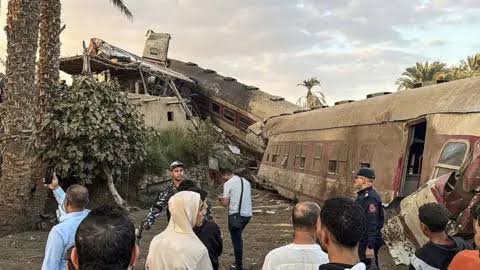
Two passenger trains collided on Sunday afternoon in Egypt’s Giza governorate, killing seven people and injuring 112 others, the Ministry of Health and Population said, after a Giza-to-Fayoum service struck the rear of a Cairo-to-Aswan train and overturned several carriages.
The Egyptian National Railways Authority said the crash occurred between Kafr Ammar and Al-Raqqa stations in the Al-Ayyat area, south of Cairo, when train No. 134 on the Giza–Fayoum route hit the rear of train No. 2010 travelling from Cairo toward Aswan. Local and international reporting, including accounts citing the public prosecution, said the Aswan-bound train had stopped on the tracks; both trains were heading in the same southerly direction.
President Abdel Fattah El-Sisi said he was following the accident closely, offered condolences to victims’ families and directed state agencies to provide medical care, investigate the circumstances urgently and hold accountable anyone found negligent. The cause of the collision has not been officially established.
Casualties and the rescue
Health ministry tallies rose through Sunday. Earlier statements cited fewer deaths and injuries before the ministry’s later figure of seven dead and 112 injured, reported by Xinhua, AFP and the BBC. The ministry said 72 ambulances took part in rescue and evacuation, with patients sent to hospitals in Giza and neighbouring Beni Suef. Health Minister Khaled Abdel Ghaffar ordered facilities in both governorates onto heightened readiness.
According to the ministry, 45 patients had been discharged after treatment and seven more were expected to leave soon, with the remainder under medical observation. Injuries ranged from bruises to fractures, head and facial wounds and chest trauma, AFP reported from the ministry. The driver of the Giza–Fayoum train was among the dead, according to ministry and prosecution accounts carried by the BBC and Egyptian media. Some Egyptian outlets and an early prosecution estimate put the injured at 114; this briefing uses the health ministry’s 112 unless a later official revision supersedes it.
Witnesses described chaotic scenes as villagers and responders tried to reach people trapped in overturned carriages. One nearby resident told AFP the crash happened around 1:30 p.m., with about six carriages overturning. The railways authority said emergency teams and cranes were sent to clear wreckage and restore traffic on the Cairo–High Dam corridor; The National reported services running normally again by Monday morning.
Investigation opened
Egypt’s public prosecution has opened a formal inquiry. BBC reporting from the office said investigators would examine damaged carriages, tracks and operational procedures and that the final casualty count was still being refined at the scene. State Information Service summarised Sisi’s Facebook statement ordering an urgent investigation and accountability for negligence. No official finding on signalling, speed or human error had been confirmed as the established cause in the principal wire accounts used for this report.
A familiar scar on a crowded network
Al-Ayyat is already etched into Egypt’s rail history. In 2002 a fire on a train in the same district killed more than 360 people in the country’s deadliest railway disaster, a benchmark repeatedly cited when crashes recur. Sunday’s rear-end collision was far smaller in scale but again put the safety of a heavily used passenger network under scrutiny.
Egyptian and international coverage has long linked repeated accidents to ageing rolling stock, management failures and the difficulty of modernising a system that moves millions of passengers. Calls for Transport Minister Kamel El-Wazir to resign surfaced in Egyptian political and media debate on Monday, according to The National; those demands are political reactions, not findings of the investigation.
For now the verifiable record is narrower: seven dead, 112 injured on the ministry’s count; a rear-end collision near Al-Ayyat on the Cairo–Aswan axis; a presidential order to investigate; and no settled official explanation of why one train struck another that had stopped. Families of the dead and the still-hospitalised injured are waiting on both medical outcomes and that inquiry.