The Dubai of 2006 Is Not the Dubai of Today: How the UAE Changed the Middle East
A passage in Robert Ludlum's 2006 novel The Bancroft Strategy captured Dubai as a glittering commercial oasis surrounded by ideological tensions. Two decades later, the UAE has become a global economic powerhouse and an assertive regional actor, actively opposing political Islam while reshaping its relationships with Washington and the wider world.
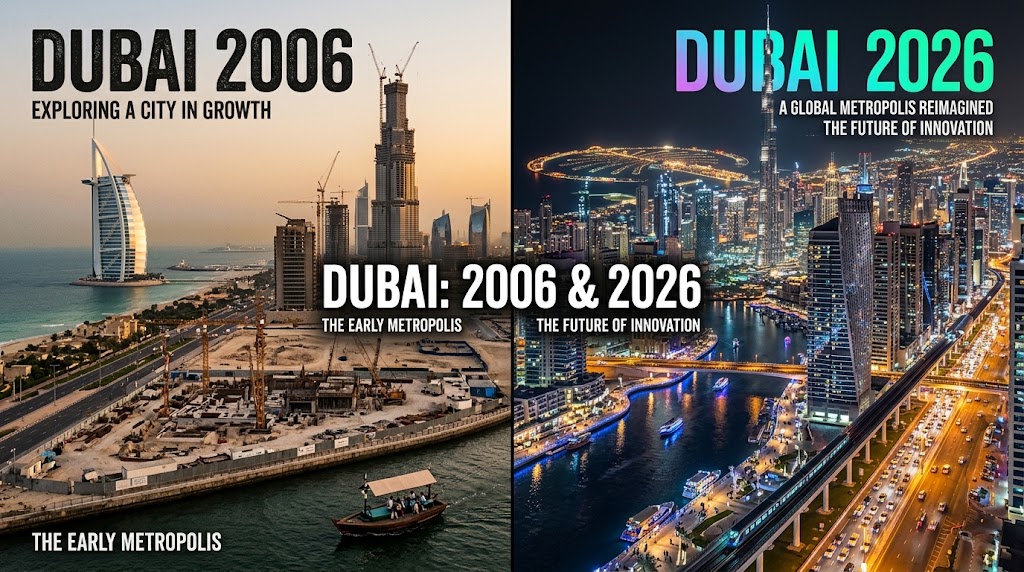
In 2006, Dubai was becoming one of the most recognisable symbols of the Middle East's economic transformation. Its skyline was rising, luxury hotels were multiplying and ambitious construction projects were turning a relatively small Gulf trading centre into an international destination for wealthy visitors, foreign investors and multinational businesses. It was a city that appeared to have chosen a future built around global commerce rather than the region's familiar political rivalries.
Robert Ludlum's The Bancroft Strategy, published that year, captured the contradiction through a striking description. Dubai was compared to Las Vegas, with its conspicuous display of wealth, extravagant architecture and seemingly limitless ambition. But the passage then introduced a darker contrast: beyond the hotels and artificial splendour, religious figures and ideological movements were pursuing a very different vision of the world, one that sought to challenge what they regarded as American imperial power.
If it weren't for the gentle azure of the Gulf, he could have been in Las Vegas in summer. The boundlessness of human greed emblemized in architecture. And yet in the real wadis and escarpments nearby were Koranic holy men who sought to establish a global ummah, and to unhorse what they regarded as the American imperium. Dubai existed for the delectation of foreigners in an arid country that dreamed fervently of their humiliation. The serenity that obtained was as perishable as a rainbow.”
— Robert Ludlum, The Bancroft Strategy (2006), page 135
The final observation was particularly revealing: the apparent serenity of Dubai was as temporary as a rainbow.
Twenty years later, that passage reads almost like a description of the strategic choices that would come to define the United Arab Emirates. Dubai did not abandon its ambition to attract the world. Instead, the UAE developed a political and security strategy increasingly hostile to Islamist movements that its leadership considers a threat to the state, while simultaneously becoming more integrated into international capitalism.
The transformation was not simply economic. It was ideological, diplomatic and military. And to understand it, one must distinguish between Dubai, the commercial face of the federation, and Abu Dhabi, whose leadership has increasingly shaped the UAE's political and security direction.
The Arab Spring changed Abu Dhabi's calculations
The most consequential change came in 2011, when uprisings across the Arab world challenged established governments and brought Islamist political movements into positions of influence.
For the UAE's leadership, the Arab Spring represented more than a wave of popular protests. It raised a fundamental question about the survival of the political system that had made the Emirates relatively stable and economically successful.
In Egypt, the Muslim Brotherhood won parliamentary and presidential elections, bringing Mohamed Morsi to power in 2012. In Tunisia, the Islamist Ennahda movement became an influential political force. Elsewhere, Islamist organisations sought to translate popular mobilisation into political authority.
The UAE leadership viewed these developments with considerable suspicion. Its political model depended on a powerful centralised state, hereditary leadership and limited space for organised political opposition. The prospect of transnational Islamist movements gaining influence through elections and popular mobilisation was therefore perceived as a threat.
The concern was not limited to violent extremism. It extended to political organisations that sought to challenge existing governments through religiously inspired political participation.
This was a defining moment in the evolution of the UAE. The country that had once been described as a glittering commercial oasis surrounded by competing ideological movements was increasingly positioning itself as an active force against the Islamist movements its leadership believed could destabilise the regional order.
From suspicion to confrontation: The Muslim Brotherhood becomes a central target
The UAE's opposition to political Islam became particularly visible through its treatment of the Muslim Brotherhood.
Founded in Egypt in 1928, the organisation developed into one of the most influential Islamist movements in the Arab world. Unlike jihadist organisations, the Brotherhood historically pursued political influence through social institutions, religious networks and, in several countries, electoral participation. Its branches and affiliates have differed significantly across national contexts.
For the UAE leadership, however, the organisation represented a challenge to the authority of existing governments.
In 2014, the UAE formally designated the Muslim Brotherhood a terrorist organisation, placing it among groups considered security threats by the government. The decision came amid a wider campaign against organisations and individuals accused of links to the Brotherhood, including the Emirati Islamist association al-Islah.
The UAE also supported the political transition in Egypt that followed the 2013 military overthrow of Mohamed Morsi.
This was not simply a disagreement over religious ideology. It was a contest over what political order should emerge in the Arab world after the uprisings.
The UAE favoured strong centralised governments that could preserve state authority and regional stability. Islamist political movements represented an alternative model of political organisation, one that could potentially challenge established ruling arrangements.
Abu Dhabi increasingly used its financial resources, diplomatic relationships and regional influence to support its preferred political outcomes.
This distinction matters because the UAE was not attempting to eliminate Islam from public life. Islam remains the country's official religion, and Islamic institutions continue to operate under state regulation. Its principal target was organised political Islam that could compete with or challenge the authority of the state.
The UAE's ambitions extended beyond its borders
The UAE's transformation also involved a growing willingness to exercise power outside its territory.
It developed military capabilities, strengthened security partnerships and became increasingly involved in regional conflicts. Its interventions in Yemen and Libya demonstrated that its foreign policy was no longer limited to protecting trade routes or attracting international investment.
In Libya, the UAE supported forces led by Khalifa Haftar against rival political and military groups, including Islamist factions. In Egypt, it became an important supporter of the post-Morsi political order. In Yemen, it participated in the Saudi-led military intervention while developing its own network of local partners.
These activities reflected a broader strategic ambition: to influence the political and security arrangements of neighbouring countries in ways that protected Emirati interests and limited the influence of movements it considered dangerous.
The UAE was becoming a significant regional military actor, with operations and partnerships extending beyond traditional diplomatic channels.
This was a remarkable departure from the image of Dubai presented in the 2006 passage.
The city remained a centre of commerce, tourism and international investment, but the wider federation was becoming a more assertive geopolitical actor.
The architecture of Dubai projected wealth. The expanding capabilities of the UAE projected power.
Dubai became more international, not less
While Abu Dhabi was increasingly shaping the UAE's security and political strategy, Dubai continued to pursue the economic ambition described in Ludlum's novel.
The emirate did not retreat from globalisation. It accelerated it.
Its financial districts, free zones, international airports, ports and property market became increasingly important to its economic model. Foreign businesses and wealthy individuals found an environment designed to attract capital, talent and international commerce.
The transformation is visible in the numbers. Dubai's population increased from approximately 1.3 million in 2005 to around 4.6 million in 2025. Its real GDP reached approximately $255.3 billion in 2025, with more than 95% of economic activity coming from non-oil sectors.
Tourism also expanded dramatically. Dubai welcomed 19.59 million international overnight visitors in 2025, according to its Department of Economy and Tourism.
These figures demonstrate how far the city has moved beyond the construction boom described in the book.
But there is a deeper political implication.
Dubai's prosperity depends on its ability to attract people and capital from societies with very different political, cultural and religious backgrounds. It needs international businesses, Western financial institutions, Asian trading partners, wealthy investors and millions of expatriate workers.
That requires a carefully managed environment in which economic openness coexists with political restrictions.
Dubai has become one of the world's most international cities without developing a Western-style democratic political system. Its commercial environment is open to foreign capital and talent, but political opposition remains tightly restricted.
In other words, Dubai's international character does not mean the UAE has embraced political pluralism. It has embraced global commerce while maintaining strict control over political organisation.
The Abraham Accords: A new expression of the UAE's political direction
Another major development came in September 2020, when the UAE normalised diplomatic relations with Israel through the Abraham Accords, brokered by the United States.
The agreement represented a significant change in regional diplomacy.
For decades, relations between Arab governments and Israel had been constrained by the Palestinian question and the broader Arab-Israeli conflict. The UAE's decision to establish formal relations demonstrated that its leadership was willing to pursue strategic and economic partnerships even when they departed from longstanding regional diplomatic conventions.
The agreement opened opportunities for cooperation in technology, investment, tourism, security and trade.
It also illustrated how the UAE's foreign policy priorities had evolved. The leadership was increasingly interested in building partnerships based on economic and strategic interests rather than allowing traditional ideological divisions to determine every diplomatic relationship.
However, normalisation did not mean the disappearance of the Palestinian question. The UAE has continued to state that a just resolution of the conflict is necessary. Its decision to maintain relations with Israel following the October 7, 2023 attacks and the subsequent war in Gaza further demonstrated its preference for maintaining strategic relationships despite regional political pressure.
The agreement reinforced a central feature of the UAE's modern identity: it wanted to become a country whose international relationships were determined primarily by state interests, commercial opportunities and strategic calculations.
What happened to the American imperium?
One of the most interesting elements of the 2006 passage is its reference to religious activists seeking to overthrow what they regarded as the American imperium.
At the time, the United States was deeply involved in Afghanistan and Iraq. Its military presence across the Middle East, combined with the aftermath of the September 11 attacks, had made American power a central target of transnational jihadist propaganda.
Twenty years later, the relationship between the UAE and the American-led international order is considerably more complicated.
The UAE remains an important American security partner, hosting US military facilities and maintaining extensive defence relationships with Washington. The United States designated it a major defence partner in 2024, reflecting the depth of their security cooperation.
But Abu Dhabi has also developed closer economic and strategic relationships with China, Russia, India and other powers.
This is not necessarily an attempt to overthrow American influence. It is an effort to reduce dependence on a single international partner and increase the UAE's freedom to pursue its own interests.
The UAE has therefore moved from being a country benefiting from American-led globalisation to one seeking a more influential role within an increasingly multipolar international system.
The question is no longer simply whether the United States can maintain its dominance. It is whether smaller but wealthy states such as the UAE can use economic resources, technology, military capabilities and diplomatic relationships to exercise influence far beyond their geographical size.
What remains true about the 2006 observation?
The most remarkable thing about the passage is that several of its central observations remain relevant, even though the political actors and circumstances have changed.
Wealth still serves as a statement of political power. Dubai's extravagant architecture continues to communicate more than prosperity. It represents the ambition of a state determined to establish itself as indispensable to international commerce. Its buildings, airports, financial districts and luxury developments are part of a larger national strategy to attract the world.
Economic openness does not necessarily produce political openness. This may be the most important lesson of Dubai's transformation. The emirate has become one of the world's most international cities without developing a Western-style democratic political system. Its commercial environment is open to foreign capital and talent, but political opposition remains tightly restricted.
Ideological competition has not disappeared. Political Islam remains relevant, although its organisations, influence and strategies have changed. The UAE's opposition to the Muslim Brotherhood and its regional affiliates has become a defining element of its foreign and domestic security policies.
Foreigners remain central to the economic model. Dubai's success depends heavily on expatriates, foreign investment and international visitors. Its population growth illustrates the extraordinary scale of that dependence.
The serenity remains conditional. Dubai's economic model depends on perceptions of security, stability and predictability. The city can build world-class infrastructure and attract extraordinary wealth, but it cannot completely separate itself from the geopolitical environment of the Gulf and the wider Middle East.
The paradox of modern Dubai
The transformation of Dubai and the UAE since 2006 is not a story of a religious society abandoning its traditions and becoming Western. It is a story of a state developing a particular political and economic model.
It welcomes global capitalism but rejects political movements that could challenge its ruling structure. It maintains close relationships with Western governments while pursuing independent partnerships with their strategic competitors. It promotes religious tolerance and international coexistence while restricting organised political opposition.
There is an irony in this transformation.
In the passage from The Bancroft Strategy, the author describes religious figures seeking to challenge American imperial power in the landscape surrounding Dubai's luxury hotels. Two decades later, the UAE has become a close security partner of Washington and one of the strongest regional opponents of the political movements that its leadership associates with challenges to established state authority.
Yet the underlying tension has not vanished. It has been reorganised.
Dubai still exists for the pleasure, business and investment of foreigners. Its wealth still depends on an international system that its leaders neither fully control nor unquestioningly accept. And the apparent serenity of its skyline still depends on political stability beyond the boundaries of its hotels and financial districts.
The most significant change since 2006 is that the UAE is no longer merely trying to protect its economic oasis from the ideological conflicts around it. It has become an active participant in shaping the political order beyond its borders.
That is perhaps the biggest difference between the Dubai described by Ludlum and the UAE that exists today.
Editorial note: The passage comes from a work of fiction. This article uses it as a historical and literary starting point, not as evidence that the specific religious figures described by Ludlum belonged to any particular real-world organisation.