The Horse That Helped Change Manchester United Forever
A champion racehorse, a bitter dispute involving Sir Alex Ferguson, and a £790 million takeover. The unlikely story of how Rock of Gibraltar became tangled in the chain of events that changed Manchester United forever.
There are plenty of explanations for how Manchester United ended up where they are today.
People blame bad transfers. Bad managers. The departure of Sir Alex Ferguson. Poor recruitment. The Glazer family. Years of questionable decisions behind the scenes.
But if you follow the story far enough back, you eventually arrive somewhere completely unexpected.
A horse.
Not metaphorically. An actual racehorse.
His name was Rock of Gibraltar, and he became one of the finest racehorses of his generation. Somehow, a disagreement over who owned the rights to this horse would grow into a bitter feud involving Sir Alex Ferguson, Manchester United's biggest shareholders and, eventually, the family that would take control of the club.
It's one of those football stories that sounds made up.
It isn't.
It started as a friendship
In the early 2000s, Sir Alex Ferguson was already a Manchester United legend.
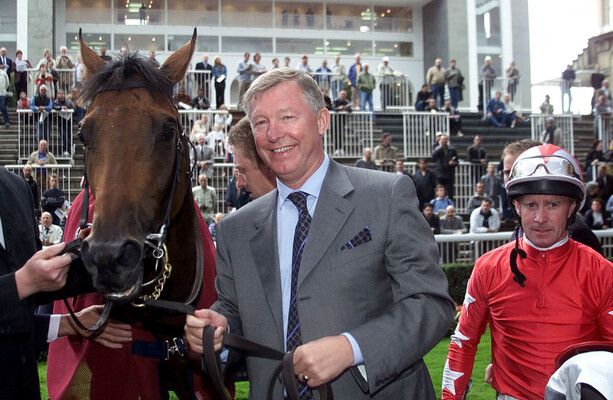
By then he'd won practically everything there was to win with the club. But away from football, Ferguson had another great passion: horse racing.
That brought him into the world of John Magnier, one of the most powerful figures in international horse breeding.
Magnier wasn't just someone Ferguson knew from the races.
He was also becoming extremely important at Manchester United.
Together with fellow Irish businessman JP McManus, Magnier would eventually control roughly 29 percent of United through their investment vehicle, Cubic Expression.
For a publicly traded football club, that was an enormous stake.
But at first, Ferguson and Magnier were friends.
And somewhere inside that friendship came Rock of Gibraltar.
Ferguson was associated with the horse as a co-owner while it raced.
At the time, perhaps nobody involved imagined how important that arrangement would become.
Because Rock of Gibraltar turned out to be very, very good.
Then the horse started winning
Rock of Gibraltar didn't merely become successful.
He became a superstar.
In 2002, the horse went on an extraordinary run, eventually winning a record seven consecutive Group One races.
Suddenly this wasn't simply a fun racehorse connected to Manchester United's famous manager.
This was an incredibly valuable animal.
And in horse racing, winning races is only part of the money.
A champion stallion can continue making enormous sums after retirement through breeding.
That is when things became complicated.
Ferguson believed his interest in Rock of Gibraltar entitled him to a share of the horse's lucrative breeding rights.
Magnier disagreed.
What had apparently begun as an arrangement between friends became a dispute potentially worth a fortune.
And Sir Alex Ferguson was not exactly famous for walking away from fights.
So he fought.
Ferguson takes on one of United's biggest shareholders
Eventually, Ferguson launched legal action over the breeding rights.
Normally, two wealthy men fighting over a racehorse wouldn't have much to do with Manchester United.
There was one rather large problem.
The man Ferguson was fighting was also one of the people who effectively held Manchester United's future in his hands.
Magnier and McManus controlled 28.89 percent of the club at the height of the dispute. Contemporary reports described the situation at Old Trafford as a genuine crisis.
And the fight didn't stay at the racecourse.
Magnier and McManus began asking questions about United's business, including transfer dealings and payments involving agents.
Now Ferguson wasn't simply arguing about a horse.
His position at Manchester United was becoming tangled up in the dispute.
Imagine the situation.
The most powerful manager in English football was effectively at war with the biggest shareholders of the football club he managed.
And standing quietly on the outside, watching all of this unfold, was an American businessman named Malcolm Glazer.
Enter the Glazers
Malcolm Glazer had already started buying Manchester United shares.
By February 2004, while Ferguson and Magnier were still fighting over Rock of Gibraltar, Glazer's stake had risen above 16 percent. Contemporary reports were already discussing the possibility of him attempting a takeover.
Ferguson and Magnier eventually settled their dispute out of court in 2004.
But the old friendship was effectively finished.
And Magnier and McManus still possessed something incredibly valuable:
almost 29 percent of Manchester United.
For Glazer, those shares were the key.
He kept increasing his own stake in the club. At one point in October 2004, negotiations to buy the Irish investors' shares actually collapsed. Without their block, Glazer's route to full control was considerably more difficult.
Then came May 2005.
This time, the deal happened.
Magnier and McManus sold their stake to Glazer.
In one transaction, Glazer's ownership jumped to approximately 57 percent of Manchester United.
He had control.
The Glazer era had begun.
And this is where the horse becomes part of United history
It would be too simple to say:
Rock of Gibraltar caused the Glazer takeover.
Business history rarely works that neatly.
Magnier and McManus were investors. Glazer was already buying United shares independently. There were negotiations, share prices and financial calculations that had nothing to do with horse racing.
And importantly, the Irish investors did not immediately sell after falling out with Ferguson. In October 2004 they actually rejected Glazer's attempt to acquire their stake.
So the horse wasn't some magical domino that automatically handed Manchester United to the Glazers.
But it's difficult to remove Rock of Gibraltar from the story entirely.
The dispute destroyed the relationship between Ferguson and men who controlled nearly a third of Manchester United.
Years later, those same men sold the block of shares that gave Malcolm Glazer majority control.
Even today, the horse dispute is remembered as one of the events that helped create the circumstances for the takeover.
And what happened afterward is much more familiar to football fans.
The Glazer takeover was heavily leveraged.
United supporters fiercely opposed it from the beginning. The anger didn't suddenly appear when the trophies disappeared after Ferguson retired.
Fans were protesting the ownership in 2005.
Yet for several years, something remarkable happened.
Manchester United kept winning.
Ferguson hid a lot of problems
This may be the strangest part of the entire story.
The man whose dispute helped destabilize United's relationship with its major shareholders stayed at the club under its new owners—and built another great team.
Cristiano Ronaldo developed into a superstar.
Wayne Rooney became one of United's greatest players.
United won Premier League titles.
They won the Champions League in Moscow in 2008.
They reached another Champions League final in 2009.
And another in 2011.
Ferguson somehow kept the machine running.
Then, in 2013, he retired.
And suddenly Manchester United discovered how difficult life was without him.
Managers came and went.
David Moyes.
Louis van Gaal.
José Mourinho.
Ole Gunnar Solskjær.
Erik ten Hag.
Huge amounts were spent on players, but United repeatedly struggled to recreate the stability and dominance of the Ferguson years.
The problems were obviously much bigger than one horse.
But that's what makes the Rock of Gibraltar story so fascinating.
Football history can turn on ridiculous things
Imagine going back to the beginning.
Sir Alex Ferguson loves horse racing.
He becomes friendly with one of the world's most powerful horse breeders.
He becomes associated with one of Magnier's horses.
The horse unexpectedly becomes one of the best in the world.
Its breeding rights become enormously valuable.
The two men disagree over who is entitled to that money.
The friendship collapses.
The dispute spills into Manchester United.
A major shareholder and the club's legendary manager become enemies.
The shareholder eventually sells his enormous stake.
Malcolm Glazer buys it.
And Manchester United enters an ownership era that supporters would spend the next two decades arguing about.
All because somewhere along the way, a horse started winning races.
There is an alternative universe where Rock of Gibraltar is an ordinary racehorse.
Maybe he wins a couple of races and disappears into racing history.
Maybe there is never enough money involved for Ferguson and Magnier to fall out.
Maybe their relationship remains intact.
Maybe Magnier and McManus hold their Manchester United shares longer.
Maybe somebody other than Malcolm Glazer eventually buys them.
Or perhaps everything happens exactly the same way anyway.
We'll never know.
That's the beauty—and cruelty—of football history.
We normally remember the goals, trophies and famous transfers.
But sometimes the decisions that change a football club forever happen nowhere near a football pitch.
In Manchester United's case, one of the most consequential stories in the club's modern history began at a racetrack.
With a horse called Rock of Gibraltar.