France's Protests Draw 410,000 as Mass Marches Give Way to Clashes and 1,400 Arrests
Hundreds of thousands marched across France on Saturday in a second weekend of nationwide protests over education, living costs and public services. Most demonstrations remained peaceful, but clashes erupted as crowds dispersed, while authorities deployed 70,000 police and ultimately reported more than 1,400 arrests.
France entered the weekend bracing for another explosion of violence.
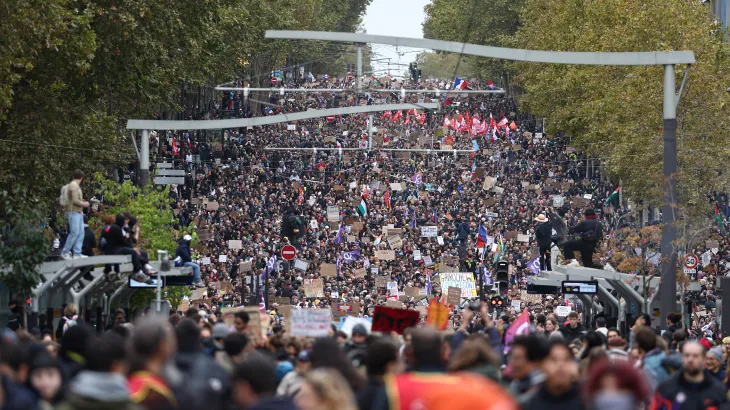
Instead, hundreds of thousands of protesters filled streets across the country in demonstrations that remained largely peaceful for much of Saturday before clashes erupted in several cities as darkness approached.
The scale was still enormous.
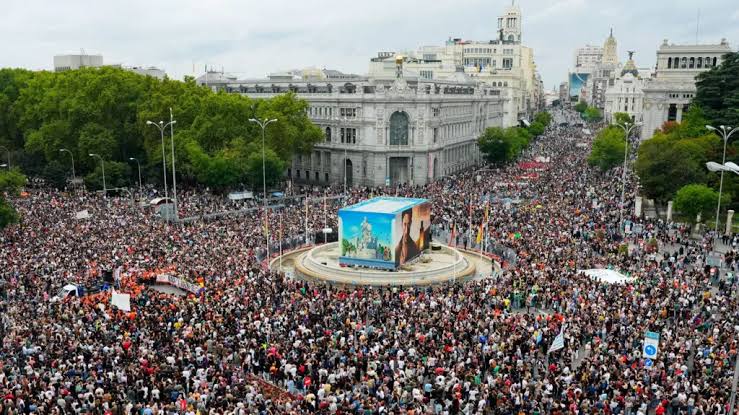
France's Interior Ministry estimated that approximately 410,000 people participated nationwide on Saturday, while the CGT trade union put the figure at roughly 800,000.
In Paris alone, authorities estimated around 110,000 demonstrators, while the CGT claimed approximately 250,000.
The demonstrations represented the second consecutive weekend of mass mobilization and came after the October 17 protests descended into widespread violence, looting and vandalism.
This time, the government was determined to prevent a repeat.
Authorities deployed approximately 70,000 police officers across France in a massive security operation.
For most of the day, that strategy appeared to work.
But as the demonstrations ended, confrontations began.
What Started the Protests?
The movement began with anger among high school students over conditions in France's education system.
Students have protested overcrowded classrooms, deteriorating school infrastructure, university access and what they regard as insufficient government investment in education.
But the movement quickly grew beyond schools.
Trade unions, university students, workers and Yellow Vest activists joined demonstrations, broadening the demands to include the cost of living, purchasing power, public services and social inequality.
By this weekend, what began as a student protest had become a much wider expression of dissatisfaction.
That transformation was visible in the streets on Saturday.
Union flags mixed with groups of students and other demonstrators, while slogans increasingly targeted President Emmanuel Macron and his government's broader record.
Paris: Huge Crowds, Then Tear Gas and Water Cannons
Paris was one of the main focuses of the government's security operation.
The authorities had been particularly concerned about a repeat of the previous weekend, when violence and looting accompanied demonstrations.
The route of Saturday's demonstration became controversial even before protesters began marching.
Police authorities changed the planned route at the last minute, directing demonstrators away from parts of central Paris.
That caused confusion and anger among unions.
Despite the tensions, the main demonstration proceeded without the kind of widespread destruction feared by authorities.
The situation changed as the march came to an end.
As the crowd dispersed around Cours de Vincennes, confrontations developed between riot police and smaller groups of protesters.
Police charged groups of demonstrators and used tear gas and water cannon.
By then, however, most participants had already left peacefully.
The clashes therefore did not develop into the widespread urban disorder witnessed during the previous weekend.
Marseille: Peaceful March Gives Way to Nighttime Clashes
A similar pattern unfolded in Marseille.
Thousands marched through France's second-largest city during the afternoon.
The prefecture estimated approximately 17,000 participants, while the CGT claimed the turnout was closer to 100,000.
The enormous difference between official and union estimates illustrated the difficulty of determining the precise scale of France's protests.
For more than three hours, however, the Marseille march passed without serious incident.
Authorities had negotiated a route designed to keep demonstrators away from commercial areas damaged during the previous weekend.
Trouble began after the organized demonstration ended.
Police moved to prevent groups from entering parts of the city center and used tear gas to disperse crowds around Porte d'Aix.
Small groups then confronted security forces into the evening.
Rubbish bins were set on fire to create roadblocks, while rocks and bottles were thrown at police.
Some looting was reported, but the destruction was significantly less extensive than on October 17.
Lyon, Nantes and Rennes Also See Confrontations
Paris and Marseille were not the only flashpoints.
In Lyon, authorities had prohibited the demonstration.
Nevertheless, large numbers of people gathered.
Police moved to disperse them around midday, leading to chases, arrests and extensive use of tear gas.
Confrontations were also reported in Nantes and Rennes, where groups of protesters entered areas authorities had attempted to restrict.
The pattern across France was therefore broadly similar.
Large daytime demonstrations were generally peaceful.
The most serious confrontations developed around the edges of marches or after organized demonstrations had officially finished.
That distinction is important.
Despite dramatic images of tear gas, riot police and burning barricades, the violence did not represent the behavior of the hundreds of thousands who marched during the day.
More Than 1,400 Arrested
The arrest figures nevertheless show the extraordinary scale of the security response.
Interior Minister Laurent Nuñez said on Monday that 1,435 people had been arrested nationwide during Saturday's demonstrations.
Police also seized weapons and gas masks during security operations.
There were injuries as well.
Among the incidents reported over the weekend, a 20-year-old man suffered a serious hand injury in Toulouse, while a police officer there required medical treatment.
The government also said it had detected another worrying development: organized far-right groups appearing in some cities and confronting far-left activists.
Nuñez said nationalist groups had mobilized in places including Nice and Montpellier, in some cases claiming they intended to defend businesses before confronting members of the radical left.
That added another layer of concern for authorities already attempting to control a protest movement involving students, unions and Yellow Vest activists.
Why This Weekend Was Different
Despite more than 1,400 arrests, Saturday did not become the repeat of October 17 that authorities had feared.
The biggest reason was the enormous police presence.
Approximately 70,000 officers were deployed nationwide.
Shops in vulnerable areas were protected or closed. Protest routes were heavily controlled. Police intervened quickly when groups attempted to move into restricted areas.
Trade unions also played a larger role in organizing and policing their own demonstrations.
The result was an unusual combination: very large protests and an extremely high number of arrests, but significantly less widespread destruction.
For the government, that provided some evidence that its security strategy worked.
Politically, however, the demonstrations revealed a different problem.
The movement has not disappeared.
Macron Offers Concessions, but Protesters Say They Will Continue
The government has begun offering measures aimed at addressing some of the students' grievances.
The package includes plans to cap the size of some high-school classes, €4 billion in loans for school renovations, €1 billion for university campuses, additional higher-education places and inflation-linked student grants.
The government has also promised to replace by 2028 a university admissions system that protesters argue disadvantages some students.
Student representatives say that is not enough.
After meeting government officials in Paris, student leaders said their demands had not been fully met and promised to continue demonstrating.
Trade unions are also pushing ahead.
Further protests are being discussed for the coming weekend, while unions have called for a larger nationwide mobilization on November 5.
Macron has acknowledged that more unrest is likely.
France's Protest Crisis Is Not Over
Saturday ultimately produced two very different images of France.
One was of hundreds of thousands of people marching through cities, overwhelmingly without violence, demanding better education, stronger public services and relief from rising living costs.
The other was of riot police, tear gas, burning rubbish bins and more than a thousand arrests.
The government's unprecedented security deployment prevented those two realities from merging into the widespread disorder France witnessed the previous weekend.
But it did not resolve the political problem underneath them.
What began with high school students has attracted unions, workers, Yellow Vest activists and other groups carrying much broader grievances.
The government has now offered concessions.
The protesters are promising to return.
France may have avoided another night of widespread destruction this weekend.
It has not yet found a way to end the movement that produced it.