France's Forgotten Empire: The Overseas Territories That Keep It a Global Power
France is often described as a European power whose influence stretches across the world through diplomacy, military alliances, trade and its position in the European Union. But there is another, less familiar reason the country retains a global presence: it still governs territories thousands of kilometres from Paris.
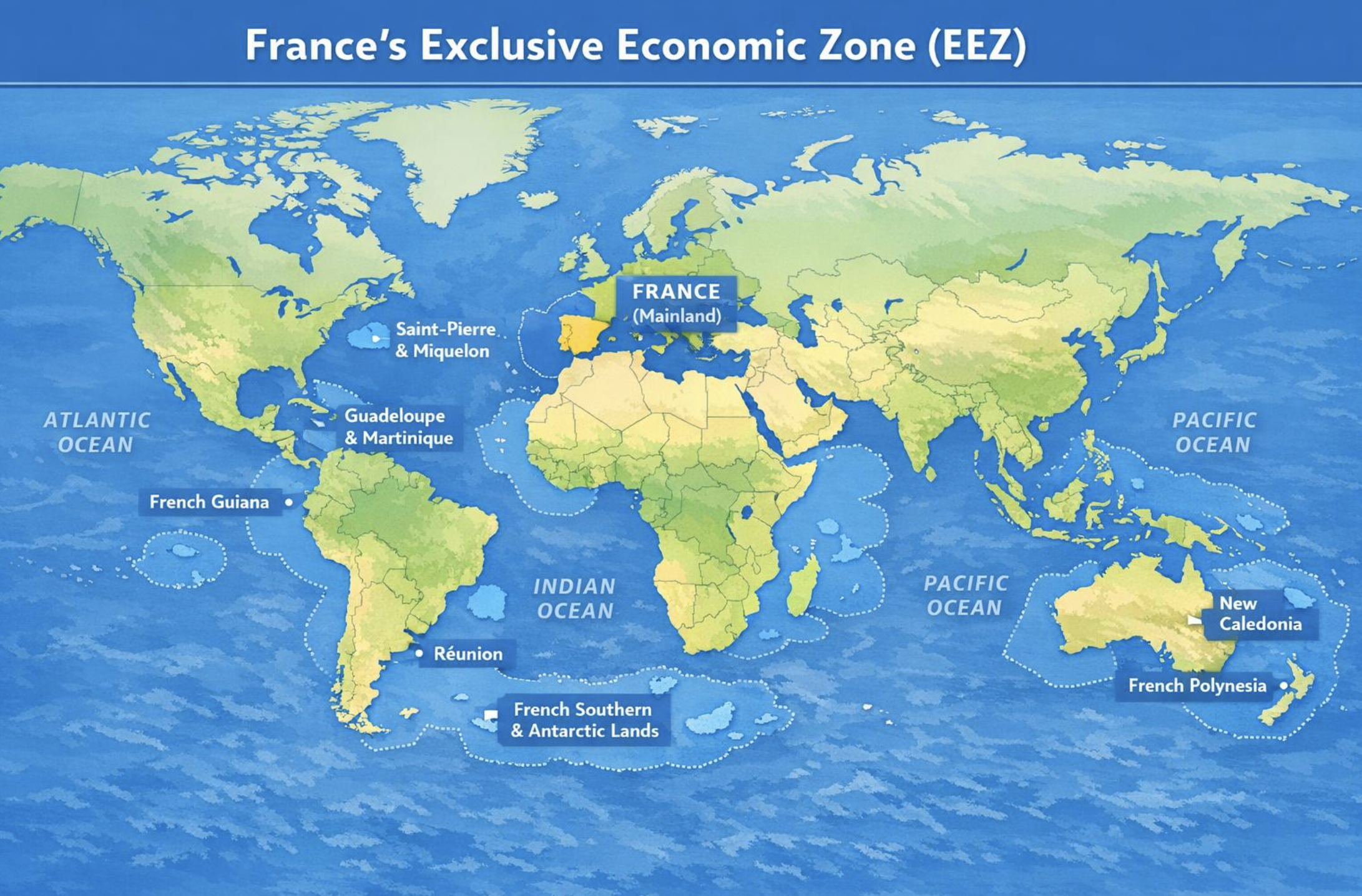
From the rainforests of South America to islands in the Caribbean, the Indian Ocean and the Pacific, France maintains a network of overseas territories that gives it a geographical reach few European countries can match. These territories provide access to strategic maritime zones, military positions, natural resources and important scientific and space infrastructure.
French Guiana, for example, places France on the South American continent and hosts Europe's principal spaceport. French Polynesia extends French influence deep into the Pacific, while Réunion and Mayotte provide a permanent French presence in the Indian Ocean.
Together, these territories help explain why France remains a global power even though its formal colonial empire largely disappeared during the twentieth century.
The French government officially recognises 12 overseas territories with different constitutional arrangements. There is also Clipperton Island, an uninhabited Pacific atoll administered separately under French law.
They are not all colonies in the legal sense. Some are fully integrated into the French Republic, others have substantial autonomy, and several have experienced strong movements demanding independence. Yet their continued connection to Paris raises an important question: how did France preserve such an extensive overseas presence after the end of its colonial empire?
France's Overseas Territories: A Global Network Beyond Europe
The scale of France's overseas presence is considerable.
According to France's overseas development agency, these territories account for approximately 97 per cent of the country's exclusive economic zone, giving France a maritime area of around 11 million square kilometres. They extend across the Atlantic, Indian and Pacific Oceans.
An exclusive economic zone, or EEZ, is an area in which a coastal state has specific rights to explore, exploit and manage marine resources. It does not mean the country owns the entire ocean or has unlimited sovereignty over it. Nevertheless, access to such an extensive maritime zone creates significant economic, environmental and strategic opportunities.
The territories also give France a presence near major international shipping routes, regional security challenges and strategically important parts of the world's oceans.
To understand how this works, it is useful to examine the territories individually.
1. French Guiana: France's Presence in South America
French Guiana is perhaps the most striking example of France's unusual global geography.
Located on the northeastern coast of South America, it shares borders with Brazil and Suriname. Its territory includes extensive Amazonian rainforest, rivers and Atlantic coastline. Its capital is Cayenne.
Unlike neighbouring countries, French Guiana is not an independent state. It is an integral part of the French Republic, with its own territorial government and representation in French national institutions.
Its importance goes beyond geography.
French Guiana hosts the Guiana Space Centre in Kourou, one of Europe's most important space-launch facilities. France selected the location in 1964 because its position close to the equator offers advantages for launching satellites into certain orbits.
The European Space Agency subsequently became a major partner in developing and operating the facility. Today, Kourou supports European launch programmes, including the Ariane and Vega rocket families.
This means that France's South American territory is not merely a distant administrative possession. It is also an important part of Europe's independent access to space.
French Guiana has another historical dimension. France used the territory as a penal colony, most famously through the infamous Devil's Island penal complex. The colonial period also involved Indigenous displacement, slavery and plantation economies.
Today, questions about development, inequality, Indigenous rights and local autonomy remain important. French Guiana demonstrates how an overseas territory can be strategically valuable while its population continues to face significant social and economic challenges.
2. Guadeloupe: The Caribbean's French Connection
Guadeloupe is an archipelago in the eastern Caribbean, southeast of Puerto Rico and north of Dominica.
Its history is closely connected to French colonial expansion, plantation agriculture and the transatlantic slave trade.
France established control over the islands in the seventeenth century. Sugar production became a central part of the colonial economy, relying heavily on enslaved Africans.
Slavery was abolished in the French colonies in 1848, following the French Revolution's earlier and reversed abolition of 1794. The legacy of plantation society continues to shape discussions about economic inequality, identity and relations with mainland France.
Today, Guadeloupe is an overseas department and region of France. Its residents are French citizens, and French national institutions and laws generally apply, subject to local adaptations.
Its position in the Caribbean gives France a continuing presence in a region historically shaped by European colonial competition, American influence and Caribbean regional politics.
Guadeloupe also provides France with a platform for regional cooperation, maritime monitoring and disaster response.
3. Martinique: A Caribbean Territory With a Colonial Legacy
Martinique lies south of Dominica and north of Saint Lucia in the Lesser Antilles.
Like Guadeloupe, it was colonised by France in the seventeenth century and developed around plantation agriculture, particularly sugar and coffee. Enslaved Africans were central to the colonial economy.
The abolition of slavery in 1848 marked a major turning point, but the island's political and economic relationship with France continued to evolve.
Martinique is now a French territorial collectivity. It has its own elected institutions and a degree of local decision-making, while remaining part of the French Republic.
Its relationship with France has not been free of tension. Economic inequality, the cost of living, dependence on imports and the legacy of colonial economic structures have periodically generated protests and political debate.
Martinique's importance to France is also geographical. Alongside Guadeloupe, it gives Paris a permanent presence in the Caribbean, where the United States, regional governments and other international actors have significant strategic interests.
4. Saint Martin: An Island Divided Between France and the Netherlands
Saint Martin is one of the most unusual examples of European territorial history in the Caribbean.
The island is divided between two European countries. France administers the northern part, known as Saint-Martin, while the southern part, Sint Maarten, is a constituent country within the Kingdom of the Netherlands.
The division has existed since the Treaty of Concordia in 1648, although the island has a much longer history of European competition and colonial settlement.
The French side became a separate overseas collectivity in 2007, gaining greater institutional autonomy from Guadeloupe.
Despite the political division, the two sides share an island economy based heavily on tourism, aviation and services. Movement across the border is generally open, making the island an example of how two European political systems can coexist within a single Caribbean territory.
For France, Saint-Martin maintains a small but important territorial presence in the northeastern Caribbean.
5. Saint Barthélemy: A Small Island With International Visibility
Saint Barthélemy, often called St Barts, is a small Caribbean island known for luxury tourism, international visitors and high-end hospitality.
France acquired the island in the eighteenth century, later transferring it to Sweden in 1784 before it returned to French control in 1878.
Today, it is an overseas collectivity with its own local institutions and considerable autonomy in certain areas.
Unlike larger French overseas territories, Saint Barthélemy does not have a substantial population or major military infrastructure. Its significance is more closely connected to tourism, international visibility and France's continuing presence in the Caribbean.
Its economy also illustrates how some overseas territories have developed very different relationships with France, depending on their size, geography and economic structure.
6. Réunion: France in the Indian Ocean
Réunion is an island east of Madagascar and southwest of Mauritius.
It became a French possession in the seventeenth century and developed around plantation agriculture, especially sugar. Enslaved Africans and later indentured labourers from India and other parts of Asia contributed to the island's economy and society.
Slavery was abolished in 1848, but plantation agriculture and the colonial labour system left a lasting social and economic legacy.
Réunion became a French overseas department in 1946. It is now an integral part of the French Republic and the European Union.
Its location is strategically important. Positioned in the southwestern Indian Ocean, it allows France to maintain a permanent presence in a region that connects Africa, the Middle East and Asia.
Réunion also provides a base for French military and maritime operations. France's armed forces in the southern Indian Ocean help monitor shipping routes, conduct regional security activities and support disaster response.
The island is therefore more than a distant French administrative region. It is one of the country's principal strategic footholds in the Indian Ocean.
7. Mayotte: France's Contested Position Near the Comoros
Mayotte is located in the Mozambique Channel, between Madagascar and the African mainland. It forms part of the Comoros archipelago.
Its political history is particularly sensitive.
When the Comoros moved towards independence from France in the 1970s, Mayotte's population voted differently from the other islands. Mayotte remained under French administration while the other islands became the independent Union of the Comoros.
The Comorian government has continued to dispute France's control of Mayotte, arguing that the archipelago should remain united.
France, meanwhile, maintains that Mayotte's population expressed its preference to remain French.
In 2011, Mayotte became a French department. In 2014, it became an outermost region of the European Union.
Its location gives France a strategic position near one of the world's important maritime corridors. The Mozambique Channel connects the Indian Ocean with shipping routes around southern Africa and provides access to major regional ports.
Mayotte is also a reminder that the end of European colonialism did not resolve every territorial dispute. Its status remains a source of diplomatic disagreement between France and the Comoros.
8. French Polynesia: France's Vast Pacific Presence
French Polynesia is a collection of islands and archipelagos in the South Pacific. It includes Tahiti, Bora Bora and the Marquesas Islands.
Although many people associate the territory with tourism and tropical landscapes, its political and military history is much more complicated.
France established control over parts of the region during the nineteenth century. French Polynesia became particularly important during the Cold War because of its role in France's nuclear weapons programme.
From 1966 until 1996, France conducted nuclear tests at Moruroa and Fangataufa atolls. The tests generated lasting controversy, particularly over environmental damage, health consequences and the rights of local populations.
The programme was a central element of France's effort to maintain an independent nuclear deterrent.
French Polynesia now has a substantial degree of autonomy. It has its own president, government and assembly, although France retains responsibility for key sovereign functions, including defence and foreign affairs.
Its geographic scale is remarkable. Its islands are spread across an enormous area of the Pacific, providing France with an extensive maritime presence.
This is one of the clearest examples of how an overseas territory can contribute to a country's strategic position far beyond its own borders.
9. New Caledonia: Nickel, Indigenous Rights and the Question of Independence
New Caledonia is located in the southwest Pacific, east of Australia.
France annexed the territory in 1853, and it developed as a colonial possession with a history of land dispossession, settlement and political inequality.
Its Indigenous Kanak population has long sought greater political recognition and, among many groups, independence from France.
The territory also possesses significant nickel resources. Nickel is important for stainless steel production and is used in some battery technologies. The mining industry has become a major part of New Caledonia's economy and its relationship with international markets.
The independence question has been especially contentious.
Three referendums were held between 2018 and 2021 under the Nouméa Accord. The first two rejected independence. The third, held in December 2021, also produced a majority against independence, but the main pro-independence movement boycotted the vote, arguing that the circumstances surrounding the COVID-19 pandemic made participation inappropriate.
The result therefore did not end the political dispute.
In May 2024, violent unrest erupted after France proposed changes to the electoral rules governing provincial elections. Many Kanak independence supporters feared the proposed changes would weaken their political influence.
France subsequently pursued a new political settlement.
The Bougival agreement was signed in July 2025, followed by the Élysée-Oudinot agreement in January 2026. These agreements proposed a new institutional framework, including the possibility of a distinct New Caledonian state within the French Republic.
However, the constitutional process has remained contested. In April 2026, France's National Assembly rejected the proposed constitutional bill, after the Senate had adopted a modified version. The territory's future therefore remains politically unsettled.
New Caledonia is arguably the clearest example of the tension between France's desire to maintain its overseas presence and the demands of a population seeking a different political future.
10. Wallis and Futuna: A Small Pacific Territory With Traditional Institutions
Wallis and Futuna consists of three main islands in the South Pacific, located between Fiji and Samoa.
France established a protectorate over Wallis in 1887 and over Futuna in 1888. The islands later became a French overseas territory in 1961.
Unlike many other French territories, Wallis and Futuna retains a distinctive system of traditional authority. Three customary kings continue to exercise important roles alongside French state institutions.
The territory has a small population and limited economic activity. Public services and financial support from France remain important to its economy.
Its strategic significance is primarily geographical. It contributes to France's territorial presence in the Pacific and reinforces its connections across an ocean increasingly important to international security and competition.
11. Saint-Pierre and Miquelon: France Just Off Canada's Coast
Saint-Pierre and Miquelon is a small archipelago in the North Atlantic, close to the Canadian island of Newfoundland.
It is one of the last remaining pieces of France's former territorial presence in North America.
The islands changed hands between France and Britain several times during the colonial wars of the seventeenth and eighteenth centuries. France retained them after the Treaty of Paris in 1814.
Today, Saint-Pierre and Miquelon is an overseas collectivity of France.
Its economy has historically depended on fishing, particularly the cod industry. However, disputes over fishing rights and maritime boundaries with Canada have shaped its modern economic history.
The territory gives France a continuing presence in the North Atlantic, close to Canada's coastline and the wider North American region.
Its importance is less about military power or population and more about maritime rights, fisheries and the historical continuity of France's North American presence.
12. The French Southern and Antarctic Lands: France's Remote Territories
The French Southern and Antarctic Lands are among the most remote territories governed by any country.
They include the Kerguelen Islands, Crozet Islands, Saint-Paul and Amsterdam islands, the Scattered Islands in the Indian Ocean and Adélie Land, France's claimed sector of Antarctica.
Most of these islands have no permanent civilian population. They are used mainly for scientific research, environmental monitoring and logistical operations.
Their strategic importance comes largely from their location and surrounding maritime zones.
The islands allow France to maintain a presence in the southern Indian Ocean, an area important for fisheries, marine ecosystems and international shipping.
However, the Antarctic component requires an important qualification. France's claim to Adélie Land is subject to the Antarctic Treaty System, which sets aside territorial disputes and prohibits new claims or enlargements while the treaty remains in force.
The territory is therefore not comparable to a normal populated French department. It is a remote administrative and scientific possession with a distinctive international legal context.
Clipperton Island: The Thirteenth Overseas Possession
There is one additional territory worth mentioning, although it is not included in France's official list of 12 overseas territories.
Clipperton Island is an uninhabited coral atoll in the eastern Pacific, approximately 1,000 kilometres off the coast of Mexico.
France maintains sovereignty over the island and administers it directly through the French state.
It has no permanent population, conventional local government or major economic activity. Its importance is mainly geographical and maritime, particularly because of the surrounding ocean area.
Clipperton demonstrates how even a tiny, uninhabited island can matter to a country's maritime presence.
Why France Still Maintains These Territories
The overseas territories are not simply historical curiosities. They contribute to several important elements of French national power.
1. They give France a global maritime presence
France's overseas territories account for approximately 97 per cent of its exclusive economic zone, estimated at around 11 million square kilometres.
This gives France rights over marine resources, fisheries, seabed exploration and certain economic activities across a vast area of the world's oceans.
It also makes France an important maritime actor in the Atlantic, Indian and Pacific Oceans.
2. They extend French military reach
France maintains military forces and facilities in several overseas territories, including French Guiana, Réunion, Mayotte, New Caledonia and French Polynesia.
These positions allow the country to conduct maritime surveillance, protect its territories, participate in regional security operations and respond to natural disasters.
They also give France the ability to maintain a military presence in regions far from mainland Europe without depending entirely on foreign bases.
3. They support Europe's independent space ambitions
French Guiana is particularly important because of the Guiana Space Centre.
The location near the equator makes it attractive for launching satellites into certain orbits. Its infrastructure supports European space programmes and gives France and its partners an important launch capability.
Without French Guiana, Europe's space-launch geography would look very different.
4. They provide access to natural resources
The territories contain important natural resources, including nickel in New Caledonia, fisheries across several maritime zones and significant marine ecosystems.
Their economic importance varies considerably, and many depend heavily on financial transfers from mainland France.
Nevertheless, their resource potential is part of the broader reason why their geographical position matters.
5. They give France influence in international affairs
France can participate in regional affairs across three oceans through its overseas territories.
It is not simply a European country with diplomatic relationships in the Caribbean, Pacific and Indian Ocean. It has territory, citizens, institutions and direct responsibilities in those regions.
That creates a different kind of international presence.
The Unfinished Debate: Are These Territories Remnants of Colonialism?
The term "French empire" can be useful when discussing the historical origins of these territories, but it can also hide important differences.
Guadeloupe, Martinique and Réunion have histories deeply connected to slavery and plantation economies. New Caledonia has a distinct history of settler colonialism and Indigenous Kanak dispossession. Mayotte's relationship with France is contested by the Comoros. French Polynesia has experienced the consequences of France's nuclear testing programme.
But their current political arrangements are not identical.
Some territories are constitutionally integrated into France. Others have their own governments and considerable autonomy. New Caledonia has a special constitutional status and is still negotiating its future relationship with Paris.
The debate is also about economic conditions. Many overseas territories face higher living costs, unemployment, limited economic opportunities and dependence on imports from mainland France.
Being legally part of the French Republic does not mean that every territory enjoys the same economic conditions or level of development as mainland France.
Supporters of continued French sovereignty often point to public investment, social protections, citizenship, infrastructure and access to French institutions. Independence and autonomy movements, meanwhile, argue that local populations should have greater control over their political and economic futures.
Both perspectives form part of the political reality of Overseas France.
France's Global Power Has a Geography Most People Overlook
France's overseas territories help explain why the country continues to have a global strategic presence long after the dissolution of most of its formal colonial empire.
They place France in South America, the Caribbean, the North Atlantic, the Indian Ocean and the Pacific. They provide access to enormous maritime zones, important military positions, natural resources and strategic infrastructure.
Yet this geographical reach also carries a complicated history. Some territories have embraced integration with France, others have demanded independence, and several continue to debate the balance between local autonomy and central authority.
The result is a distinctive feature of modern France: a European republic whose political and strategic geography extends across the world.
France's overseas territories are therefore more than distant islands and administrative regions. They are part of the foundation of its international position—and a reminder that the end of formal colonial empires did not necessarily end the territorial relationships they created.